
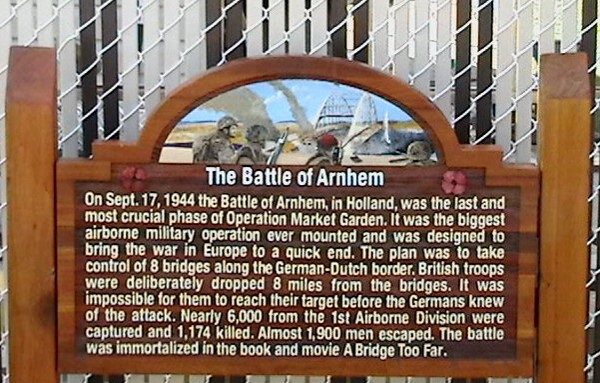
Arnhem Street is named in honour of the Canadian and Allied troops who fought in the Battle of Arnhem. It is located in Montgomery Place, an area developed in 1946 to house returning Second World War Veterans and their families. Most streets and parks in the area are named for prominent military members, famous battles, and military units.
In 2004, the Montgomery Place Community Association embarked on a project to explain the choice of names for Montgomery Place streets. The research and writing were undertaken by Kevin Gooding who was the Finance Director at the time, with help from President Jim Earle.
The signs were produced at Abe’s Sign Design Group of Saskatoon, with owner Gerry Tunicliffe giving the Association his whole-hearted support. Gerry even offered the Cassino Avenue sign free-of-charge, since his father had fought at the Battle of Monte Cassino. With interest and dedication, Gerry was also a great help to Kevin tracking down photos for the signs.
On September 22, 2007, Kevin, Jim and Vice-President Dave Price, along with Secretary Larry Rempel, Communications Director Gary Berg and resident Don Janzen, rented an auger and then dug, filled, tamped and installed the first 16 signs. Three more signs were installed later.
The first Battle of Arnhem took place between September 17-25, 1944, when Allied Forces launched OPERATION MARKET GARDEN, the surprise attack that was to capture bridges at Eindhoven, Nijmegan and Arnhem in the Netherlands, to allow the Allied Forces to bypass the German defensive Siegfried Line before pursuing offensive operations into Germany. 437 Squadron Royal Canadian Air Force, was involved in towing gliders and logistic airdrops to support the British 1st Airborne Division at Arnhem but the Division encountered far stronger resistance than anticipated. In the ensuing battle, only a small force managed to hold one end of the Arnhem Road Bridge and after the ground forces failed to relieve them, they were overrun on September 21. The rest of the division, trapped in a small pocket west of the bridge, had to be evacuated on September 25. 20 Field Company and 23 Field Company, Royal Canadian Engineers, assisted in the withdrawal of these forces by establishing crossing sites at Heveadorp and Driel, just west of Arnhem, along the Nederrijn River.
The second Battle of Arnhem was part of an Allied offensive that began in the early months of 1945, to enter Germany and the Reichwald. 1st Canadian Army was given the mission to capture a number of towns and cities along the advance including Arnhem, which was capture by 1 Canadian Corps in mid-April 1945.