
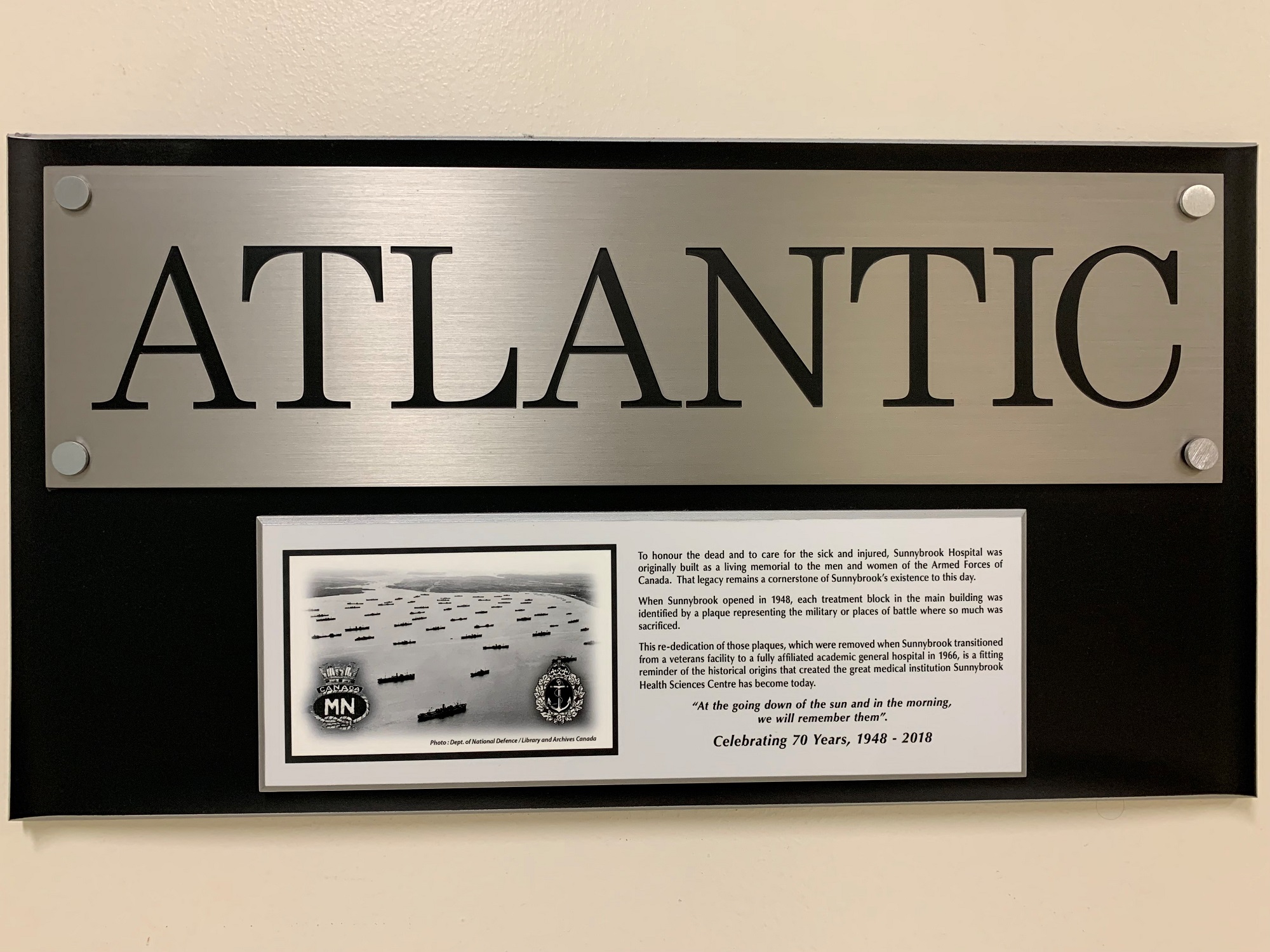
When Sunnybrook Military Hospital opened in 1948, each treatment block in the main building was identified by a plaque representing military or places of battle where so much was sacrificed. Although the plaques were removed when Sunnybrook transitioned from a Veterans facility to a fully affiliated academic general hospital in 1966, they were rededicated in 2018. Atlantic Wing is currently called B Wing.
From the very outset of hostilities in the Second World War in 1939, the Atlantic supply route from North America to the United Kingdom was threatened. For six long years the Royal Canadian Navy, the Canadian Merchant Navy and the RCAF were central participants in what was to be known as the Battle of the Atlantic.
The sea lanes of the North Atlantic formed a grim battleground. Navigation was hazardous, and sailors in the navy and merchant marine died not only from enemy attack, but from exposure and accidents in the fog and winter gales. Nor was protection sufficient to prevent heavy losses. There were too few naval vessels and maritime patrol aircraft available, as well as a severe lack of training and modern equipment and technology.
In 1939, Canada possessed only a few dozen Canadian-registered merchant ships, six destroyers, five small minesweepers, two training vessels, and a single squadron of modern military flying boats. No one would have predicted that, from this tiny beginning, Canada's forces would go on to play a large and significant part in the Atlantic war, and that the Canadian Merchant Navy would carry cargoes around the world.