
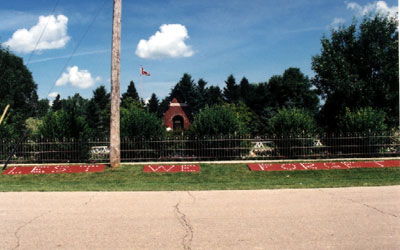
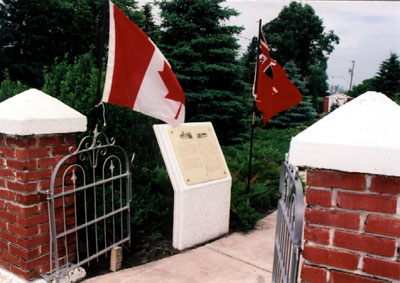
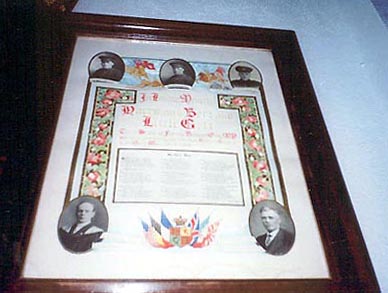
Darlingford Memorial Park includes a park and a brick building containing plaques and photographs. Ferris Bolton donated the land for a memorial park, which was dedicated on July 5, 1921. The site was deliberately located near the school (now a museum) so that the memorial would remain an ever-present reminder to generations of students. Bolton wanted children and adults to remember the sacrifices of those who had gone before. Three of his sons – Bert, 22 years old; Harry, 20; and Elmer, 18 enlisted in 1915 and went over to France and into the firing line the following year. They remain with those who sleep in Flanders’ Fields.
The red brick building with a sharp-gabled roof, the only free-standing war memorial of its type in Western Canada, was designed by Arthur A. Stoughton, the first Dean of Architecture at the University of Manitoba. Stone steps lead to a heavily studded door. Inside the brick building is a black granite honour roll of over 200 names in gold lettering of men and women from the area who served in the World Wars. Around the walls are relics of the war: German helmets, a gas mask, parts of trench mortars and machine guns, a trench periscope, photographs of local boys who served, and other objects of interest. The display of wartime artefacts and memorabilia was assembled by Bob Jordan, a Veteran of the Second World War.
The landscaping was designed and maintained by Dr. W.R. Leslie and staff at the Morden Experimental Farm. In white stones across the front of this small park that overlooks vast expanses of rolling farmland are the words of remembrance: Lest We Forget.
Surveyor Barry Veals was born here in 1937 and served as a youngster in the Salvage Corps during the war. He remembers decorating his bicycle to celebrate V-E Day and the safe return by train of his teacher’s husband from prison camp in Germany. His maternal grandfather was custodian of the nearby school plus the memorial grounds for nice years. During that time, he planted the original fir trees at the school, memorial park and the local cemetery, many of which stand today. The iron fence and brick posts across the entire front of the property have likely existed since 1921. The same goes for the cement tablets on the boulevard in which white raised stones spell out “Lest We Forget”.