
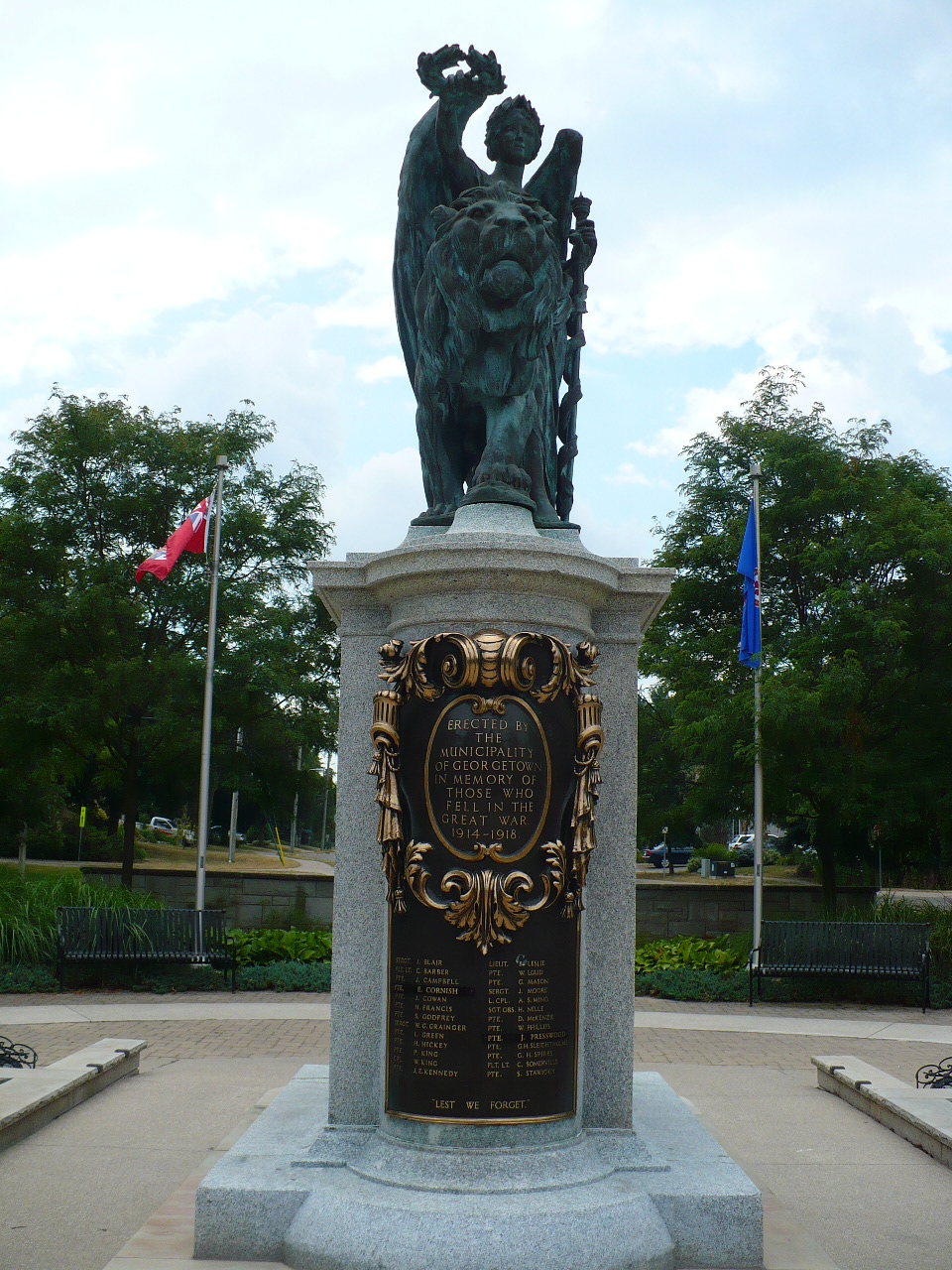
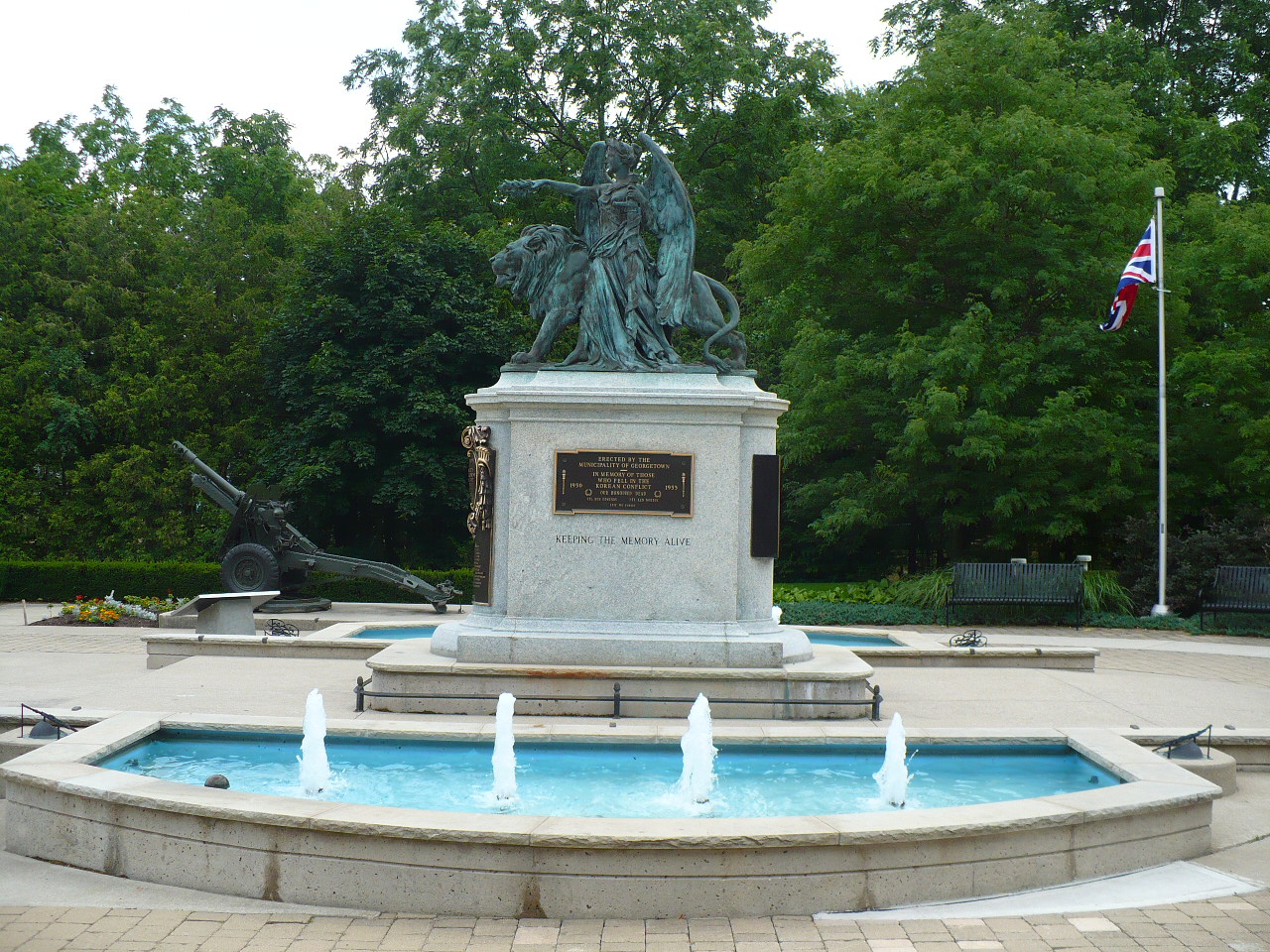

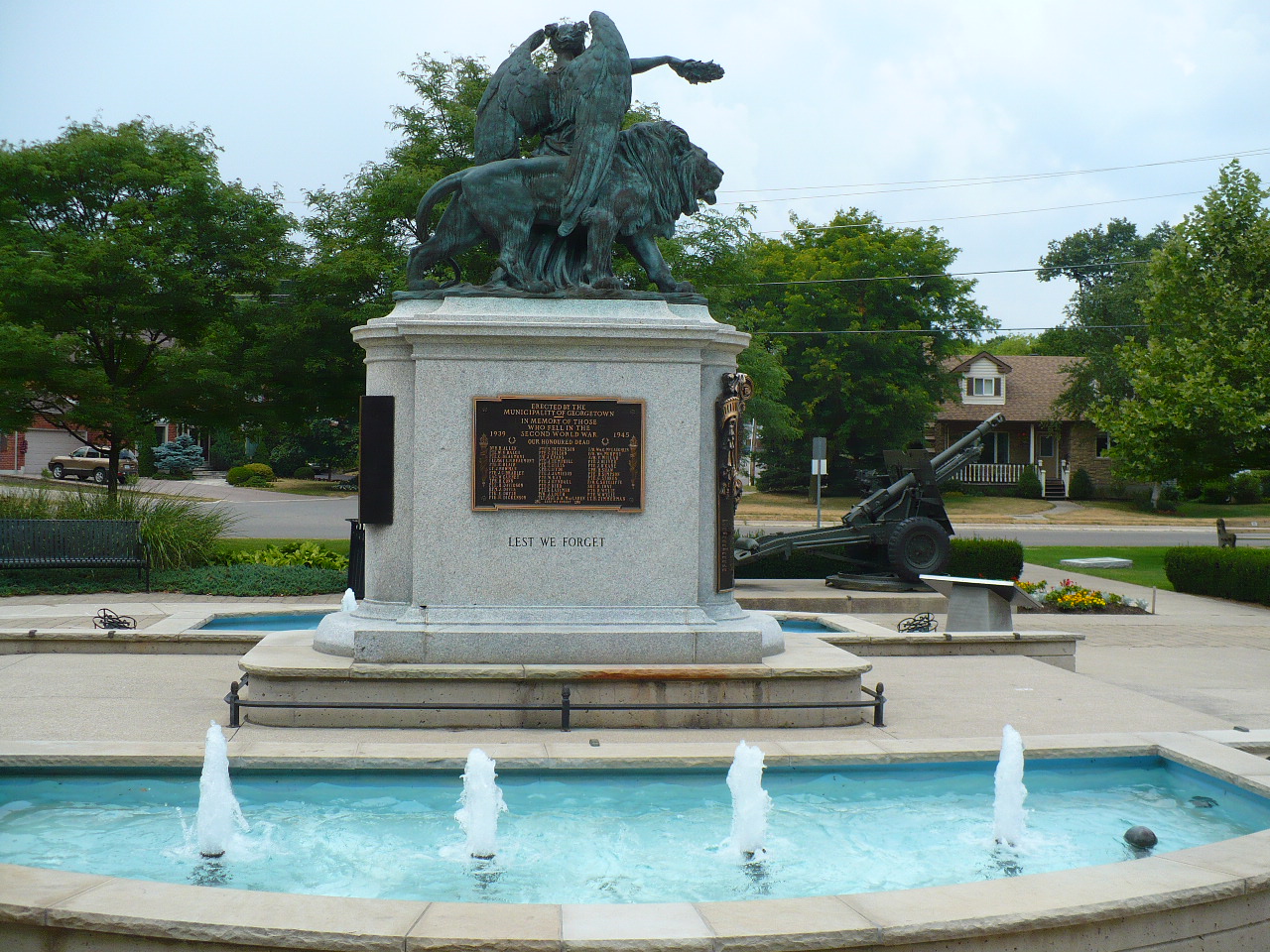
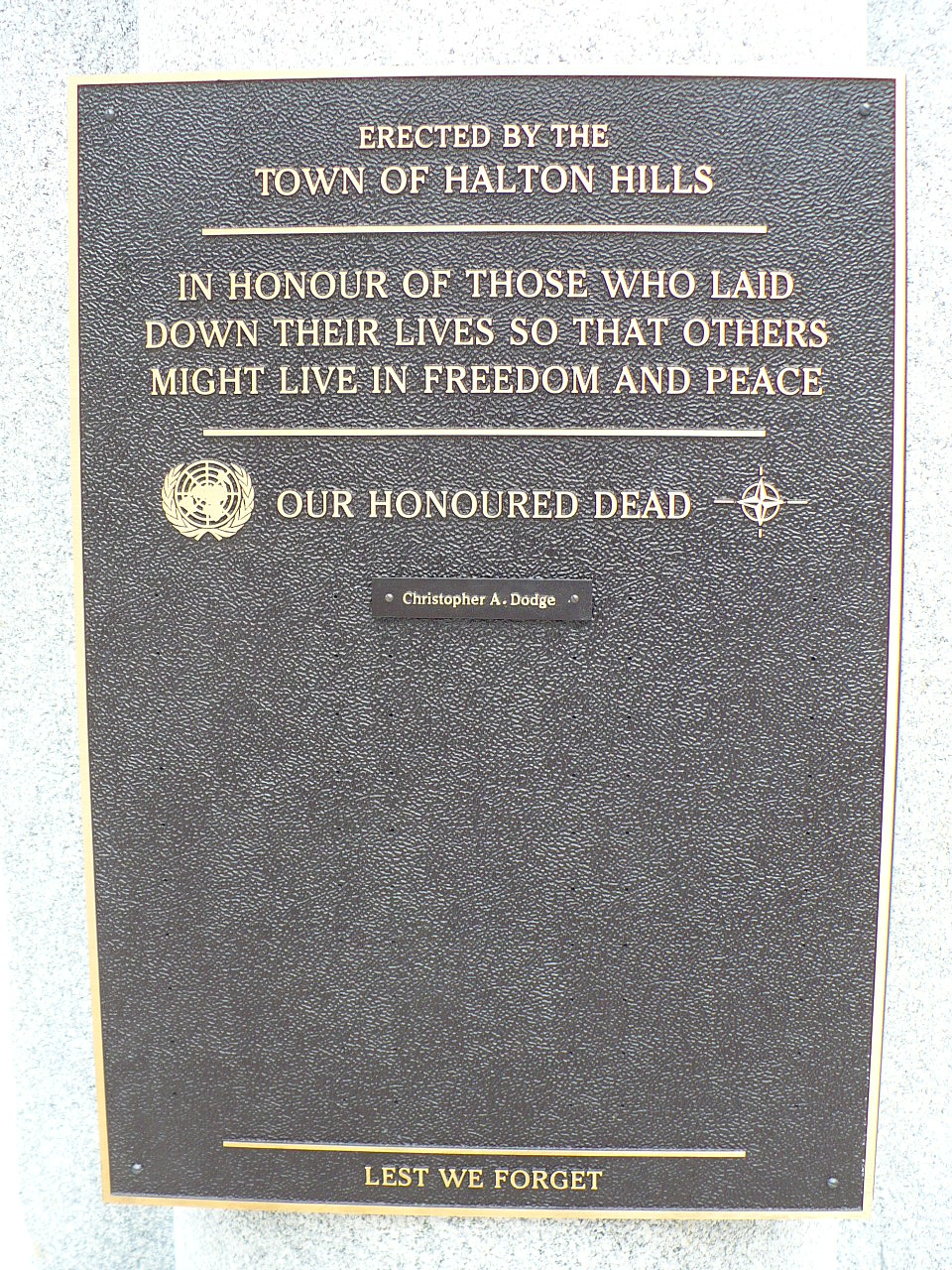
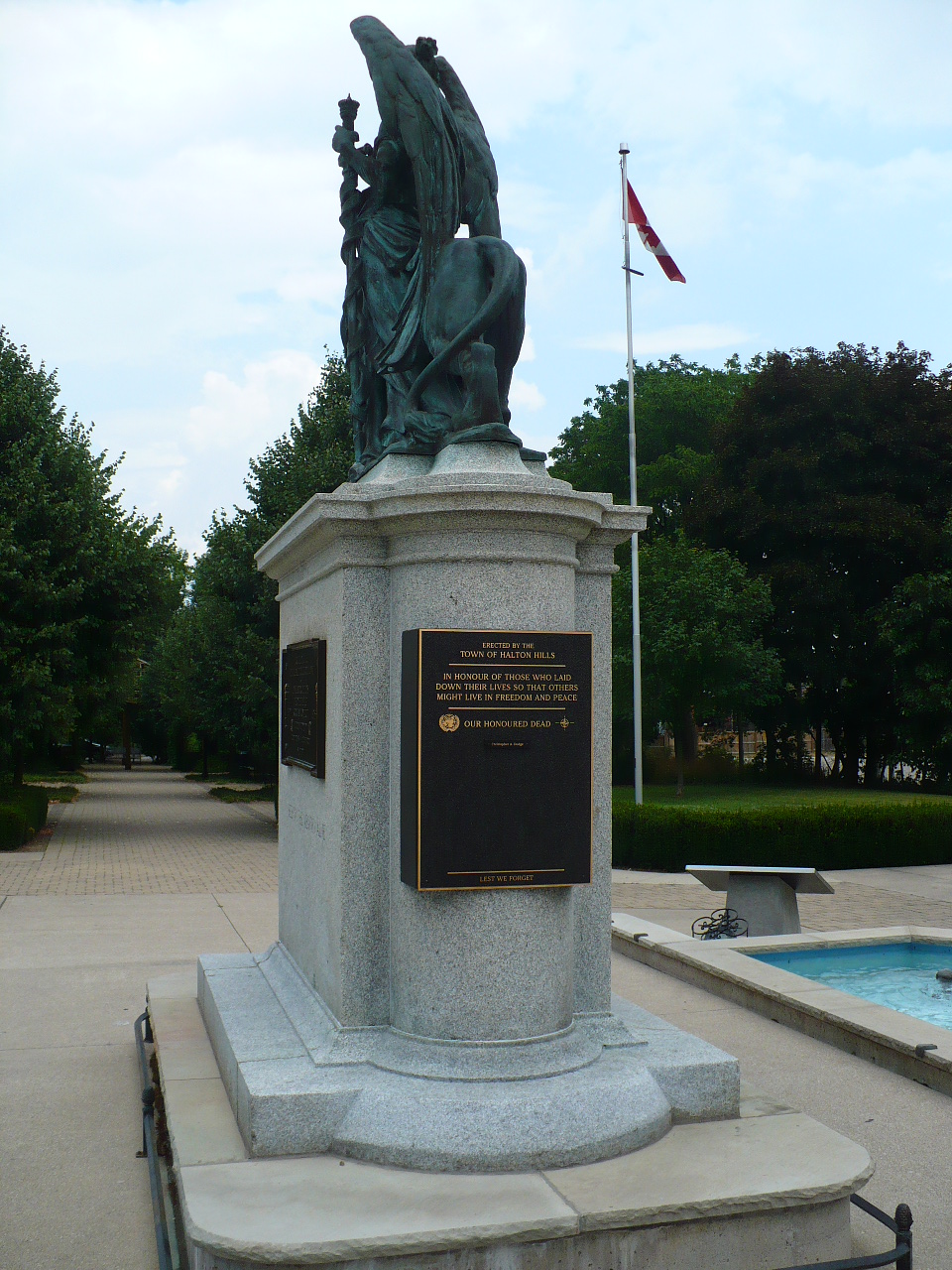
Georgetown citizens expressed their desire for a fitting memorial to honour their fallen from the First World War as early as February of 1919. On March 28, 1919, the Soldiers Memorial Committee met for the first time in the Georgetown Council Chambers in the Townsends Market Hall to discuss the erection of a monument to the Georgetown war dead. Discussions surrounding the design and location of Georgetown's war memorial extended through the summer of 1919, causing growing frustration among residents due to the prolonged lack of consensus.
Fundraising began in 1920, with Georgetown’s business community approached for donations and a public subscription program established. By 1921, a design featuring a bronze Imperial Lion atop a granite plinth was finalized; however, funding remained below the goal set by the Georgetown War Veterans Association. To bridge the gap, Town Council passed a bylaw in December 1922 to raise $6,000 through taxation and floated an $8,000 debenture, awarded to Mappin & Webb of Montreal. The statue was cast in England, marking the final step in bringing the monument to completion.
In April 1924, Council voted to place the war memorial at the junction of Guelph Street and Main Street North with site preparations beginning in late May. On top of the memorial is a large statue of the Imperial Lion of Britain and winged Britannia Victoria. the Imperial Lion of Britain, commonly seen on Canadian, British, and Australian war memorials, embodies Britain’s strength, power, and guardianship as the head of the Empire. This symbol serves a dual purpose: it represents unity among the dominions and colonies that transcended individual national identities to form a cohesive British imperial identity. For Canadian memorials, the lion not only signifies the country’s ties to Britain but also honors the shared sacrifices made by Canadians and their fellow soldiers within the Empire during conflicts fought under the imperial banner. It is important to note that Canadians during this period identified as British North Americans, rather than as North Americans under British rule.
Historically, the Imperial Lion has symbolized courage, valour, and royal authority, qualities central to the British Empire’s self-image. For Canadian soldiers, particularly during the World Wars, the lion reflected their loyalty to both Britain and the broader Empire, symbolizing their dedication to defending these shared values. In the early twentieth century, the lion represented the unified strength of the Empire’s dominions under the Crown.
The winged Britannia Victoria (Britannia in Victory), symbolizes Britain's imperial spirit as a female warrior. Often depicted in Athenian form with a Corinthian helmet, shield, and trident, Britannia embodies the unity, spirit, ideals, and 6 strength of all Britons and represents the broader British Empire, including its dominions and colonies. With wings, Britannia assumes a transcendent role, embodying not only protection, divine justice, and the unity of the British Empire but also the profound ideals of hope and sacrifice. In this angelic form, she guides both the fallen to the heavens and civilization toward a vision of lasting peace. Her presence on war memorials speaks to the noble pursuit of these ideals, symbolizing the guardianship over lands and peoples, including distant dominions like Canada. Her wings carry the hope that their sacrifices were not in vain but served a purpose both sacred and eternal. This celestial quality enshrines their memory, evoking a sense of reverence and a belief that the dignity of their cause endures in both remembrance and the peace they sought to achieve.
Britannia is adorned with a corona triumphalis, a crown of victory composed of laurel leaves, a powerful Western imperial image rooted in Roman iconography that became prominent in British symbolism from the early eighteenth to early twentieth century. In her left hand, she grasps a sword partially wrapped in her stola’s drapery. The wrapped sword, echoing classical imagery, evokes themes of restrained power, justice, and moral 7 authority. The sword suggests strength, while the toga signifies civic duty, wisdom, and governance, reflecting ideals of “peace through strength” and the judicious use of power only when necessary.
In the context of war memorials, this symbolism speaks to ideals of disciplined power and moral righteousness, portraying the Empire’s military engagements as justified actions in the pursuit of justice and peace. For Canadians, the wrapped sword reinforces that their sacrifices were in alignment with ideals of honor and righteousness. It serves as a reminder that those who served under the imperial banner did so to restore peace, not out of conquest or aggression.
In her right hand, Britannia extends a laurel wreath over the Imperial Lion’s head. The wreath crown, traditionally a symbol of both peace and victory, has its roots in classical antiquity, where it was awarded to victorious generals and athletes. The laurel wreath honors accomplishments achieved through noble effort, notably the achievement of peace and victory through sacrifice, and serves on war memorials as a symbol of both triumph and a solemn dedication to peace.
In the context of Canadian and British imperial memorials, the laurel wreath symbolizes that victory is tempered with the desire for a lasting peace. The wreath’s circular form reflects the cyclical nature of peace following conflict, as well as the enduring memory of those who sacrificed. It signifies not only the end of a battle but also the hope for a peaceful future sustained by the sacrifices made by those who fought. Through the wreath, Canada’s contributions to the Empire’s successes are honoured, reaffirming that the ultimate goal of these conflicts was not solely military victory but the establishment of peace.
At 10:30 a.m. on August 30, 1924, a parade advanced from the Georgetown Library, accompanied by the chimes of the Presbyterian Church, marking the solemnity of the occasion. General Currie led the procession, escorted by a Georgetown honor guard, as they proceeded up Main Street toward the cenotaph. As St. George’s Church bell tolled marking the hour of eleven o’clock, Sir Arthur Currie unveiled the monument to Georgetown’s 34 fallen soldiers.
After the Second World War, the monument gained renewed importance as the town faced the loss of another generation of young men in Europe. On September 26, 1948, Mayor Joseph Gibbons led a Legion parade, accompanied by the Lorne Scots Band and Georgetown Girls Pipe Band, to unveil a new tablet listing the names of Georgetown residents who had fallen in the Second World War.
The extremely busy corner was no longer a suitable place for reflection and the Town of Georgetown decided to move the cenotaph in June of 1960. Its new home would be a parcel of land owned by the town which would become Remembrance Park. Unfortunately, the move did not go according to plan. The truck, with the added weight of the memorial, got stuck in the marshy land forcing the movers to install it right where their wheels sank in. It was a few meters east of its current location, facing parallel to Charles Street.
The Korean War plaque was unveiled by Mayor Joseph Gibbons during the Remembrance day ceremony on November 11, 1965. In 2000, the Dutch Canadian Remembrance Committee, and many others who helped, refurbished the memorial and moved it to its current location.