
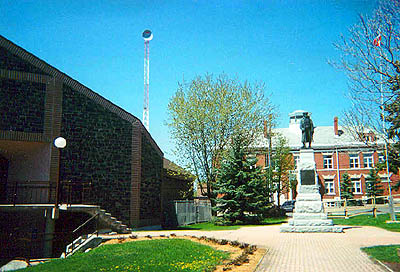
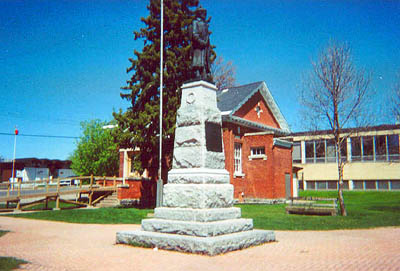
In the spring of 1923, a War Memorial Committee was established in the town of Kenora. Its mandate was a war memorial to commemorate the local people who fought in the First World War and never returned.
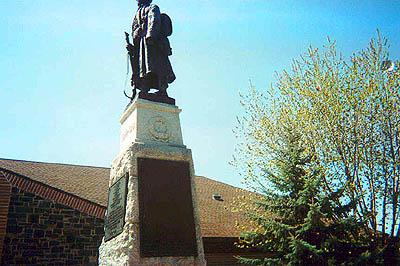
By early May, the Committee selected the site of the square in front of the Court House. A fundraising campaign was launched for the latter part of June and into July when the town was thoroughly canvassed. By August of 1923, enough money had been raised to proceed. The Creber Brothers of Toronto were awarded the contract – their design judged the best by the Committee. The 22-feet tall monument was made of Stanstead granite and surmounted by the bronze figure of a soldier created by Toronto sculptor Charles Adamson.
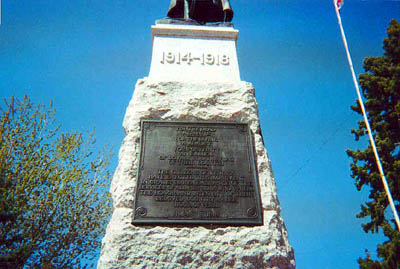
The foundation was installed the fall of 1923 and fundraising continued with such events as “The War Memorial Carnival.” The Committee canvassed the community to ensure that the name of every soldier who fell in the Great War was placed on the cenotaph.
On Sunday, September 7, 1924, the unveiling address was delivered by Lieutenant-Colonel H.A.C. Machin, commanding officer of the 94th overseas battalion, followed by a prayer of consecration by Reverend E. Diamond and an address by Captain the Reverend A.J. Labonte, military chaplain overseas. The cenotaph was unveiled by Mrs. E. Mills, Mrs. John Bull, and Mrs. J.A. Horan – the wives or mothers of three of the 96 Kenora men who are commemorated on the cenotaph. Nearly 4,000 people attended the unveiling, an impressive showing considering the population of the town was about 7,500 in 1924.
Following the Second World War, the names of those who never returned from that war were added to the cenotaph.