
In 1972, the Wall of Valour was created to recognize the bravery decorations awarded to members of the Canadian Navy and the Naval Reserves. The plaques on the wall are owned and maintained by Parks Canada.
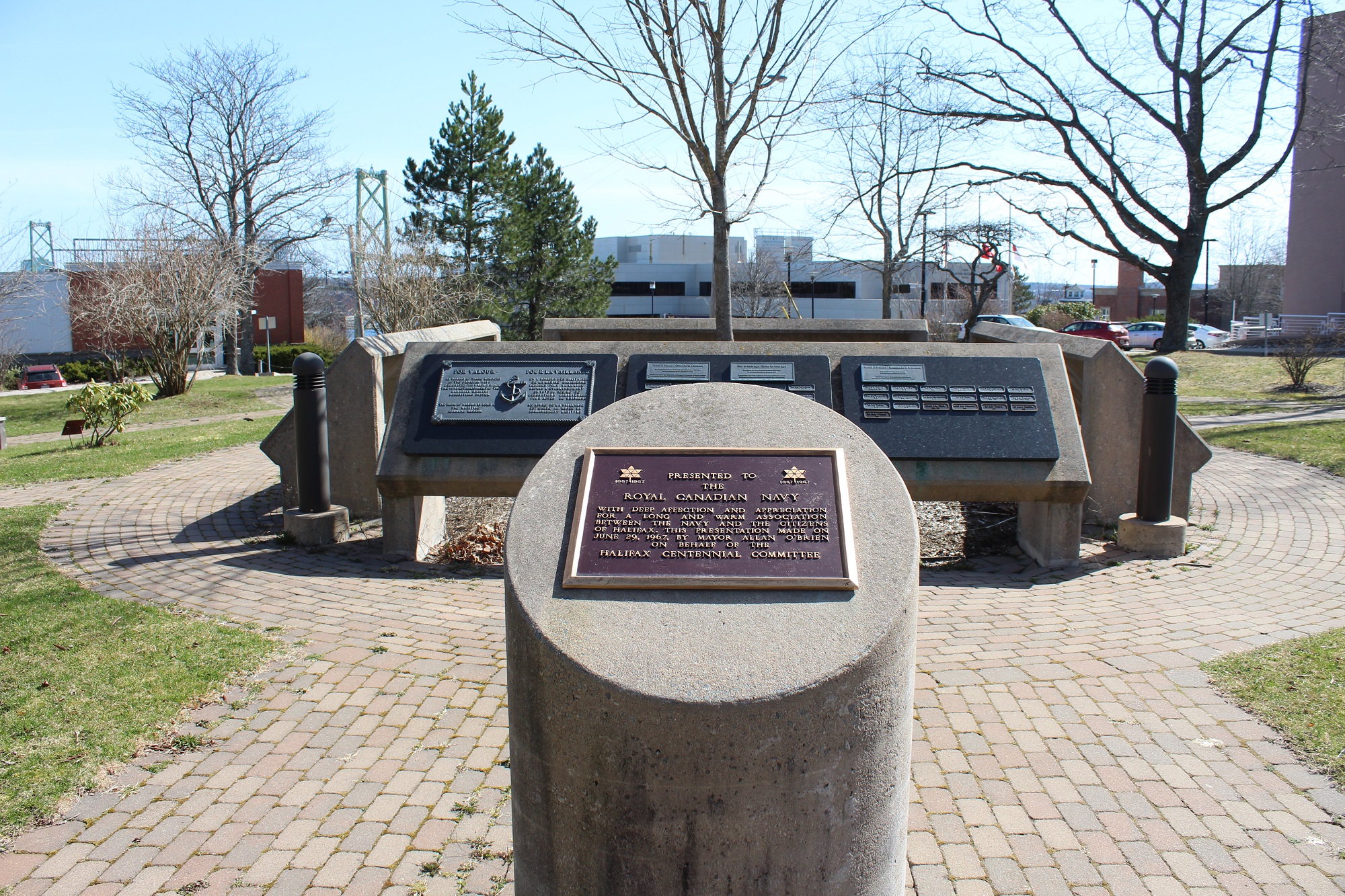
surroundings
Naval Museum of Halifax1
of
6
images

front wall
Naval Museum of Halifax1
of
6
images
left wall
Naval Museum of Halifax1
of
6
images
right wall
Naval Museum of Halifax1
of
6
images
back wall
Naval Museum of Halifax1
of
6
images
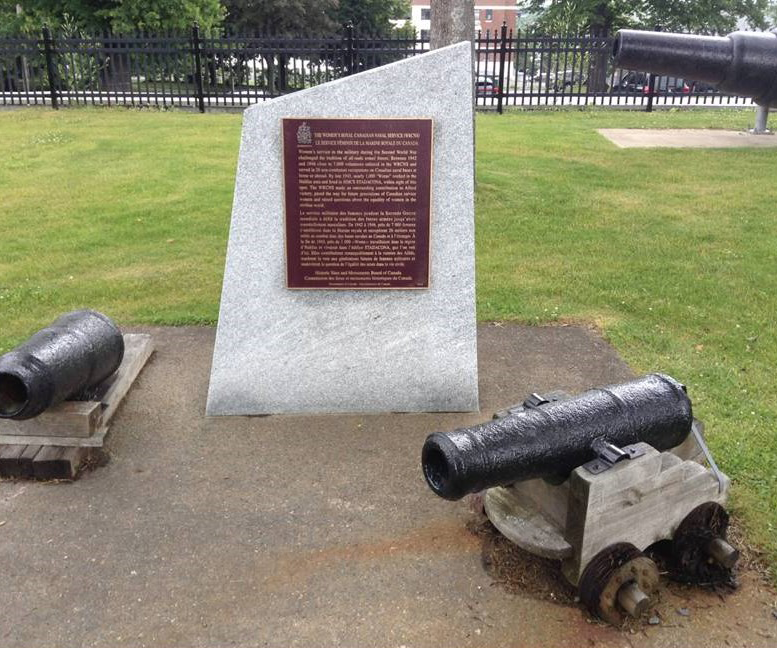
Women's Royal Canadian Naval Service plaque
Parks Canada1
of
6
images
Type
Wall of Valour
Halifax, Nova Scotia
Notice:
The National Inventory of Canadian Military Memorials is a public, crowd-sourced registry that helps Canadians learn about memorials in their communities. Inclusion in the Inventory does not imply VAC ownership or authority. Responsibility for the care, management, and any changes to a memorial rests with its owning or governing organization.
Inscription
[plaque on column/plaque sur colonne]
PRESENTED TO
THE
ROYAL CANADIAN NAVY
WITH DEEP AFFECTION AND APPLICATION
FOR A LONG AND WARM ASSOCIATION
BETWEEN TEH NAVY AND THE CITIZENS
OF HALIFAX. THIS PRESENTATION MADE ON
JUNE 29, 1967, BY MAYOR ALLAN O'BRIEN
ON BEHALF OF THE
HALIFAX CENTENNIAL COMMITTEE
[front wall/paroi frontale]
(plaque)
- FOR VALOUR
- IN HONOUR OF THOSE MEMBERS
- OF THE CANADIAN NAVY
- DECORATED FOR VALOUR SINCE
- THE 1972 ESTABLISHMENT OF THE
- CANADIAN BRAVERY
- DECORATIONS SYSTEM
- THE BOOK OF VALOUR IS HELD AT
- THE MARITIME
- COMMAND MUSEUM
- POUR LA VAILLANCE
- EN L'HONNEUR DES MILITAIRES
- DE LA MARINE CANADIENNE
- DÉCORÉS POUR VAILLANCE
- DEPUIS L'ÉSTABLISSEMENT
- EN 1972 DU RÉGIME DE
- DÉCORATIONS CANADIENNES
- POUR ACTES DE BRAVOURE
- LE LIVRE DE LA VAILLANCE
- EST GARDÉ AU MUSÉE DU
- COMMANDEMENT MARITIME
(plaque)
Cross of Valour/Croix de la vaillance
Awarded for acts of the most conspicuous courage
in circumstances of extreme peril
Décernée pour les actes de courage vraiment remarquables
accomplis dans des circonstances extrêmement périlleuses
|
CWO V.O. PARTANEN, CV, CD |
OS A. GARRAMMONE, |
|
P02 L.J. STRINGER, CV, CD |
(plaque)
Star of Courage/Étoile du courage
Awarded for acts of conspicuous courage
in circumstances of great peril
Décernée pour les actes de courage remarquables
accomplis dans des circonstances très périlleuses
|
PO2 C.L. BUSSIERE, |
LCDR L.L. VOYER, SC, CD |
CWO J.L. MCINTOSH, |
|
SLT D.P. FINCH, |
LS C.H. SHERPPARD, |
SLT C.E. REFFIENSTIEN, |
|
PO2 P.G. MARSH, |
MAT3 J.R.M. BOUCHARD, |
AB D.O. MORRISON, |
|
PO2 J.A. LEITH |
(plaque)
Medal of Bravery/Médaille de la Bravoure
Awarded for acts of bravery
in hazardous circumstances.
Décernée pour des actes de bravoure
accomplis dans des circonstances dangereuses
|
CP02 R.G. GEORGE, |
LS J. G. WHITE, |
MS E.A. NASH, |
P02 J.G. YURCAK |
MAT3 J.E.D. LEPAGE, |
LS B.E. CLARKE, |
|
LT(N) R.K. DRUGGETT, |
P01 G.J. GILLINGHAM, |
AB R.J.J. BROADHEAD, |
OS B.R. BROWN, |
OP02 J.R.R. CLOUTIER, |
OS C.S. WINSOR, |
|
LS S.N. OLSON, |
LS K.F. GEORGE, |
LT(N) J.A. FREW, |
A/SLT A.H. BRANNEN, |
LS K.D. GRANT, |
OS J.J.P. BRETON, |
|
MS M.N. PENNEY, |
OS C.S. WINSOR, |
MS C.S. WINSOR, |
LS P.S. Moulden, MB, CD |
|
|
[right wall/paroi droite]
(plaque)
GEORGE EDWARD WATTS
1786-1860
Born in Halifax, Watts entered the Royal Navy in 1797 and
served on the Halifax and West Indies stations until 1806, ris-
ing, by that date to the rank of Senior Lieutenant. In 1807, after
being cited for gallantry in action at Copenhagen, he was promot-
ed to Commander. Thereafter he served in the Baltic and North
Sea until 1813 when he was given command of the Jaseur.
In this ship, during the later part of the War of 1812, he
captured more than thirty ships, including an American privateer.
He was advanced to Captain in 1814, to Rear-Admiral in 1849
and to Vice-Admiral in 1856. He died at Malvern, England.
Né à Halifax, Watts fut admis dans la Marine royale en 1797.
Il fit son service à Halifax et dans les Caraïbes jusqu'en 1806
et obtint le grade de premier lieutenant. Cité pour sa bravoure
à la bataille de Copenhague, il fut nommé commandant en 1807.
Il servit dans la mer Baltique et la mer du Nord et reçut le
commandement du JASEUR en 1813. Avec ce navire il captura,
pendant la guerre de 1812, plus de trente vaisseaux, dont un corsaire
américain. Capitaine en 1814, il fut promu contre-amiral en 1849 et
vice-amiral en 1856. Il mourut à Malvern, en Angleterre.
Historic Sites and Monuments Board of Canada.
Commission des lieux et monuments historiques du Canada.
Government of Canada - 1949 - Gouvernement du Canada
(plaque)
PROVO WALLIS
1791-1892
Provo Wallis was born in Halifax, where his
father was a dockyard employee, and joined the
Royal Navy in 1804. As second lieutenant of
HMS SHANNON he distinguished himself in the
fight with USS CHESAPEAKE, and brought the
captured American frigate into the harbour of
his native town on June 6, 1813. After a long
career on various European and American
stations, he became a full admiral in 1863.
He died at Funtington, England, as Admiral of
the Fleet Sir Provo Wallis.
Né à Halifax, où son père était employé au
chantier naval, Provo Wallis entra dans la
marine royale en 1804. Lieutenant en second du
HMS SHANNON, il se distingua dans l’engagement
avec le USS CHESAPEAKE et, le 6 juin 1813, il
ramena au port de sa ville natale la frégate
américaine capturée. Après une longue carrière
dans diverses stations européennes et
américaines, il devint amiral en 1863.
Lorsqu’il mourut à Funtington (Angleterre), il
était amiral de la flotte sir Provo Wallis.
Historic Sites and Monuments Board of Canada.
Commission des lieux et monuments historiques du Canada.
Government of Canada - 1949 - Gouvernement du Canada
(plaque)
SIR EDWARD BELCHER
1799-1877
Edward Belcher was born in Halifax and entered the Royal Navy in
1812. After long and creditable service as a naval surveyor, chiefly in
the western Pacific, he returned to Canadian waters to command one
of the Franklin search expeditions (1852-54). In the course of this ex-
pedition he quarreled with his subordinates and, against their advice,
abandoned his ships in the Arctic ice. For this action, the most contro-
versial in a career market by controversy, he was court-martialed and,
though acquitted, remained under a shadow for the rest of his life.
He attained the rank of admiral in 1870, and died in London.
Né à Halifax, Edward Belcher entra dans la Marine royale en 1812.
Après une carrière fructueuse comme cartographe, surtout dans le
Pacifique occidental, il revint pour commander une des expéditions
entreprises à la recherche de Franklin (1852-1854). Ce fut l’épisode le
plus discuté d’une carrière par ailleurs très controversée; il se disputa
avec ses subordonnés et, malgré eux, abandonna ses navires dans
les glaces arctiques. Passé en cour martiale, il fut acquitté, mais sa
réputation en resta à tout jamais ternie. Devenu amiral en 1870, il
mourut à Londres.
Government of Canada - Gouvernement du Canada
[left wall/paroi gauche]
(plaque)
- THE FOUNDING OF THE CANADIAN
NAVAL SERVICE - The Royal Canadian Navy, founded in
1910 as the Canadian Naval Service, was
the first national service of its kind. It
played a key role in the Dominion’s
contributions to the Allied effort during
the First World War, notably in military
recruitment and training, organization
and operation of an Allied convoy
service, coastal patrol, and provisioning
British naval forces on the Atlantic coast.
The establishment of the navy was an
important expression of autonomy at a
critical time in Canada’s development
from colony to nation. - Historic Sites and
Monuments Board of Canada
and Parks Canada - LA CRÉATION DU SERVICE NAVAL
DU CANADA - La Marine royale du Canada, premier
service national du genre, fut fondée
en 1910 sous le nom de Service naval du
Canada. Elle joua un rôle clé dans l’effort
de guerre du Dominion pendant la
Première Guerre mondiale, notamment
par le recrutement et la formation,
l’organisation et les opérations d’un
service de convois alliés, la surveillance
côtière et l’approvisionnement des
forces navales britanniques sur la côte
atlantique. La création de la marine
permit au Canada d’affirmer son
autonomie à un moment crucial de sa
transition de l’état de colonie à celui de
nation. - Commission des lieux et
monuments historiques du Canada
et Parcs Canada
(plaque)
HALIFAX DOCKYARD
ARSENAL DE HALIFAX
The creation in 1758 of the royal dockyard, the first in North America,
recognized and enhanced the strategic importance of Halifax and its
harbour. This served as the principal depot for the North American
squadron until 1819, when that function was transferred to Bermuda.
Nevertheless it continued until 1905 to be the summer rendezvous of
the North American and West Indies squadron and to symbolize the
importance of the Royal Navy to the economic and social life of
Halifax. In 1910 the dockyard was formally transferred to Canada.
Revitalized during two world wars, it still serves Canada’s navy.
La création, en 1758, de ce premier arsenal royal de l’Amérique du
Nord démontra l’importance stratégique de Halifax et de son port. Il
servit de dépôt principal à l’escadre nord-américaine jusqu’en 1819,
quand l’on déménagea ses installations aux Bermudes. Jusqu’en 1905,
l’arsenal de Halifax demeura le rendez-vous estival de l’escadre nord-
américaine et antillaise et symbolisa l’importance de la marine royale
dans la vie sociale et économique de Halifax. En 1910, l’arsenal fut
officiellement remis au Gouvernement canadien et joua un rôle consi-
dérable durant les deux guerres mondiales.
Historic Sites and Monuments Board of Canada.
Commission des lieux et monuments historiques du Canada.
Government of Canada - 1949 - Gouvernement du Canada
(plaque)
PHILIP WESTPHAL
1782-1880
Philip, the elder brother of Admiral Sir George Westphal, was
born near Halifax, and entered the Royal Navy in 1794. He
was with Nelson at Copenhagen in 1801, and later in the
Mediterranean. Although he attracted favourable notice from
his superiors in the West Indies in 1806, promotion came slowly
to Westphal; it was not until he had distinguished himself in
American waters in the War of 1812 that he was made a com-
mander. In 1847 he became a pensioner of Greenwich Hospital,
and thereafter rose, on the retired list, to the rank of admiral in
1866. He died at Ryde in England.
Frère aîné de l’amiral sir George Westphal, Philip naquit près
d’Halifax et entra dans la marine royale en 1794. Il accompagna
Nelson à Copenhague en 1801 et, plus tard, dans la Méditerranée.
Même s’il se fit bien voir de ses supérieurs en 1806 dans les
Antilles, son ascension fut lente. Ce n’est qu’après s’être distingué
en eaux américaines durant la guerre de 1812 qu’il fut fait com-
mandant. En 1847, il devint pensionnaire de l’hôpital Greenwich
et, retraité, atteignit le rang d’amiral en 1866. Il mourut à Ryde
en Angleterre.
Historic Sites and Monuments Board of Canada.
Commission des lieux et monuments historiques du Canada.
Government of Canada - 1949 - Gouvernement du Canada
(plaque)
SIR GEORGE AUGUSTUS WESTPHAL
1785-1875
George Westphal was born near Halifax and entered the Royal
Navy in 1798. As a midshipman in HMS VICTORY he was
seriously wounded at Trafalgar, but survived to serve with con-
spicuous gallantry throughout the Napoleonic Wars, rising to
the rank of commander by 1813. Promoted to flag-captain on
the North American station in 1832, he was invalided home in
1834. For the remaining forty years of his life he saw no further
service afloat, but advanced, by regular gradation, to the rank
of admiral. He died at Brighton, the last of the officers who had
fought in the VICTORY at Trafalgar.
Né en Nouvelle-Écosse, près d’Halifax, Westphal entra dans
la marine royale en 1798. Aspirant de marine à bord du HMS
VICTORY, il fut grièvement blessé à Trafalgar, mais il survécut
et se distingua par sa bravoure durant les guerres de Napoléon,
accédant au rang de commandant en 1813. Promu capitaine de
pavillon à la station nord-américaine en 1832, il fut réformé en
1834. Pendant les quarante dernières années de sa vie, il ne servit
plus en mer mais atteignit, de promotion en promotion, le rang
d’amiral. Lors de son décès à Brighton, il était le dernier des
officiers ayant combattu à bord du VICTORY à Trafalgar.
Historic Sites and Monuments Board of Canada.
Commission des lieux et monuments historiques du Canada.
Government of Canada - 1949 - Gouvernement du Canada
(plaque)
- SIR CHARLES EDMUND KINGSMILL
- (1855–1935)
- Director of Canada’s first standing navy
- from its founding in 1910 until 1920,
- Admiral Kingsmill was responsible for
- Canada’s naval contribution during the
- First World War. He asserted Canadian
- autonomy over naval operations and
- bases, organized Allied mercantile
- convoys out of Halifax and Sydney,
- and established inshore patrols and
- a continent-wide supply system for
- the Allied fleet. Providing sound
- administrative oversight, Kingsmill set
- up command structures and training
- institutions that later enabled the Royal
- Canadian Navy to expand into one of
- the world’s largest naval forces during the
- Second World War.
- Historic Sites and
- Monuments Board of Canada
- and Parks Canada
- SIR CHARLES EDMUND KINGSMILL
- (1855-1935)
- Directeur de la première marine
- permanente du pays, de sa fondation en
- 1910 jusqu’en 1920, l’amiral Kingsmill
- fut responsable des opérations navales
- pendant la Première Guerre mondiale.
- En plus d’affirmer l’autonomie du
- Canada sur les bases et les opérations, il
- organisa des convois marchands à partir
- de Halifax et de Sydney, des patrouilles
- côtières et un système continental de
- ravitaillement pour la flotte alliée. En
- dirigeant rigoureux, Kingsmill mit en
- place les structures de commandement
- et de formation qui firent de la Marine
- royale du Canada l’une des principales
- forces navales de la Seconde Guerre
- mondiale.
- Commission des lieux et
- monuments historiques du Canada
- et Parcs Canada
[back wall/paroi arrière]
(plaque)
ON THE OCCASION OF
THE REVIEW OF THE INTERNATIONAL FLEET
ASSEMBLED AT HALIFAX, NOVA SCOTIA
HONOURING THE 100TH ANNIVERSARY OF
THE CANADIAN NAVY
UNVEILED BY
HER MAJESTY QUEEN ELIZABETH II
ACCOMPANIED BY
HIS ROYAL HIGHNESS THE DUKE OF EDINBURGH
29 JUNE 2010
EN SOUVENIR DE
LA REVUE INTERNATIONALE DE LA FLOTTE
QUI A EU LIEU À HALIFAX (NOUVELLE-ÉCOSSE)
À L'OCCASION DU 100E ANNIVERSAIRE
DE LA MARINE CANADIENNE
PLAQUE DÉVOILÉE PAR
SA MAJESTÉ LA REINE ELIZABETH II
ACCOMPAGNÉE PAR
SON ALTESSE ROYALE LE DUC D'ÉDIMBOURG
LE 29 JUIN 2010
[plaque]
THE WOMEN'S ROYAL CANADIAN NAVAL SERVICE (WRCNS)
LE SERVICE FÉMININ DE LA MARINE ROYALE DU CANADA
Women's service in the military during the Second World War
challenged the tradition of all-male armed forces. Between 1942
and 1946 close to 7,000 volunteers enlisted in the WRCNS and
served in 26 non-combatant occupations on Canadian naval bases at
home or abroad. By late 1943, nearly 1,000 "Wrens" worked in the
Halifax area and lived in HMCS STADACONA, within sight of this
spot. The WRCNS made an outstanding contribution to Allied
victory, paved the way for future generations of Canadian service
women and raised questions about the equality of women in the
civilian world.
Le service militaire des femmes pendant la Seconde Guerre
mondiale a défié la tradition des forces armées jusqu’alors
essentiellement masculines. De 1942 à 1946, près de 7 000 femmes
s’enrôlèrent dans la Marine royale et occupèrent 26 métiers non
reliés au combat dans des bases navales au Canada et à l’étranger. À
la fin de 1943, près de 1 000 «Wrens» travaillaient dans la région
d’Halifax et vivaient dans l’édifice STADACONA, que l’on voit
d’ici. Elles contribuèrent remarquablement à la victoire des Alliés,
tracèrent la voie aux générations futures de femmes militaires et
soulevèrent la question de l’égalité des sexes dans la vie civile.
Historic Sites and Monuments Board of Canada
Commission des lieux et monuments historiques du Canada
Government of Canada - Gouvernement du Canada
Street View
Location
Wall of Valour
2729 Gottingen Street
Halifax
Nova Scotia
Wall of Valour
2729 Gottingen Street
Halifax
Nova Scotia
GPS Coordinates
Lat. 44.65953
Long. -63.59282
Lat. 44.65953
Long. -63.59282