

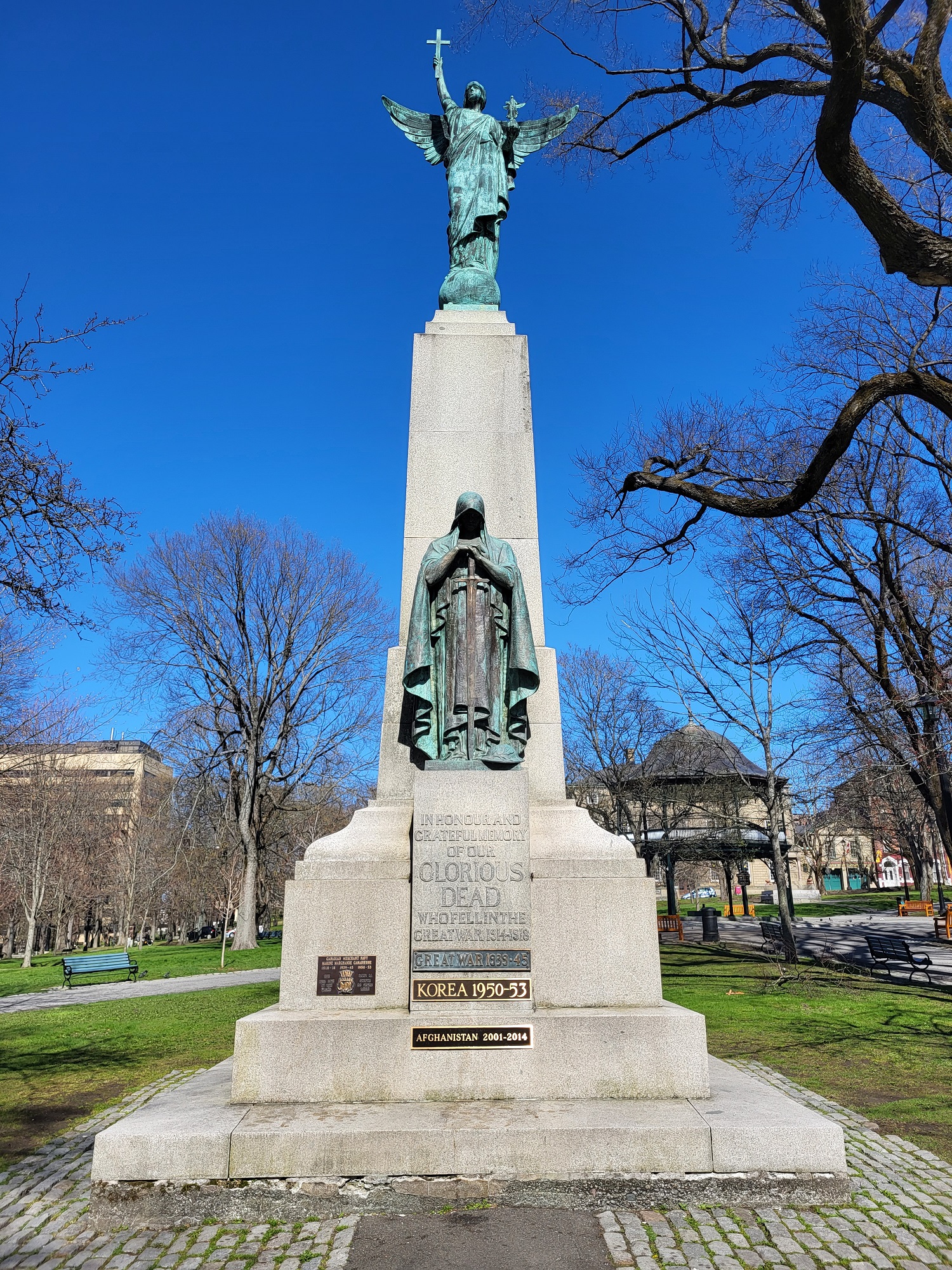
In 1922, the Municipal Chapter of the Imperial Order of the Daughters of the Empire in Saint John held a meeting to organize a memorial to honour the city’s war dead. The War Memorial Committee held a design competition and chose a design by Canadian sculptor, Alfred Howell. It symbolizes the triumph of victory through sacrifice with a winged bronze figure holding a flag of victory and a cross. She stands on a globe, suggesting the universal victory for which men died. A statue below, depicts a figure mourning, with her hands resting on a sword and at its feet, lies a soldier’s helmet with a spray of laurel leaves on it.
The War Memorial Committee wanted to put the monument at the head of King Street, which was in the center of town and close to many prominent buildings and institutions. However, in 1885 the local branch of the Women’s Christian Temperance Union had installed a water fountain at the head of King Street in memory of the Loyalist women who had settled in the city. Some prominent Saint John citizens, including the mayor, thought that removing the fountain would be erasing that sacred memory. The majority of Saint John citizens wanted it moved and there wasn’t a single letter to the editor in favour of keeping the fountain. In the end, the War Memorial Committee put aside the debate and agreed to put the memorial a few feet to one side of the fountain in order to unveil the memorial in a timely fashion.
The lower mourning statue was covered in a massive Union Jack which General A.H. Macdonell removed on June 10, 1925, with the words, "I now reverently unveil this War Memorial to the glory of those citizens of Saint John who served in the Army, the Navy, the Air Force, or as nursing sisters, who lost their lives in the Great War." General Macdonell commanded the 5th Infantry Brigade of which the local regiment, the 26th New Brunswick Battalion was part.
Canon Lawrence prefaced his dedicatory prayer by saying that Saint John is a good place to live in, thanks to the sacrifices of the men whom this memorial remembered. "Be it ours," he said, "to make Saint John what they would like it to be." The War Memorial was erected for $20,000 in perpetual memory of those who paid the supreme sacrifice during the Great War. On June 24, 1925, the City of Saint John formally took over the care and maintenance of the memorial.
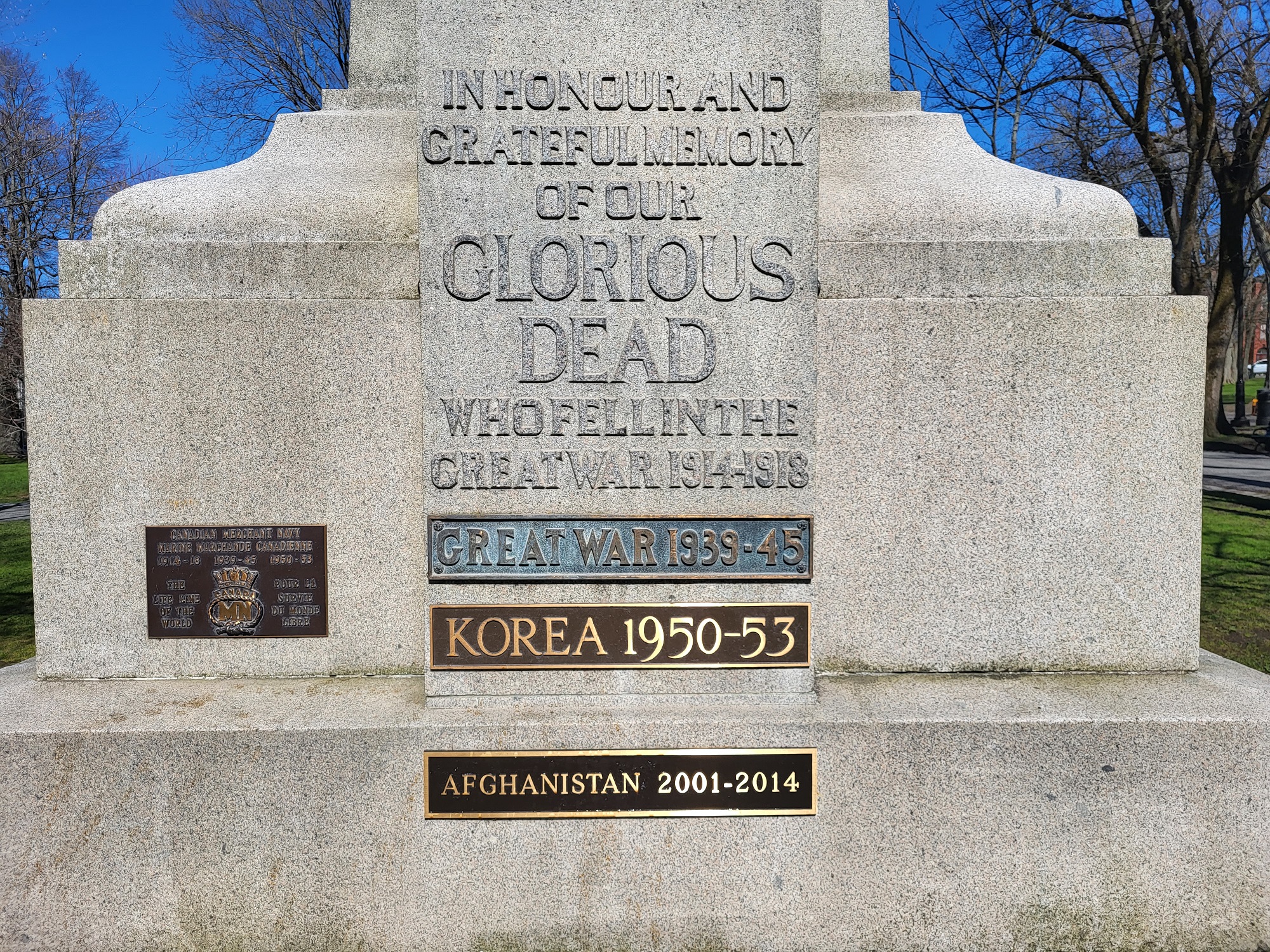
The dates of the Second World War, Korean War, and Afghanistan were added to the memorial after those conflicts.
Alfred Howell was born in 1889 in Oldbury, England and studied at the Royal College of Art in London. In Canada, he taught at the Toronto Central Technical School. Following the First World War, he was awarded a contract to create bronze monuments throughout Canada to commemorate the sacrifices of Canadian soldiers. His commissions include: Guelph War Memorial, Garden of the Unforgotten, Triumph of Right over the God of War, William Hamilton Merritt Memorial and Central Technical School Memorial.