
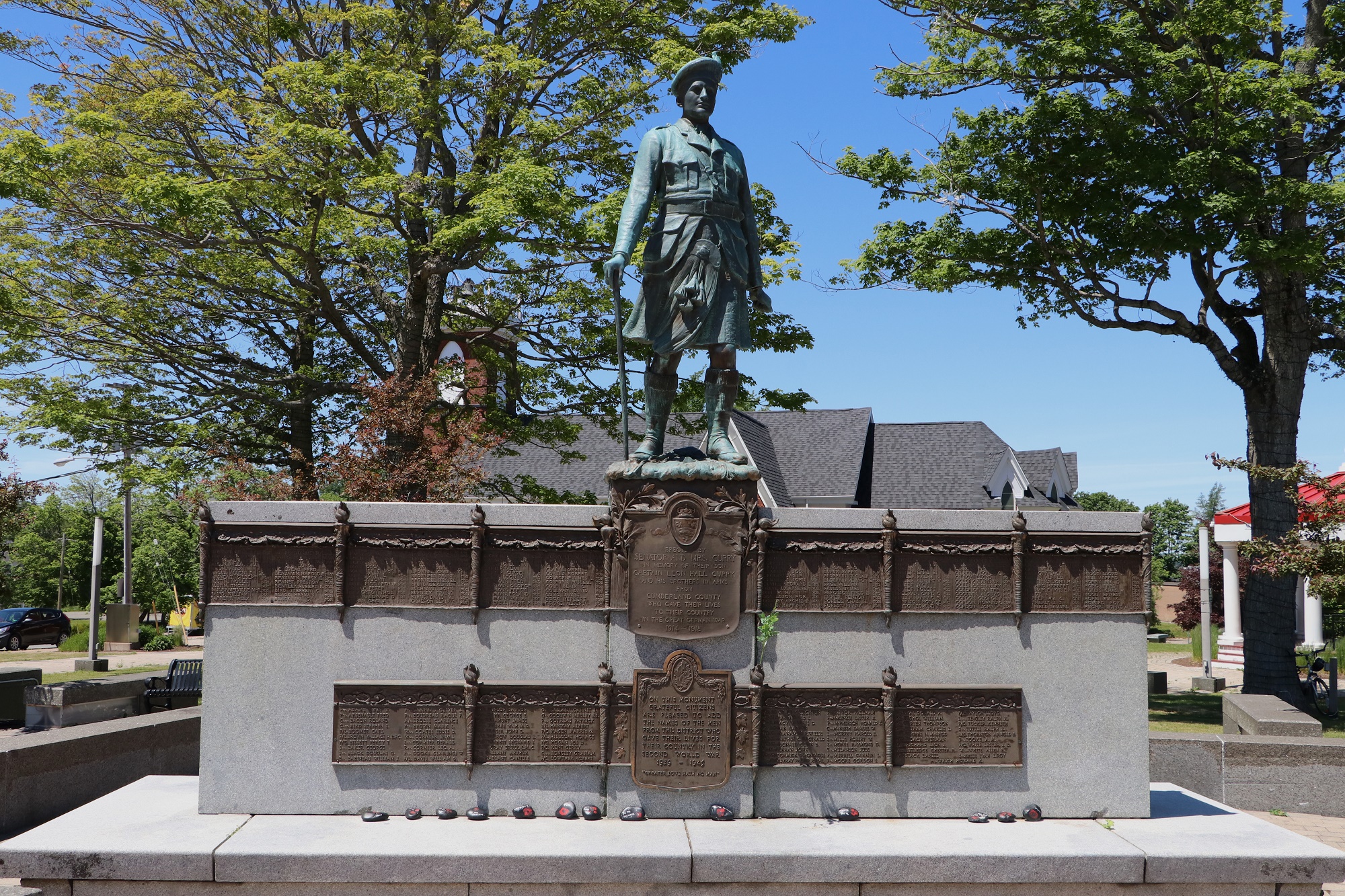
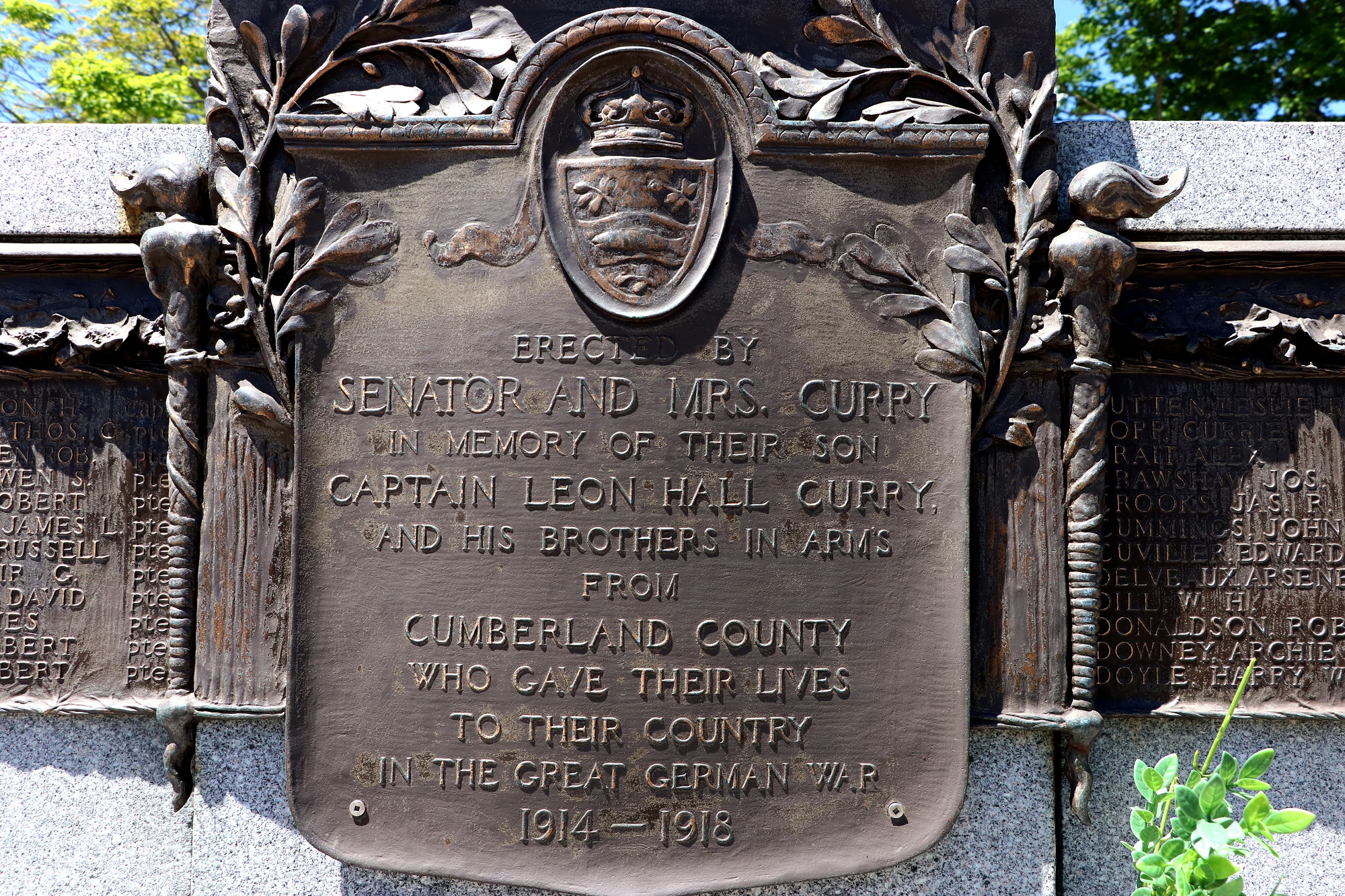
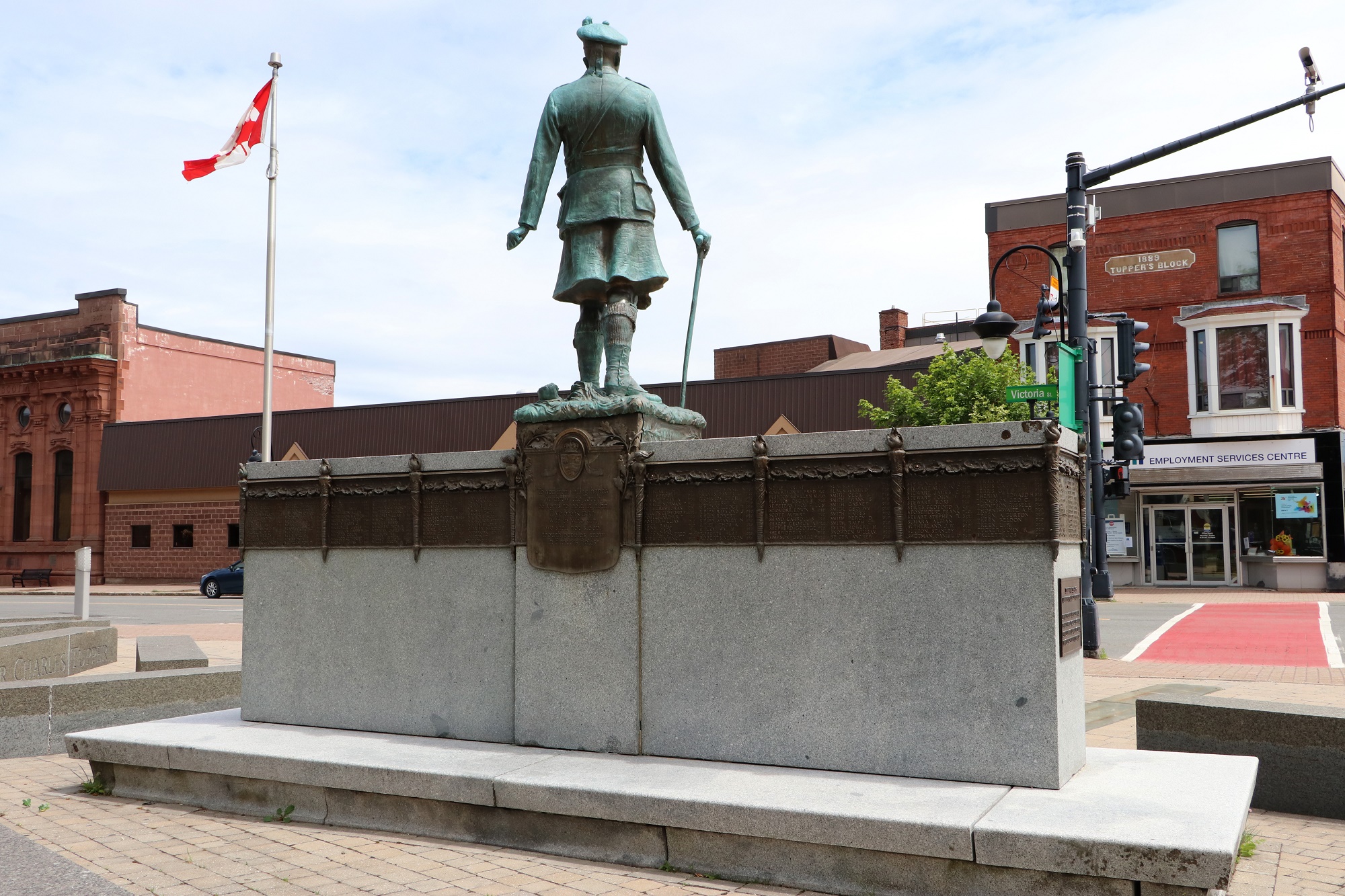
The Cumberland County Soldiers Memorial Monument was erected by Senator Nathaniel Curry and Mary Hall Curry in memory of their son, Captain Leon Hall Curry, as well as the other Cumberland County war dead of the First World War. Curry was the first University of Acadia graduate to fall in the Great War.
Following the official presentation by Senator Curry, it was unveiled on July 2, 1921, at three o'clock Saturday afternoon by Colonel C.E. Bent, C.M.G., D.S.O. An impressive silence settled over Victoria Square as the loose folds of the Canadian flag, which shrouded the monument, were drawn slowly asunder disclosing the life like bronze statue of a Nova Scotia Highlander, representing Cumberland's contribution of men in the Great War. Designed by the famous Italian sculptor A. G. Ghiloni, who took as his basic idea, Colonel John MacRae's immortal poem "In Flanders Fields".
The base of the gray native granite was cut and erected by the local firm of J.A. Tingley and Sons, and is surmounted by a heavy bronze tablet form that is surrounded with interwoven poppies and crosses, flanked at regular intervals with flaming torches. The bronze design extends around the whole monument, the tablets bearing the printed names and ranks of the 336 Cumberland men who gave their lives in the war. In the front, the metal work terminates in a large bronze plate topped by the Nova Scotia Coat of Arms. In the rear of the monument a similar plate contains the verse from "In Flanders Fields". The surmounting statue's face is a remarkable likeness of the late Captain Leon Curry. The figure is attired in the full dress uniform of the 85th Highlanders - highland kit and beret, standing in the natural posture of ease, with one arm leaning on a stout cane.
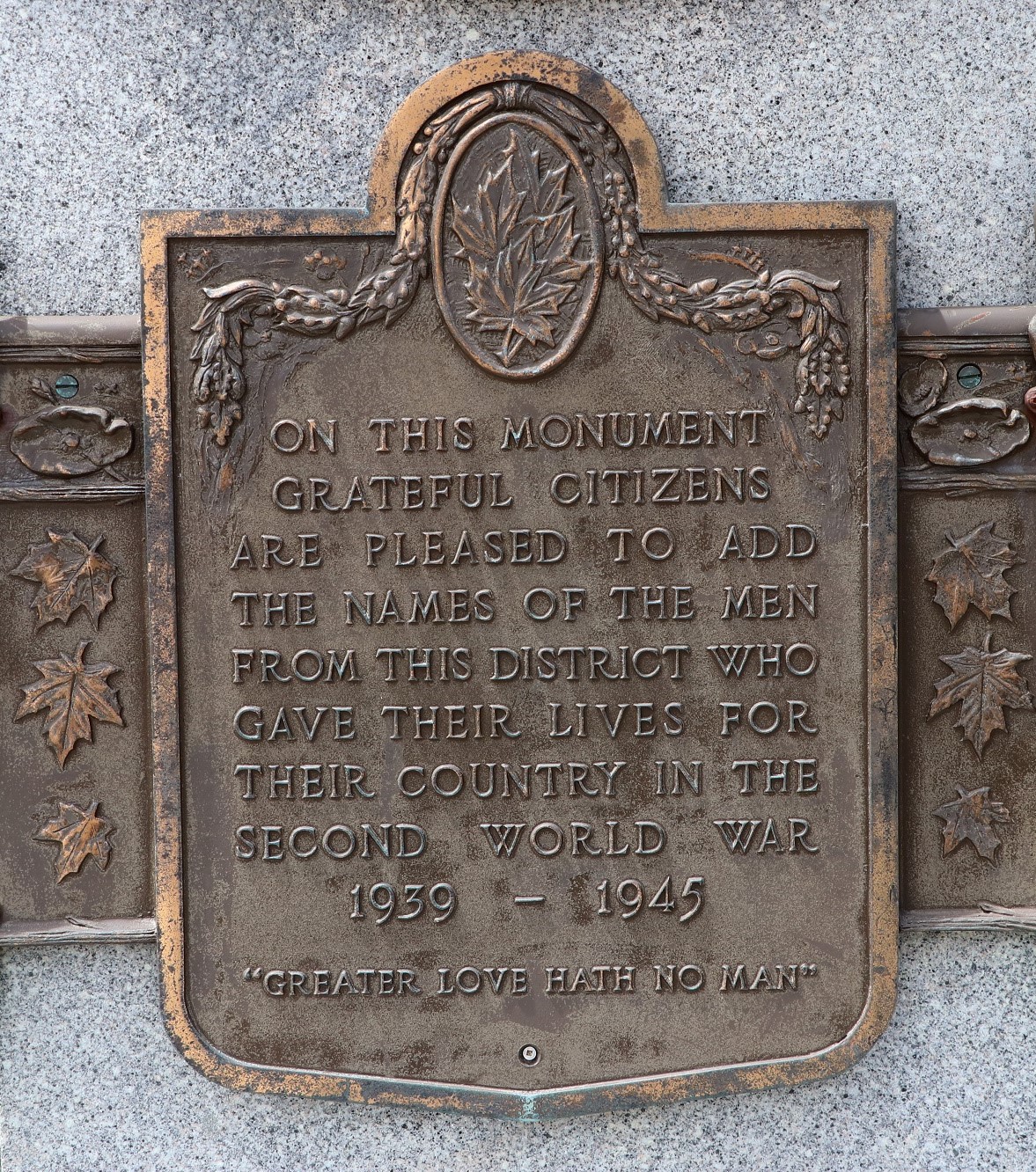
The cenotaph was later expanded to include the 79 names of the war dead from the Second World War. Amherst celebrated its centennial year in 1989 and a time capsule was sealed in the base of the memorial. In 1992, the statue was struck by a vehicle. In the course of repairing the memorial, additions were made to the time capsule and it was sealed again.
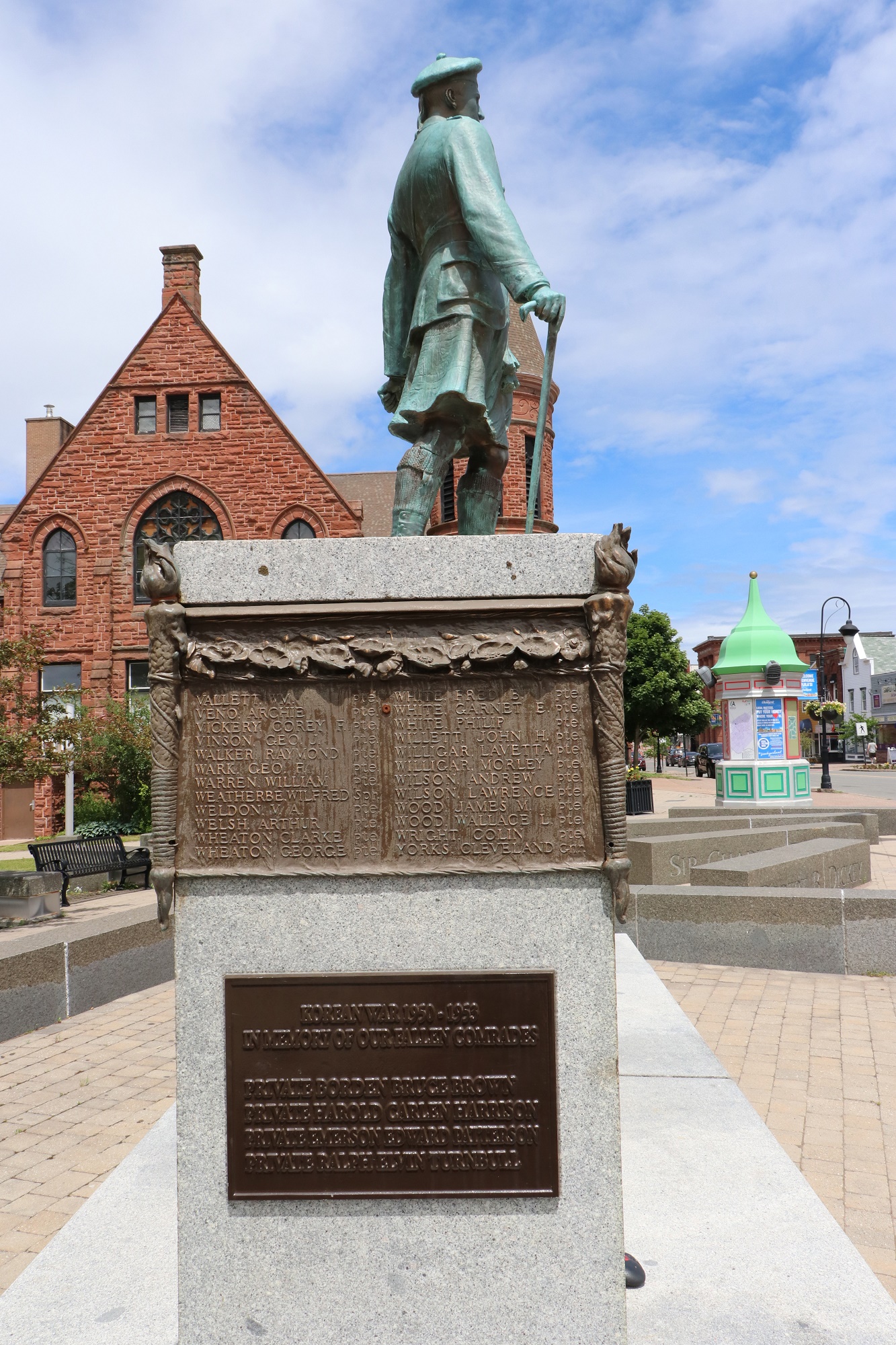
On November 4, 2020, the Korean War plaque made by Liberty Enterprises Ltd. of Brookdale was unveiled. It was placed on the west side of the cenotaph, the side facing the courthouse and the direction in which Canadian soldiers would have travelled in order to reach Korea. Hal Patterson, who spent 13 months fighting in Korea with the 1st Battalion Princess Patricia’s Canadian Light Infantry, helped Amherst Mayor David Kogon unveil the plaque.