
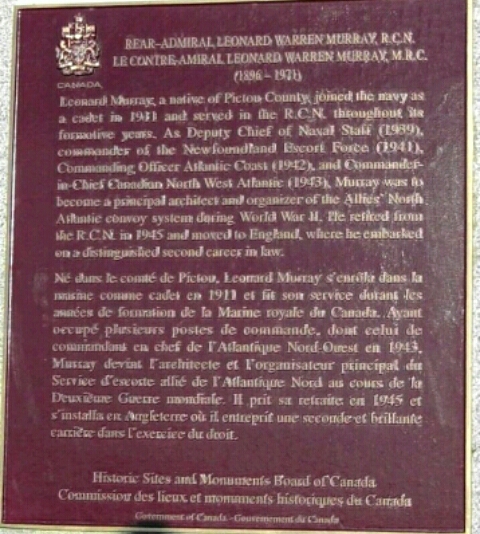
This memorial is dedicated to the memory of Rear Admiral Leonard Warren Murray. It was unveiled 14 October 2004.
Rear Admiral Leonard Warren Murray Memorial Plaque
Pictou, Nova Scotia
Notice:
The National Inventory of Canadian Military Memorials is a public, crowd-sourced registry that helps Canadians learn about memorials in their communities. Inclusion in the Inventory does not imply VAC ownership or authority. Responsibility for the care, management, and any changes to a memorial rests with its owning or governing organization.
Inscription
[plaque/plaque]
DEDICATED TO THE MEMORY OF
REAR ADMIRAL LEONARD WARREN MURRAY
CB, CBE, R.C.N.
SUPREME COMMANDER ALLIED NAVAL FORCES
NORTHWEST ATLANTIC 1943 - 1945
ERECTED BY THE TOWN OF PICTOU
OCTOBER 14, 2004
[information panel/renseignments]
[left/gauche]
The Battle Of The Atlantic
On September 16, 1939, the first convoy set out from Halifax for the United Kingdom. The sea lanes of the
North Atlantic formed a grim battle ground. Navigation was hazardous and sailors in the Navy and the
Merchant Navy died not only from enemy attacks, but from exposure and accidents in the fog and winter
gales. Bridging the Atlantic was the key to strategic supply and it was in maintaining the Atlantic lifeline
that the Canadian Navy and the Merchant Marines played an increasingly vital role. To transport safely,
the vast amounts of goods and troops that were needed, ship movements had to be organized and controlled.
Escort work would remain the RCN's chief responsibility for the duration of the war. It was onerous and
dangerous work and Canadians shared in the worst hardships experienced in the war at sea. For six long
years, the Royal Canadian Navy and Canadian Merchant Navy were principle contenders in what as to
be known as the Battle of the Atlantic.
In September, for the first time, U-boats began using the so-called wolf-pack tactics. At night, groups of
U-boats (usually as many as six, sometimes more) attacked convoys sailing form North America to Britain.
At first the Canadian groups held their own. But as the size of the wolf packs increased and winter
storms swept the Atlantic, several convoys escorted by the RCN suffered heavy losses. In 1942, the RCN
had 16,000 members, serving in 188 War Ships, a number that was still too few for the enormous
commitments. The results were calamitous. As many as twenty percent of a convoy's heavy-laden
cargo ships were sunk.
Canada's role in the Battle of the Atlantic was large and significant. Starting from a tiny base of ships,
aircraft and personnel and an infrastructure of meager proportions, Canada became one of the foremost
allied powers in the Atlantic War. In 1942, Canada was able to carry a major share of the defense of the
North American waters and at the same time was Britain's principle partner in defense of Trans Oceans
Convoys. By 1944, her forces had developed the strength and capability to assume as well a significant share in other theatres of war.
[right/droit]
Admiral Leonard Murray, C.B., C.B.E.
Leonard Murray was born in Granton, N.S., 22 June 1896, and in 1911 at the age of 14, while in his 3rd. Year at Pictou Academy, he was accepted as a cadet in the new Royal Naval College, Halifax. At the
outbreak of WWI, by choice of lot, he went to Ottawa, Ont., in lieu of HMS GOOD HOPE where four
of his classmates went and who later became the first four casualties in the Royal Canadian Navy when
the GOOD HOPE was sunk off the South American Coast.
In 1927 he was promoted to Lieutenant Commander, in 1929 to the rank of Commander and appointed Senior Naval Officer Esquimalt. In 1948 he was appointed Director of Naval Operations in Ottawa with the rank of Captain and then promoted to Commodore while Deputy Chief of Naval Staff. His only
sea command in WWII was from October 1940 to February 1941, HMCS ASSINIBOINE as Commanding
Officer and Commodore Commanding Halifax Force. On 15 June 1941, he became Flag Officer
Newfoundland during which time he was honored with awards from France, the U.S.A., Britain and
Norway. In April 1943, he became Commander-Chief Canadian North West Atlantic, with the rank of
Rear Admiral and was responsible for all shipping and escorts operating out of Newfoundland, Canada,
New York and Boston, to an easterly point around Iceland, a post he held until the end of hostilities.
Admiral Murray left the RCN in March, 1946 and in 1947 moved to England where he enrolled as a student of law. He was called to the Bar in November 1949 and specialized in Admiralty Law. He died suddenly at the age of 75 on 25 November 1971. His cremated remains were placed in the Naval Vault beneath St. Paul's Church in Halifax.
"Some knew him as a man of war and we knew him as a man of peace, a man who could undertake immense
responsibilities, yet who, when he spoke to you was gently, immensely kind and considerate'.
Street View
Location
Rear Admiral Leonard Warren Murray Memorial Plaque
Pictou
Nova Scotia
Rear Admiral Leonard Warren Murray Memorial Plaque
Pictou
Nova Scotia
GPS Coordinates
Lat. 45.6805061
Long. -62.7279123
Lat. 45.6805061
Long. -62.7279123