
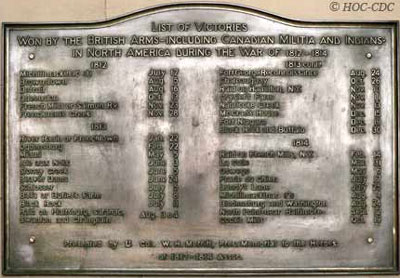
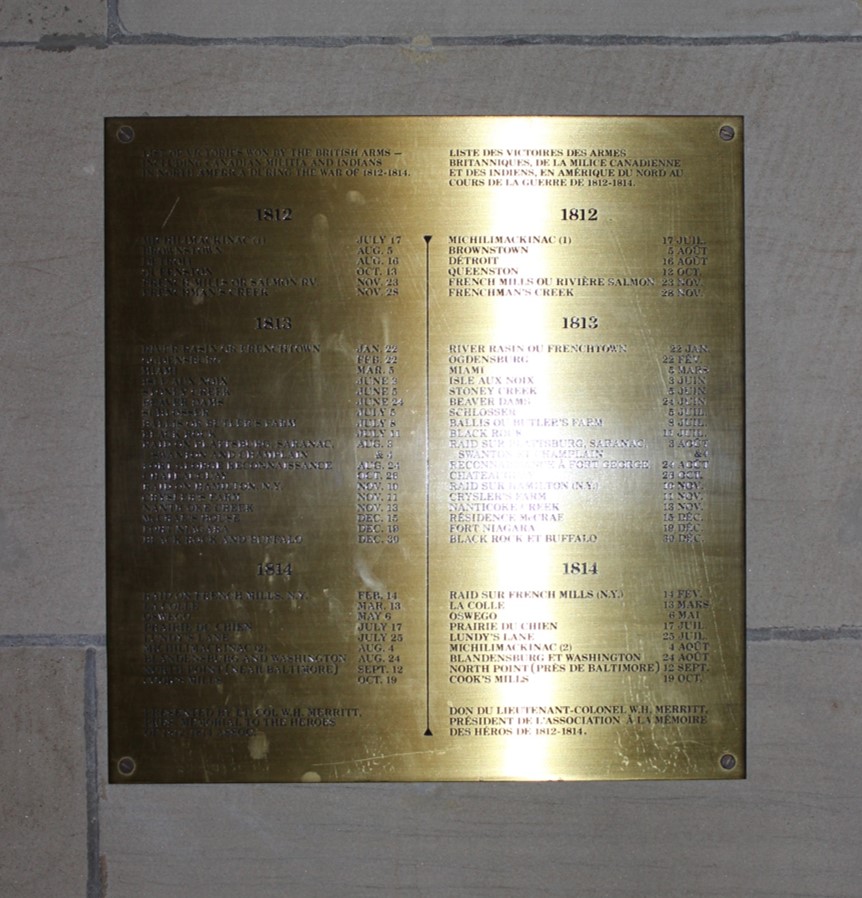
The Memorial to the Heroes of 1812 - 1814, as it is formally known, was commissioned by Lt.-Col. William Hamilton Merritt, in 1913 and unveiled before April 1914. It was created to commemorate the centennial of the Anglo-American war, fought between 1812 and 1814, and the successful defense of British North America by the British, Canadian and Indigenous.
Merritt had a personal interest in the war because his grandfather and namesake had distinguished himself in a number of major actions. His grandfather was captured and interned by the Americans following the Battle of Lundy’s Lane, in 1814.
Lt.-Col. Merritt was on an extended trip to Switzerland when he wrote directly to Prime Minister Sir Robert Borden, in 1913, to offer the plaque for installation in the Parliament Buildings. The Prime Minister liked the idea and consulted with members of his cabinet to see if accepting it would be appropriate. Sir George Perley, Minister without Portfolio, replied that he thought it was right and proper that we should have a memorial of this kind to spur on future generations.
Perley was concerned that a plaque celebrating victories over the Americans might offend some American visitors if it was displayed in too prominent a location. He recommended that it be installed in a discrete location between the old Reading Room and the Library of Parliament.
In early 1914, the Minister of Public Works wrote to Lt. Col. Merritt to accept his generous gift on behalf of the Prime Minister. By this time, Merritt had already taken delivery of the plaque from a German foundry. The plaque was then shipped to Canada and subsequently installed in the Parliament Building before April 1914. Its exact location at that time is not currently known.
The plaque was installed in the original Parliament Buildings, survived the fire of 1916 and was reinstalled in the Centre Block in the 1920s.