
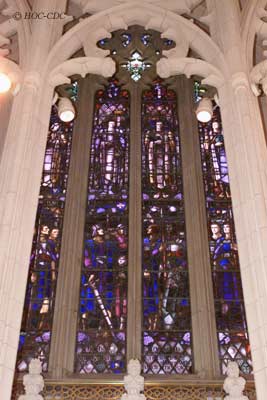
The Call to Arms was unveiled in 1927, created by artist Frank S.J. Hollister and constructed by Cowan & Hollister. Frank S.J. Hollister of Toronto, spent four years in active service during the Great War. Preliminary drawings, accompanied by a description of each window, were prepared and presented to the Department of Public Works for approval by Order in Council, in 1925.
The four figures in the upper part of the window represent:
- Victory - a woman holding a crown, surrounded with a laurel branch and helmet on shield.
- Labour - a figure surrounded by symbols such as a shovel, astrolabe and spinning-wheel, with the motto Fortitudo Industria et Pax;
- Progress - man holding a book and quill, with other symbols such as a celestial crown, galley, scales and hourglass.
- Science - a figure holding a microscope and flask, with a ribbon above his head indicating Metallurgy, Mineralogy and Chemistry, and accompanied by symbols such as a globe and a torch.
In the lower part, the figures holding spears and shields represent the people of Canada, gathered in response to the sounding of the trumpet.
In the second panel, a man holding sword and trumpet calls "To Arms"; at his side a child holds flowers in a scene evoking faith and courage. In the next panel, immediately below the trumpet's bell, stands a figure representing the many women who worked tirelessly ministering to the wounded and needy, while also sharing the dangers and deprivations of wartime. She bears a rod entwined with winged serpents, symbolic of her work as a healer.
In the background, a marching host of men and horses gather from field and farm, office and factory, while a fleet of ships sails forth to fulfill its duty.
The window includes coat of arms of the United Kingdom, Canada and provinces.