
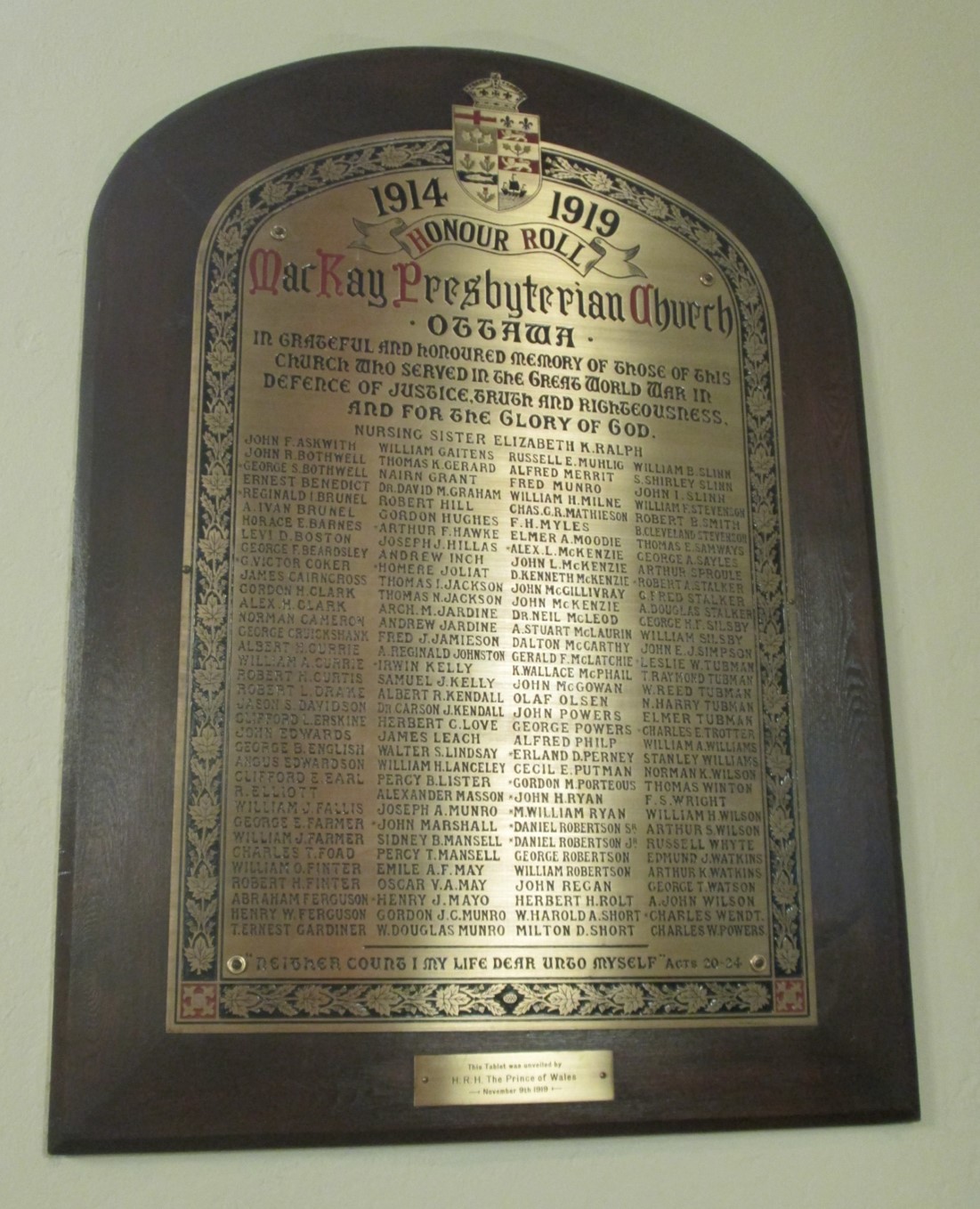
On November 9, 1919, Edward, His Royal Highness Prince of Wales (the future King Edward VIII), visited MacKay Presbyterian Church to unveil two brass plaques honouring the 140 men and one woman who, out of a congregation of 437 members and 137 families, had fought for King and Country in the Great War. On one side of the Sanctuary was the Honour Roll listing all who served; on the opposite wall was a plaque bearing the names of the nineteen who died.
Elizabeth Kirkland Ralph, a 34-year-old former nursing sister, handed the ribbons to the Prince to unveil the two plaques. Elizabeth – the only woman on the First World War Honour Roll – was born on March 8, 1885. In 1907, she enrolled in the Clifton Springs Sanitarium Training School for Nurses. Elizabeth wanted to serve her country when war broke out, but the Canadian Army Medical Corps was initially reluctant to recruit large numbers of nurses and political pull was often needed to get in. Many medical men still did not consider nurses as medical professionals. The British had no such qualms. Early in the First World War, facing a shortage of trained nurses, the Queen Alexandra Imperial Nursing Service sent out a call for nursing sisters from “the Dominions” to serve with the Imperial forces. Some 313 Canadian nurses answered the call. In April 1916, Elizabeth was on a ship to England, along with six other nurses from the Ottawa area.
By 1917, the Canadian Army Medical Corps changed its mind and wanted more trained nurses. On October 16, 1917, she enlisted in the Canadian Army Medical Corps as a nursing sister (lying about her age to appear four years younger than she was). She was now a lieutenant/nursing sister, equivalent to 2nd lieutenant, which allowed her to be treated as an officer, to wear a uniform off-duty, to have authority at least over local hospital staff and “other ranks” patients.
On November 10 she was assigned to No. 12 Canadian General Hospital in Bramshott. She worked there until the hospital was closed in July 1919. In September she was “brought to notice Secretary for War for valuable services rendered during the war” – the equivalent of “mentioned in dispatches.” She was discharged in Canada on August 17, 1919.