
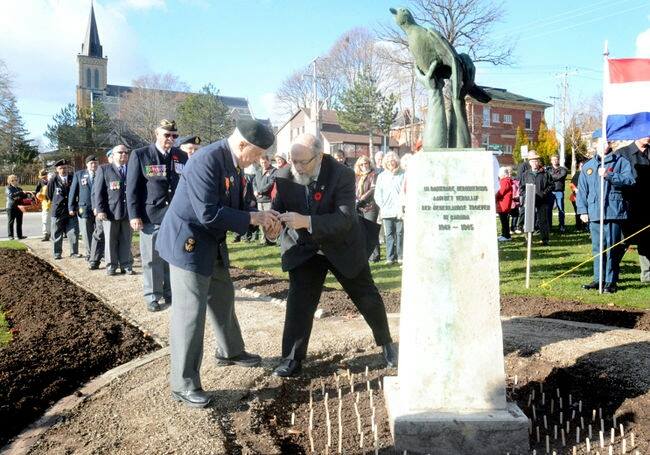
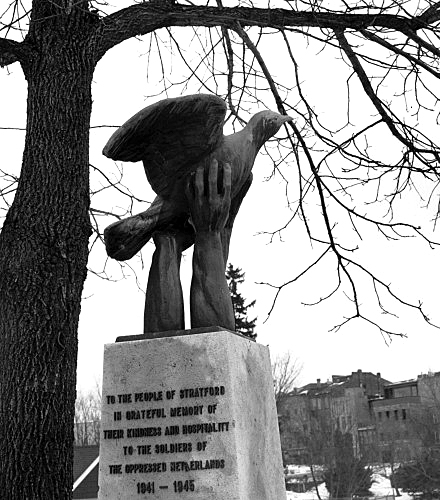
The sculpture of a pair of hands holding a dove, which is symbolic of Canada’s support to the Netherlands, marks the Canadian soldiers' successful efforts to end Nazi occupation of the Netherlands. The sculpture memorial was a gift from the Netherlands after WWII, as a token of appreciation for Stratford’s hospitality to seven hundred free men of Dutch birth who came to Stratford to form a battalion. After the occupation of Holland by Nazi armies, Canada invited free men of the world to use Stratford for a military training base. Queen Juliana of the Netherlands came four times to see them. Their Caserne or barracks was a former furniture factory on Trinity Street. For this reason and that of the participation of the Perth Regiment in the liberation of Holland in 1945, there is a close bond between our countries.
The Dutch-Canadian Friendship Tulip Garden was erected in 2015 by Stratford and District Horticultural Society, which partnered with Communities in Bloom (CIB). Horticultural Society volunteers planted an interlaced pattern of red and white tulip bulbs in the garden beds leading to the Memorial. The blooms will offer a visual reminder next spring of the link between the two countries.
Stratford was one of the 140 communities selected from the more than 400 applications received by the Canadian Garden Council. Each of the 140 new 70th Anniversary Dutch-Canadian Friendship Tulip Gardens across the country will consist of 700 red and white tulip bulbs (350 of each colour) donated by Vesey’s Bulbs in Prince Edward Island.
The memorial is dedicated as a living monument in recognition of the 70th Anniversary of the original Dutch-Canadian Friendship Tulip Garden planted in Ottawa at the end of World War II in 1945. The memorial is in appreciation of the safe haven that members of Holland’s exiled royal family received during World War II, and in recognition of the role Canadian troops played in the liberation of the Netherlands.