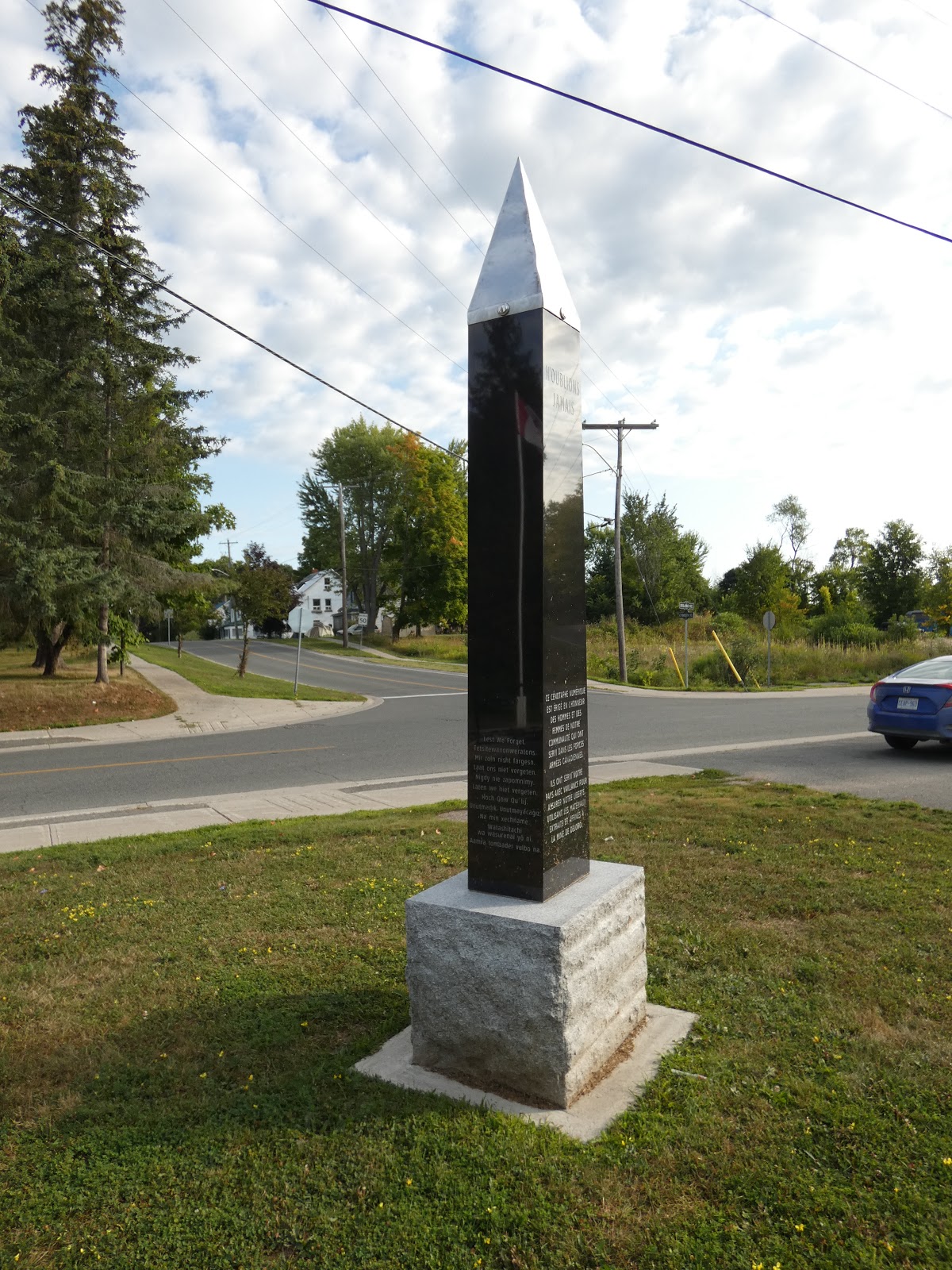
[front/devant]
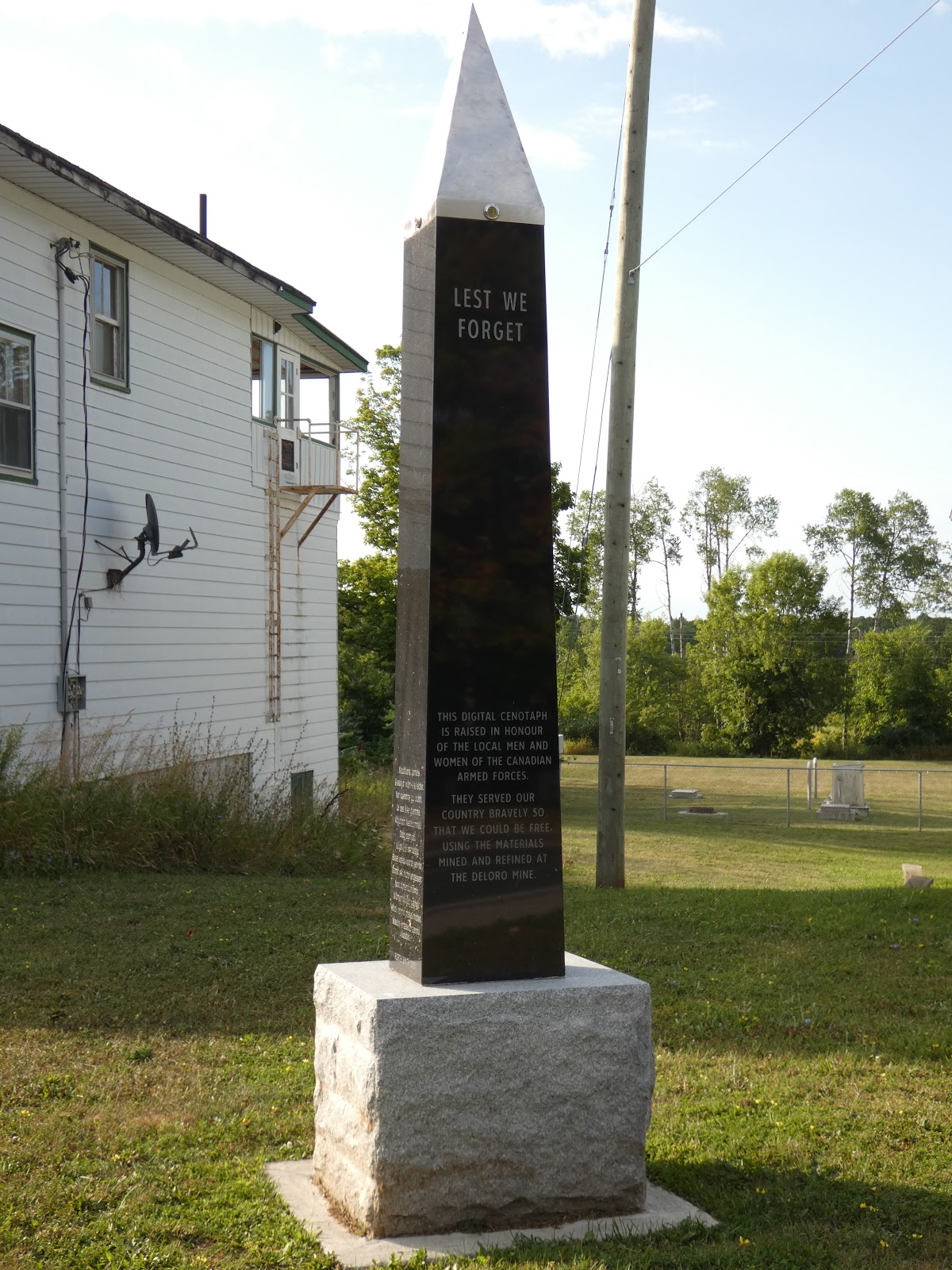
LEST WE FORGET
THIS DIGITAL CENOTAPH
IS RAISED IN HONOUR
OF THE LOCAL MEN AND
WOMEN OF THE CANADIAN
ARMED FORCES.
THEY SERVED OUR
COUNTRY BRAVELY SO
THAT WE COULD BE FREE,
USING THE MATERIALS
MINED AND REFINED AT
THE DELORO MINE.
[right side/côté droit]
THEY SERVED OUR
COUNTRY BRAVELY SO
THAT WE COULD BE FREE
USING MATERIALS
MINED AND REFINED AT
THE DELORO MINE.
[back/arrière]
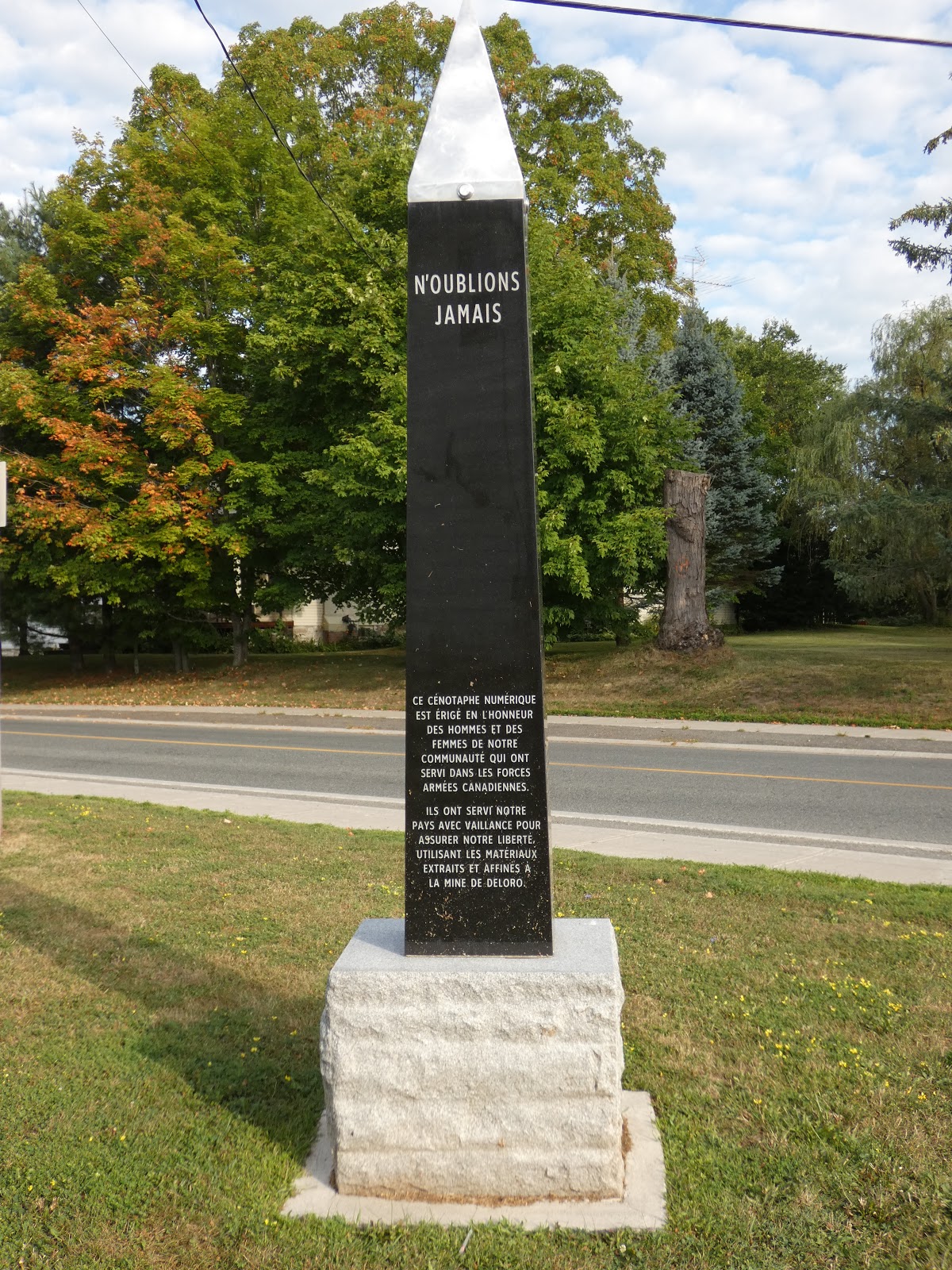
N'OUBLIONS
JAMAIS
CE CÉNOTAPHE NUMÉRIQUE
EST ÉRIGÉ EN L'HONNEUR
DES HOMMES ET DES
FEMMES DE NOTRE
COMMUNAUTÉ QUI ONT
SERVI DANS LES FORCES
ARMÉES CANADAIENNES.
ILS ONT SERVIE NOTRE
PAYS AVEC VAILLANCE POUR
ASSURER NOTRE LIBERTÉ
UTILISANT LES MATÉRIAUX
EXTRAITS ET AFFINÉS À
LA MINE DE DELORO
[left side/côté gauche]
N'oublionis Jamais.
êkawiya wâni-kiskisîtân.
Nar cuimhne gu brath.
La oss ikke glemmé.
Abychom Nezapomneli.
Dolg pamyati.
Uliga il-ji anhdolog.
Etwel vokau worla yen-tor.
Damit wir nicht vergessen.
Non dimentichiamo.
Women buyao wangji.
Hindi namin maklimotan.
Waaba intaasoo aannu
illoobin.
FORTH/SMITH 2015
[plaque]
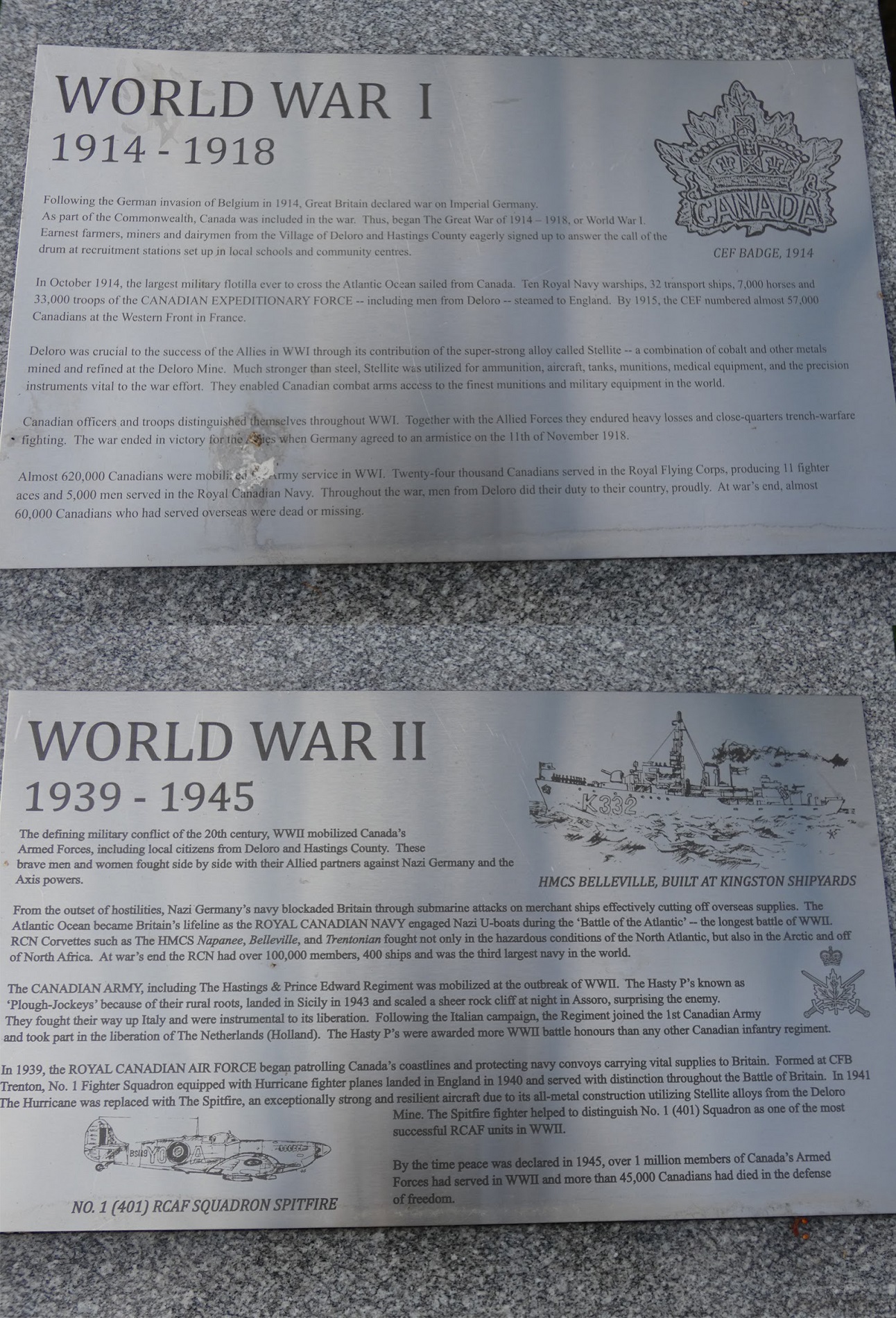
WORLD WAR I
1914 - 1918
Following the German invasion of Belgium in 1914, Great Britain declared war on Imperial Germany. As part of the Commonwealth, Canada was included in the war. Thus, began The Great War of 1914 – 1918, or World War I. Earnest farmers, miners and dairymen from the Village of Deloro and Hastings County eagerly signed up to answer the call of the drum at recruitment stations set up in local schools and community centres.
In October 1914, the largest military flotilla ever to cross the Atlantic Ocean sailed from Canada. Ten Royal Navy warships, 32 transport ships, 7,000 horses and 33,000 troops of the CANADIAN EXPEDITIONARY FORCE -- including men from Deloro -- steamed to England. By 1915, the CEF numbered almost 57,000 Canadians at the Western Front in France.
Deloro was crucial to the success of the Allies in WWI through its contribution of the super-strong alloy called Stellite -- a combination of cobalt and other metals mined and refined at the Deloro Mine. Much stronger than steel, Stellite was utilized for ammunition, aircraft, tanks, munitions, medical equipment, naval search-lights, and the precision instruments vital to the war effort. They enabled Canadian combat arms access to the finest munitions and military equipment in the world.
Canadian officers and troops distinguished themselves throughout WWI. Together with the Allied Forces they endured heavy losses and close-quarters trench-warfare fighting. They persevered and were ultimately successful in helping to drive the battlefront back across France and into Belgium. The war ended when Germany surrendered on the 11th of November 1918.
Almost 620,000 Canadians were mobilized for Army service in WWI. Twenty-four thousand Canadians served in the Royal Flying Corps, producing 11 fighter aces and 5,000 men served in the Royal Canadian Navy. Throughout the war, men from Deloro did their duty to their country, proudly. At war’s end, almost 60,000 Canadians who had served overseas were dead or missing.
[plaque]
WORLD WAR II
1939 - 1945
The defining military conflict of the 20th century, WWII mobilized Canada’s Armed Forces, including local citizens from Deloro and Hastings County. These brave men and women fought side by side with their Allied partners against Nazi Germany and the Axis powers.
From the outset of hostilities, Nazi Germany’s navy blockaded Britain through submarine attacks on merchant ships effectively cutting off overseas supplie Atlantic Ocean became Britain’s lifeline as the ROYAL CANADIAN NAVY engaged Nazi U-boats during the ‘Battle of the Atlantic’ -- the longest battle of WWII. RCN Corvettes such as The HMCS Napanee, Belleville, and Trentonian fought not only in the hazardous conditions of the North Atlantic, but also in the Arctic and off of North Africa. At war’s end the RCN had over 100,000 members, 400 ships and was the third largest navy in the world.
The CANADIAN ARMY, including The Hastings & Prince Edward Regiment was mobilized at the outbreak of WWII. The Hasty P’s known as ‘Plough-Jockeys’ because of their rural roots, landed in Assoro, Sicily in 1943 and scaled a sheer rock cliff at night, surprising the enemy. They fought their way up Italy and were instrumental to its liberation. Following the Italian campaign, the Regiment joined the 1st Canadian Army and took part in the liberation of The Netherlands (Holland). The Hasty P’s were awarded more WWII battle honours than any other Canadian infantry regiment.
In 1939, the ROYAL CANADIAN AIR FORCE began patrolling Canada’s coastlines and protecting navy convoys carrying vital supplies to Britain. Formed at CFB Trenton, No. 1 Fighter Squadron equipped with Hurricane fighter planes landed in England in 1940 and served with distinction throughout the Battle of Britain. In 1941, Mine. The Spitfire fighter helped to distinguish No. 1 (401) Squadron as one of the most successful RCAF units in WWII.
By the time peace was declared in 1945, over 1 million members of Canada’s Armed Forces had served in WWII and more than 45,000 Canadians had died in the defense of freedom.
[plaque]
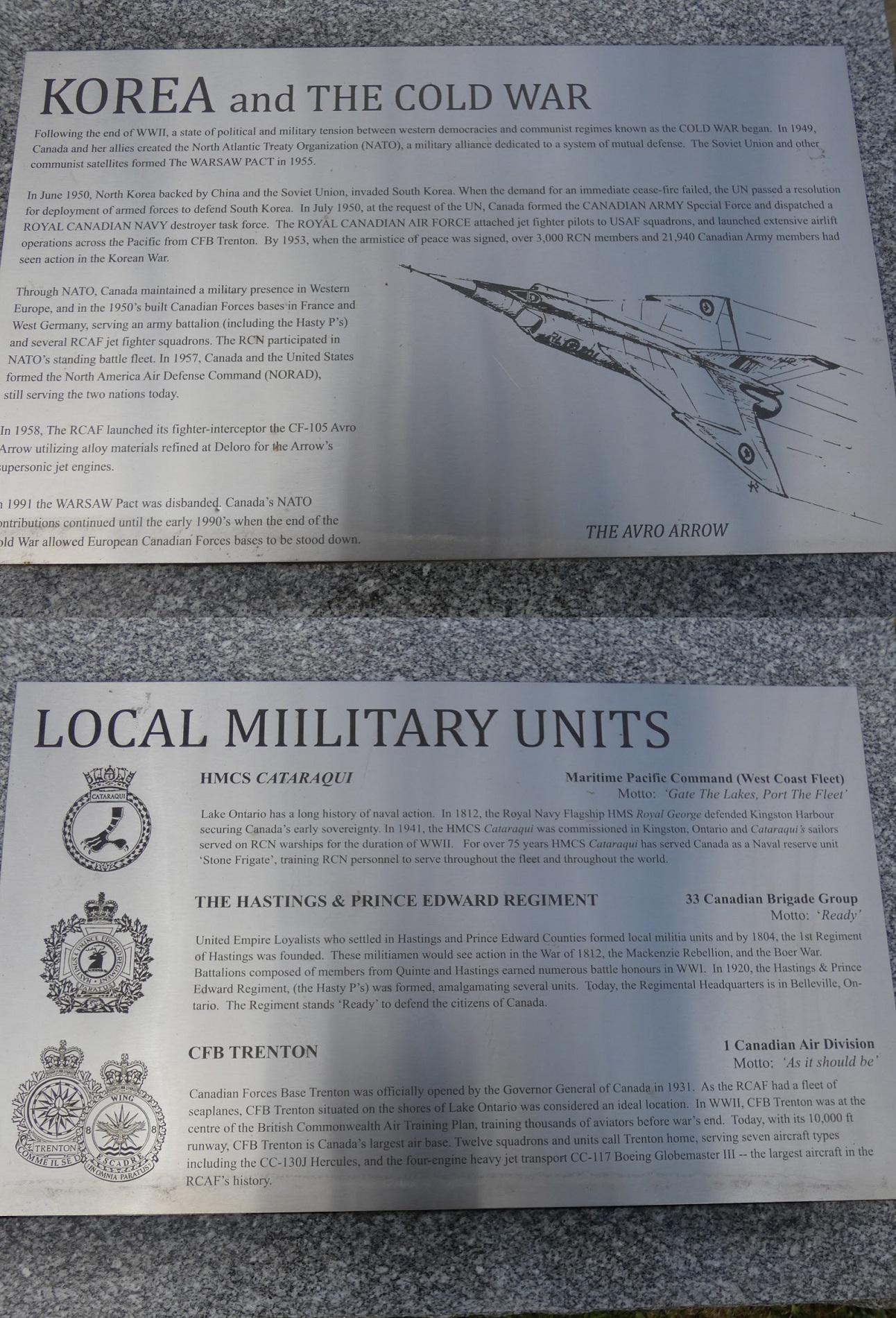
KOREA and THE COLD WAR
Following the end of WWII, a state of political and military tension between western democracies and communist regimes known as the COLD WAR began. In 1949, Canada and her allies created the North Atlantic Treaty Organization (NATO), a military alliance dedicated to a system of mutual defense. The Soviet Union and other communist satellites formed The WARSAW PACT in 1955.
In June 1950, North Korea backed by China and the Soviet Union, invaded South Korea. When the demand for an immediate cease-fire failed, the UN passed a resolution for deployment of armed forces to defend South Korea. In July 1950, at the request of the UN, Canada formed the CANADIAN ARMY Special Force and dispatched a ROYAL CANADIAN NAVY destroyer task force. The ROYAL CANADIAN AIR FORCE attached jet fighter pilots to USAF squadrons, and launched extensive airlift operations from CFB Trenton across the Pacific. By 1953, when the armistice of peace was signed, over 3,000 RCN members and 21,940 Canadian Army members had seen action in the Korean War.
Through NATO, Canada maintained a military presence in Western Europe, and in the 1950’s built Canadian Forces bases in France and West Germany, serving an army battalion (including the Hasty P’s) and several RCAF jet fighter squadrons. The RCN participated in NATO’s standing battle fleet. In 1957, Canada and the United States formed the North America Air Defense Command (NORAD), still serving the two nations today.
In 1958, The RCAF launched its fighter-interceptor the CF-105 Avro Arrow utilizing alloy materials refined at Deloro for the Arrow’s supersonic jet engines.
In 1991 the WARSAW Pact was disbanded. Canada’s NATO contributions continued until the early 1990’s when the end of the Cold War allowed European Canadian Forces bases to be stood down.
[plaque]
LOCAL MIILITARY UNITS
HMCS CATARAQUI Maritime Pacific Command (West Coast Fleet)
Motto: ‘Gate The Lakes, Port The Fleet’
Lake Ontario has a long history of naval action. In 1812, the Royal Navy Flagship HMS Royal George defended Kingston Harbour securing Canada’s early sovereignty. In 1941, the HMCS Cataraqui was commissioned in Kingston, Ontario and Cataraqui’s sailors served on RCN warships for the duration of WWII. For over 75 years HMCS Cataraqui has served Canada as a Naval reserve unit ‘Stone Frigate’, training RCN personnel to serve throughout the fleet and throughout the world.
THE HASTINGS & PRINCE EDWARD REGIMENT 33 Canadian Brigade Group
Motto: ‘Ready’
United Empire Loyalists who settled in Hastings and Prince Edward Counties formed local militia units and by 1804 the 1st Regiment of Hastings was founded. These militiamen would see action in the War of 1812, the Mackenzie Rebellion, and the Boer War. Battalions composed of members from Quinte and Hastings earned numerous battle honours in WWI. In 1920, the Hastings & Prince Edward Regiment, (the Hasty P’s) was formed, amalgamating several units. Today, the Regimental Headquarters is in Belleville, Ontario. The Regiment stands ‘Ready’ to defend the citizens of Canada.
CFB TRENTON 1 Canadian Air Division
Motto: ‘As it should be’
Canadian Forces Base Trenton was officially opened by the Governor General of Canada in 1931. As the RCAF had a fleet of seaplanes CFB Trenton situated on the shores of Lake Ontario was considered an ideal location. In WWII, CFB Trenton was at the centre of the British Commonwealth Air Training Plan, training thousands of aviators before war’s end. Today, with its 10,000 ft runway, CFB Trenton is Canada’s largest air base. Twelve squadrons and units call Trenton home, serving seven aircraft types including the CC-130J Hercules,Canadian Forces Base Trenton was officially opened by the Governor General of Canada in 1931. As the RCAF had a fleet of seaplanes CFB Trenton situated on the shores of Lake Ontario was considered an ideal location. In WWII, CFB Trenton was at the centre of the British Commonwealth Air Training Plan, training thousands of aviators before war’s end. Today, with its 10,000 ft runway, CFB Trenton is Canada’s largest air base. Twelve squadrons and units call Trenton home, serving seven aircraft types including the CC-130J Hercules, and the four-engine heavy jet transport CC-117 Boeing Globemaster III -- the largest aircraft in the RCAFs history.
[plaque]
THE DELORO MINE
The Deloro Mine contributed in significant ways to Allied Forces’ successes in WWI and WWII. The Stellite from the Deloro Mine was utilized for munitions, ammunition, tanks, aircraft, precision instruments and medical equipment in both world wars. In WWI, Deloro residents contributed to the war effort by both working in the Mine and enlisting. Many of Deloro’s finest young men joined the Royal Navy, the Royal Flying Corps, and local military units, which would later become the Hastings & Prince Edward Regiment.
With the commencement of WWII in 1939, The Deloro Mine was awarded the contract to provided the Stellite needed to build the Spitfire fighter, an airplane which was instrumental to Allied air campaigns against the Nazis in Europe. Many Deloro Mine workers joined up and fought for Canada as soldiers, seamen and airmen. They distinguished themselves and contributed to our successes overseas including helping to liberate Italy and Holland. Deloro women also joined up and served in the Canada’s Armed Forces.
Meanwhile, Deloro Mine workers and their families also contributed to the war effort in many ways collecting monies for the Deloro War Fund, selling War Savings Stamps and sending care packages, quilts, bandages and cigarettes.
In 1943, when Hitler cut off access to cobalt refineries in Belgium, the Allied Forces had nowhere to refine their high-grade cobalt. Without cobalt, the Allies couldn’t produce the materials they needed to win the war. That’s when Deloro proved its mettle. A few swift upgrades to the Deloro Mine made it ready for the high-grade cobalt, and with time running out and Hitler’s forces advancing every day it seemed like the fate of the Allies rested on the shoulders of this tiny village as once again it was rallied to the war effort – this time to refine the Allied cobalt. The biggest push for the Deloro Mine came in 1944 with lead-up to D-Day when a massive amount of cobalt was refined to produce over 450,000 tonnes of munitions needed for the assault on Normandy and Juno Beach. And with it Canadian Armed Forces and the Allies fought spectacularly to push back Hitler and the Nazis and eventually win the Second World War.
Deloro Mine Workers suffered significant health problems due to the toxic elements to which they were exposed during the mining and refining process. In many ways, their sacrifice was similarly heroic to the soldiers who fought for our freedom. We remember their contributions and honour them through this Memorial.
[plaque]
ABOUT THE DELORO MEMORIAL
Dedicated October 24, 2015
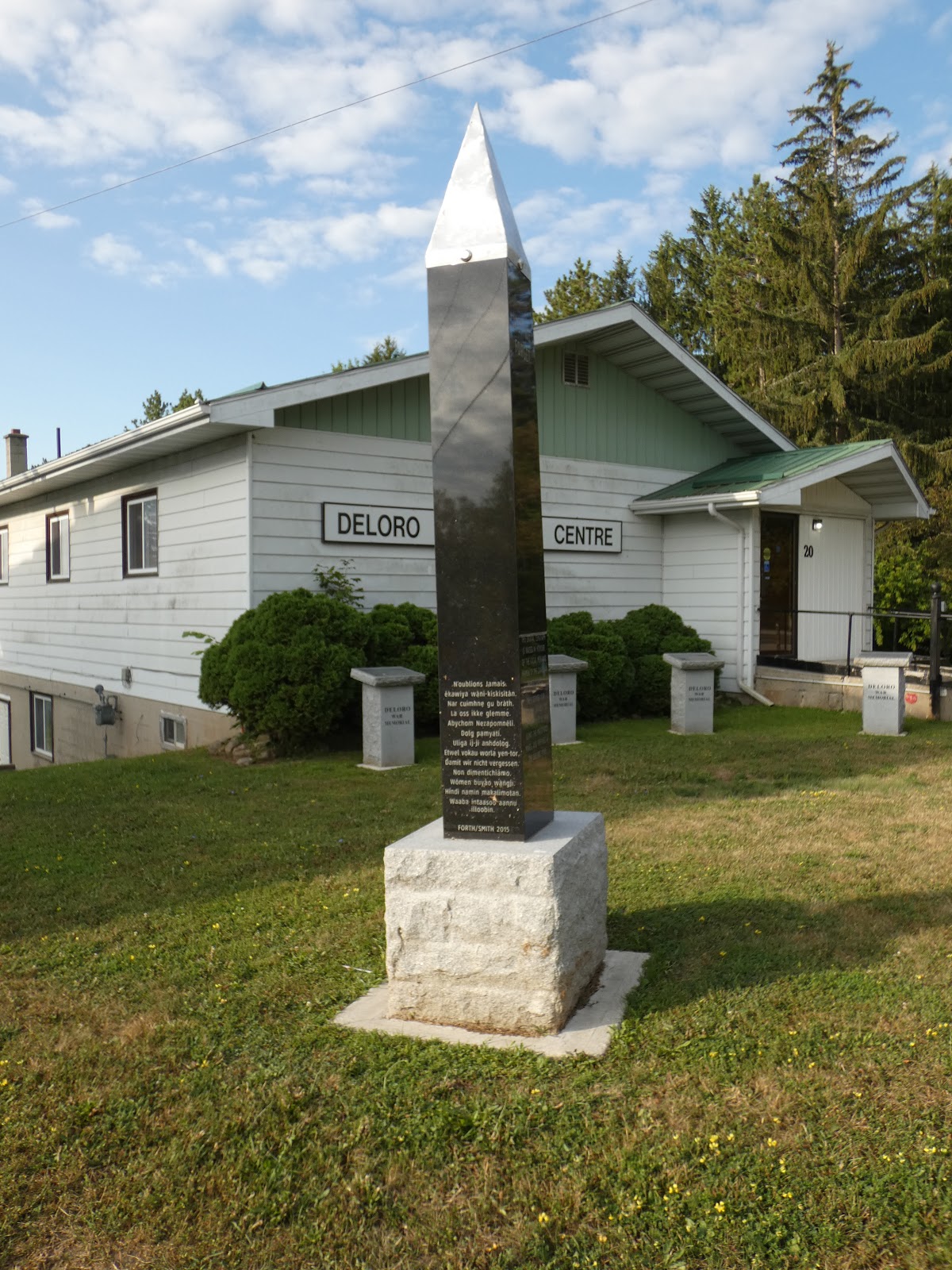
The Deloro Memorial Cenotaph is a three metre high obelisk crafted from black granite by Lons Memorials. The one-of-a-kin digital cenotaph is embedded with a QR code that can be scanned by a smartphone or other digital devices to access the online historical tribute film entitled LEST WE FORGET.
The LEST WE FORGET video was created through the participation of CAF service members from the Hastings & Prince Edward Regiment, 8 Wing/CFB Trenton and the Royal Canadian Navy. Local Deloro residents also participated both on-screen and behind the scenes. The video was filmed at location in the Village of Deloro, the Hastings & Prince Edward Regiment Armouries (Belleville). The National Air Force Museum of Canada (Trenton) and the Marine Museum of the Great Lakes in Kingston.
The Deloro Memorial was conceived and managed by Laura J. Forth and James Aubrey Smith. As Deloro residents they aspired to honour the significance role that Deloro and the Deloro Mine played in history, and also help to herald-in a new era of Deloro rejuvenation and community pride.
Although the mining and refining that occurred in Deloro left a terrible environmental devastation on the land, the Deloro Mine was crucial to the Allied war effort and ensured that Canadians enjoy the freedom that we do today.
Thanks to the Ministry of the Environment and Climate Change, TERVITA, QUANTUM MURRAY, the Ontario Clean Water Agency, McIntosh Perry, Peak Engineering, AECON, RadSafe and other environmental and rehabilitation experts, the Deloro Mine is being cleaned up and rehabilitated. Old tailings ponds, contaminated slag and other hazardous materials have been contained in state-of-the-art receptacles. Local water sources have been rejuvenated and fish and other wildlife are being protected. The Deloro Mine cleanup and rehabilitation means that the Village of Deloro can now look forward to a clean, healthy and proud future.