
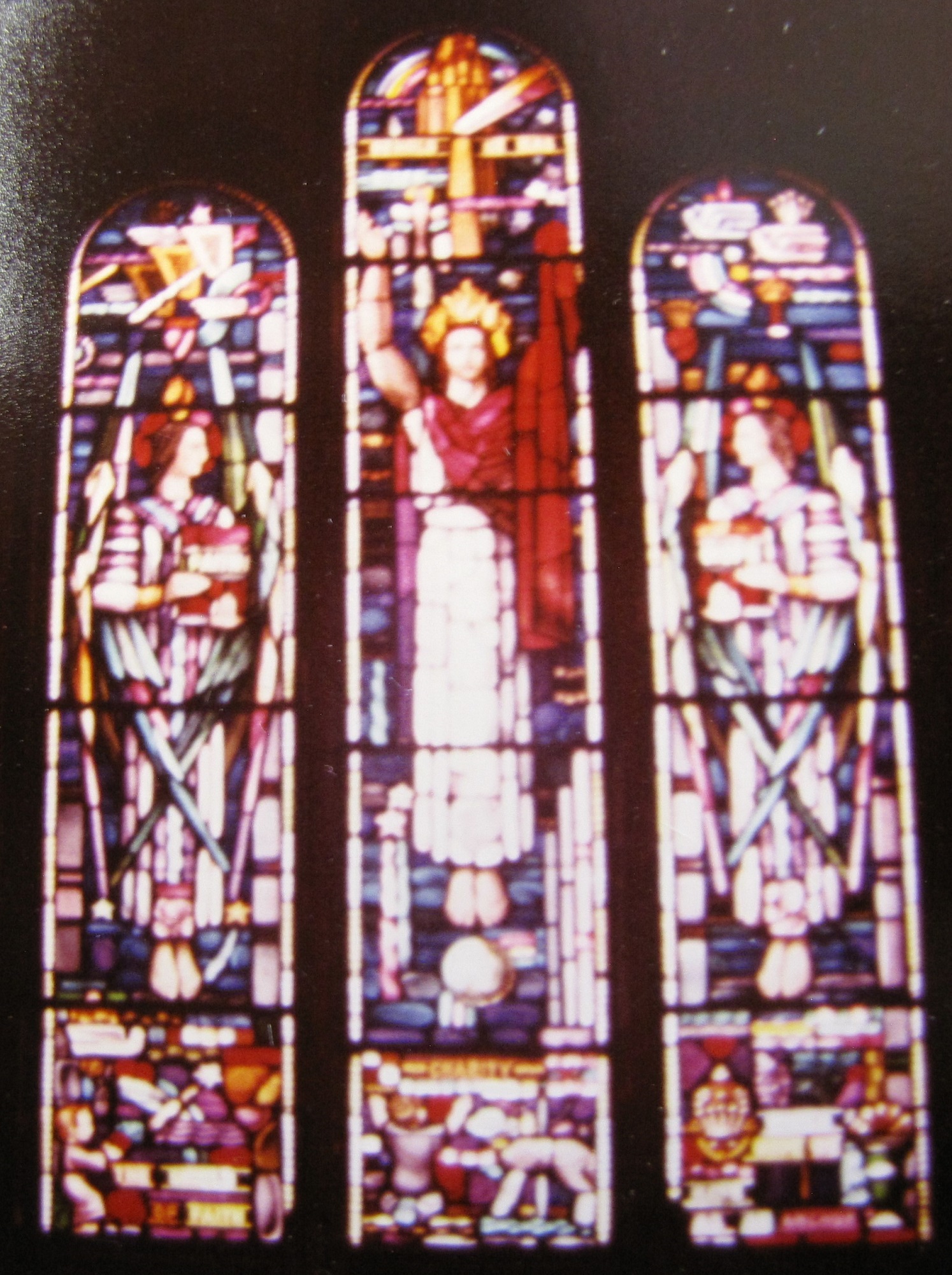
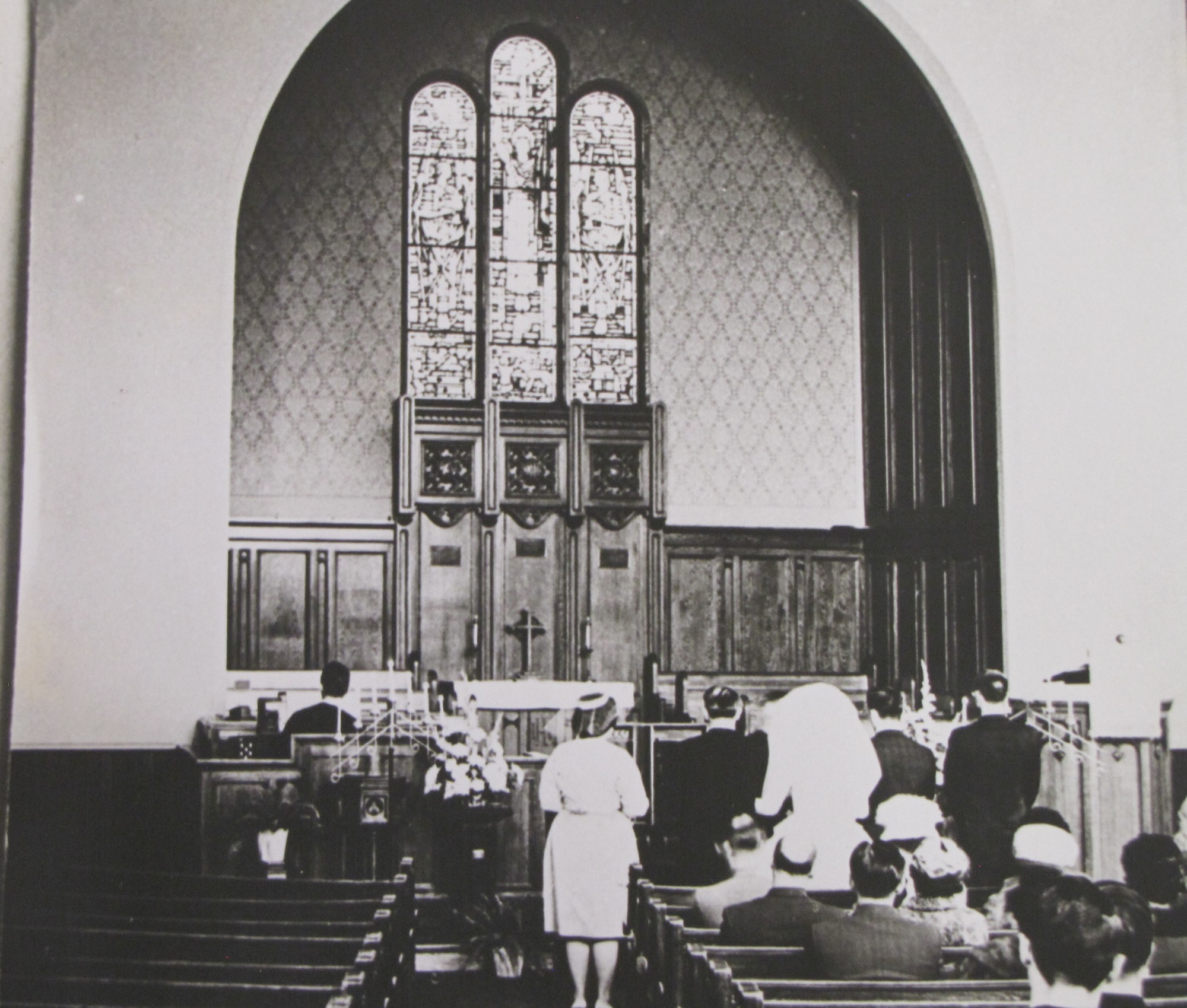
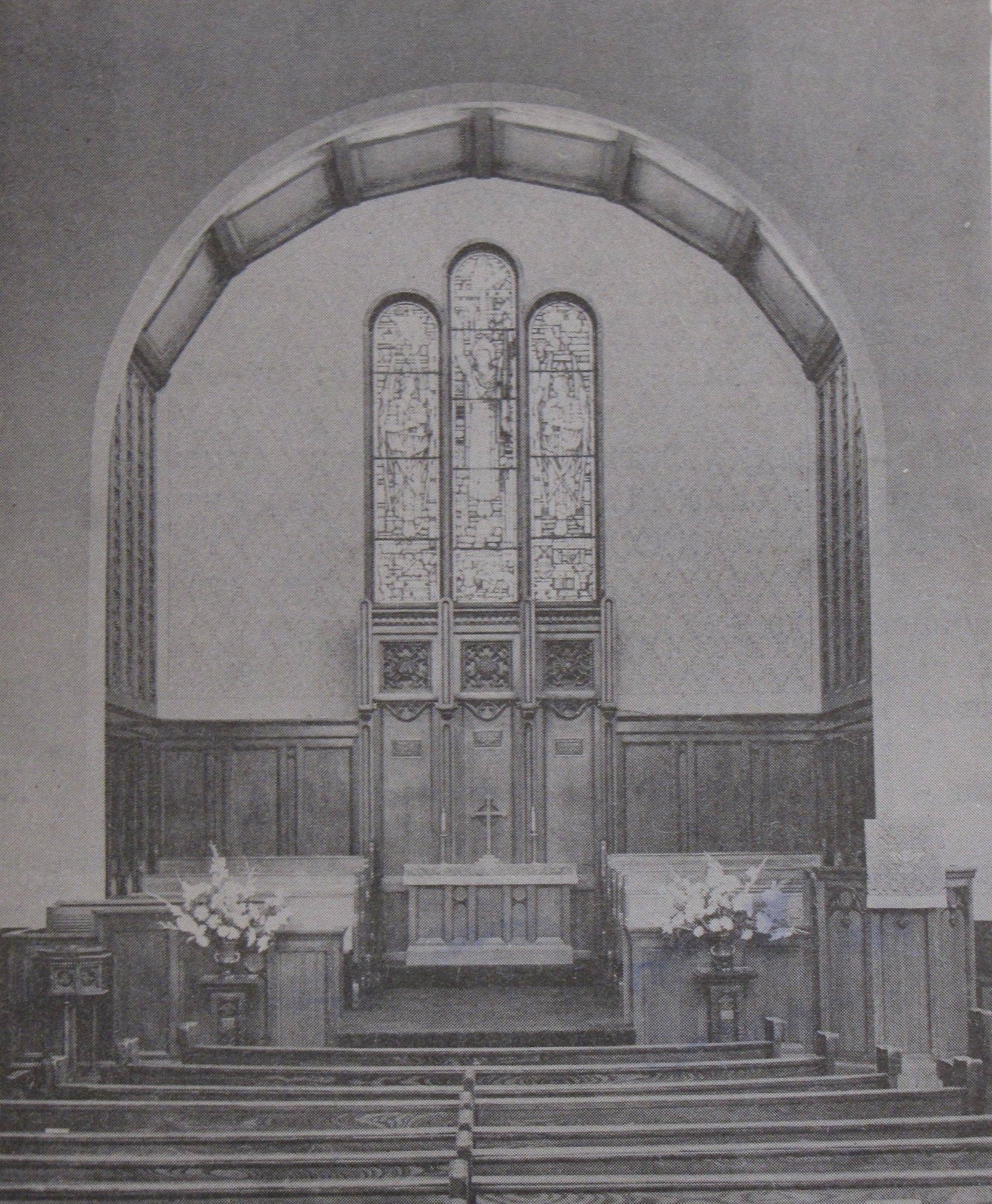
A set of three memorial windows designed by Peter Haworth, a Toronto stained glass artist, were dedicated in St. Paul's United Church (formerly St. Paul's Presbyterian Church) on Sunday, October 10, 1948. The window set was donated with funds raised by the congregation in memory of the nine men from the church who died while serving in the Second World War. The congregation joined the United Church in 1925 and became St. Paul's United Church. The windows were destroyed in a fire that razed the church on Sunday, August 11, 1963.
The center window depicts the ascension of Jesus Christ and his embodiment as love. The theme of the set, Faith, Hope and Charity, was inspired by 1 Corinthians, Chapter 13, verse 13. Christ, who embodies the supreme Christian virtue of Charity, or Love, the one power that will win the world for peace so that wars may finally end. The window is a tribute to the nine men who fulfilled Christ's words: "Greater love hath no man than this, that a man lay down his life for his friends." (John, Chapter 15, verse 13).
The left window depicts the Angel of Faith and was donated in memory of Flying Officer Wallace “Wally” Lang. After the fire, his brother, Don Lang, searched through the rubble and located the bronze plaque that was mounted on the wall underneath this window donated in memory of his brother. This plaque is still in possession of the Lang family.
The right window depicts the Angel of Hope and was donated in memory of Oiler Ross Edward Stevens.
Three Second World War plaques were located below the stained glass windows. Two of the three plaques were recovered in the rubble of the burned out remains of the church after a fire on Sunday, August 11, 1963. The Second World War Window Plaque and the Second World War Chancel Plaque are located at the Lambton Heritage Museum in Grand Bend.
Artist Peter Haworth was born in 1889 in Oswaldtwistle, Lancashire, England. During the First World War he served in the Royal Flying Corps and won the Distinguished Flying Cross. After the war, he studied at the Royal College of Art in London and specialized in stained glass at an early stage in his career. In 1923, the Haworths immigrated to Canada, where Peter was appointed Director of Art at the Central Technical School in Toronto. While teaching Peter Haworth also accepted commissions to undertake stained glass work. After the outbreak of the Second World War he was commissioned by the Government of Canada to record the activities of the armed forces on the coast of British Columbia.