
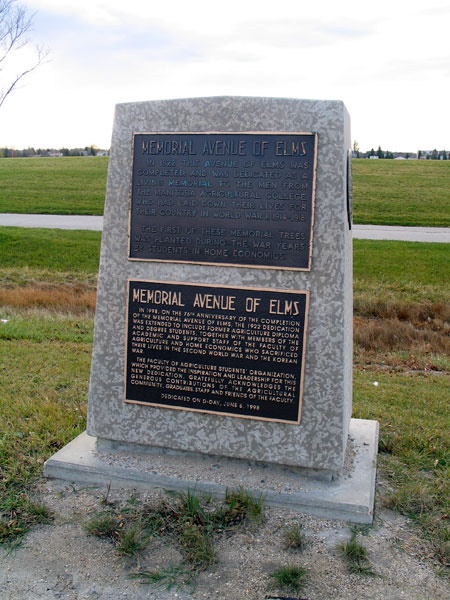
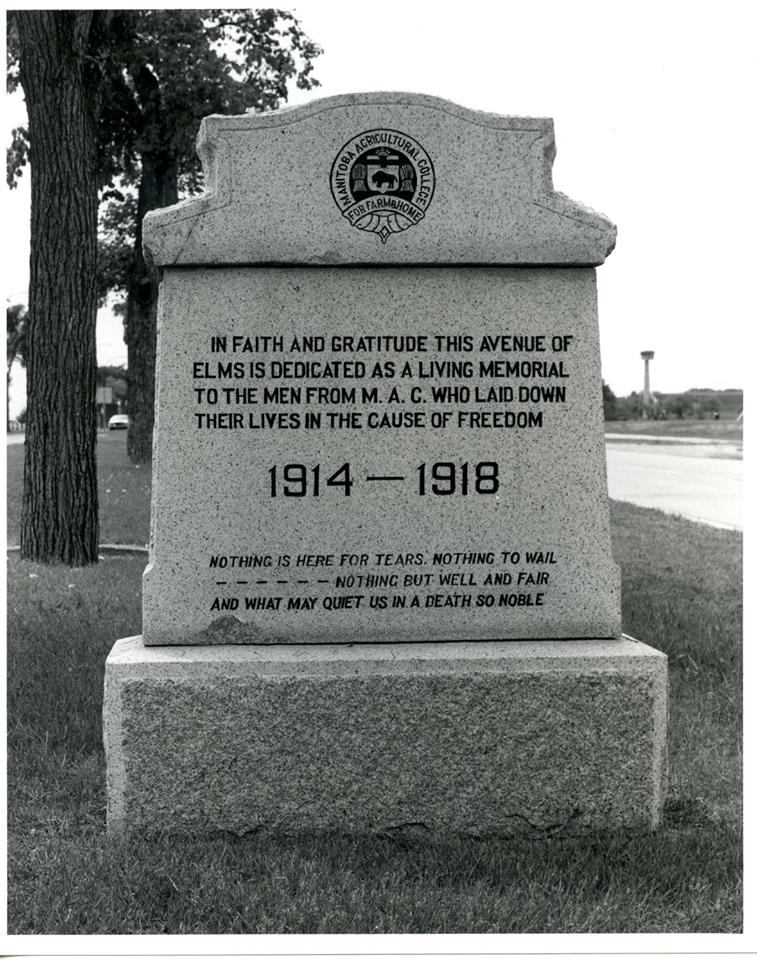
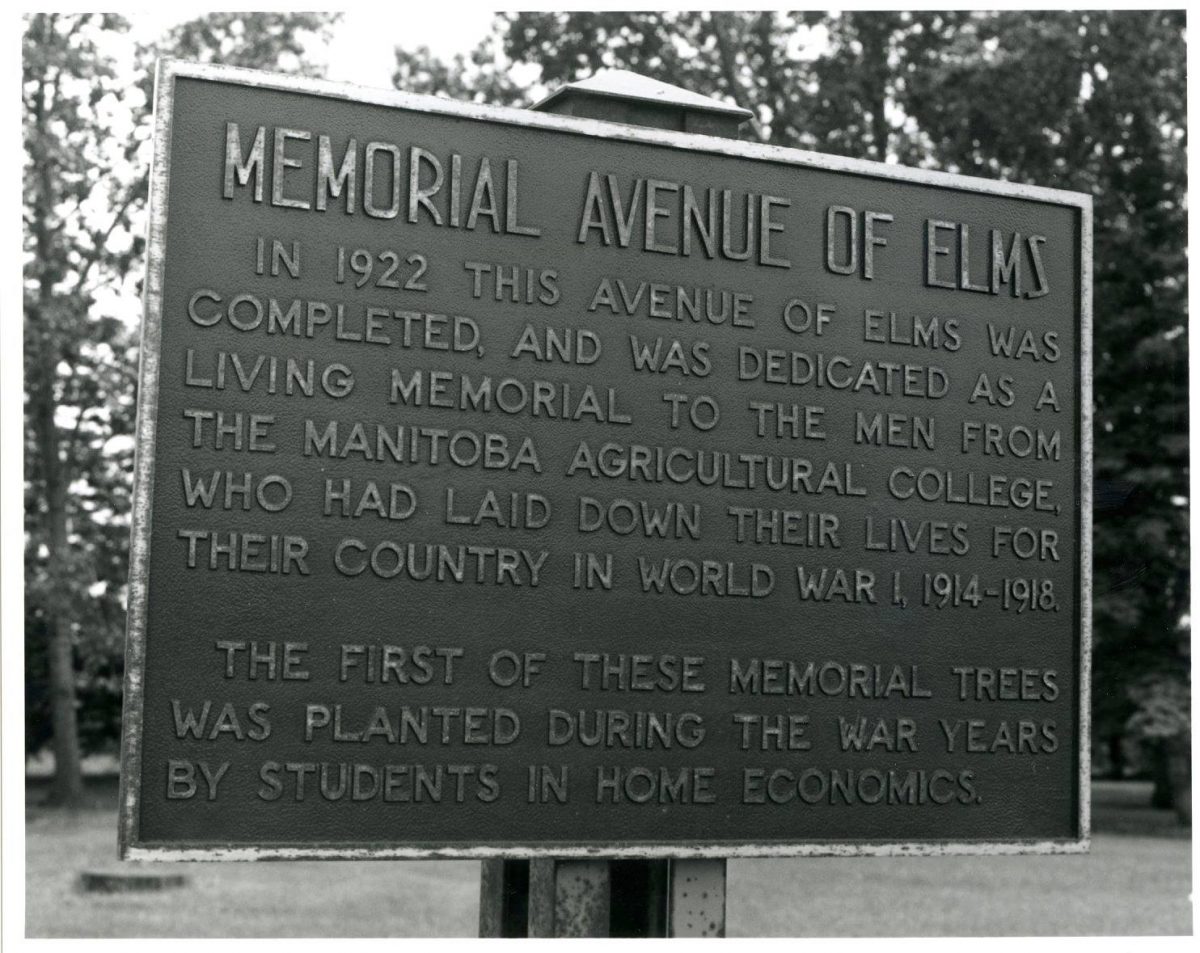
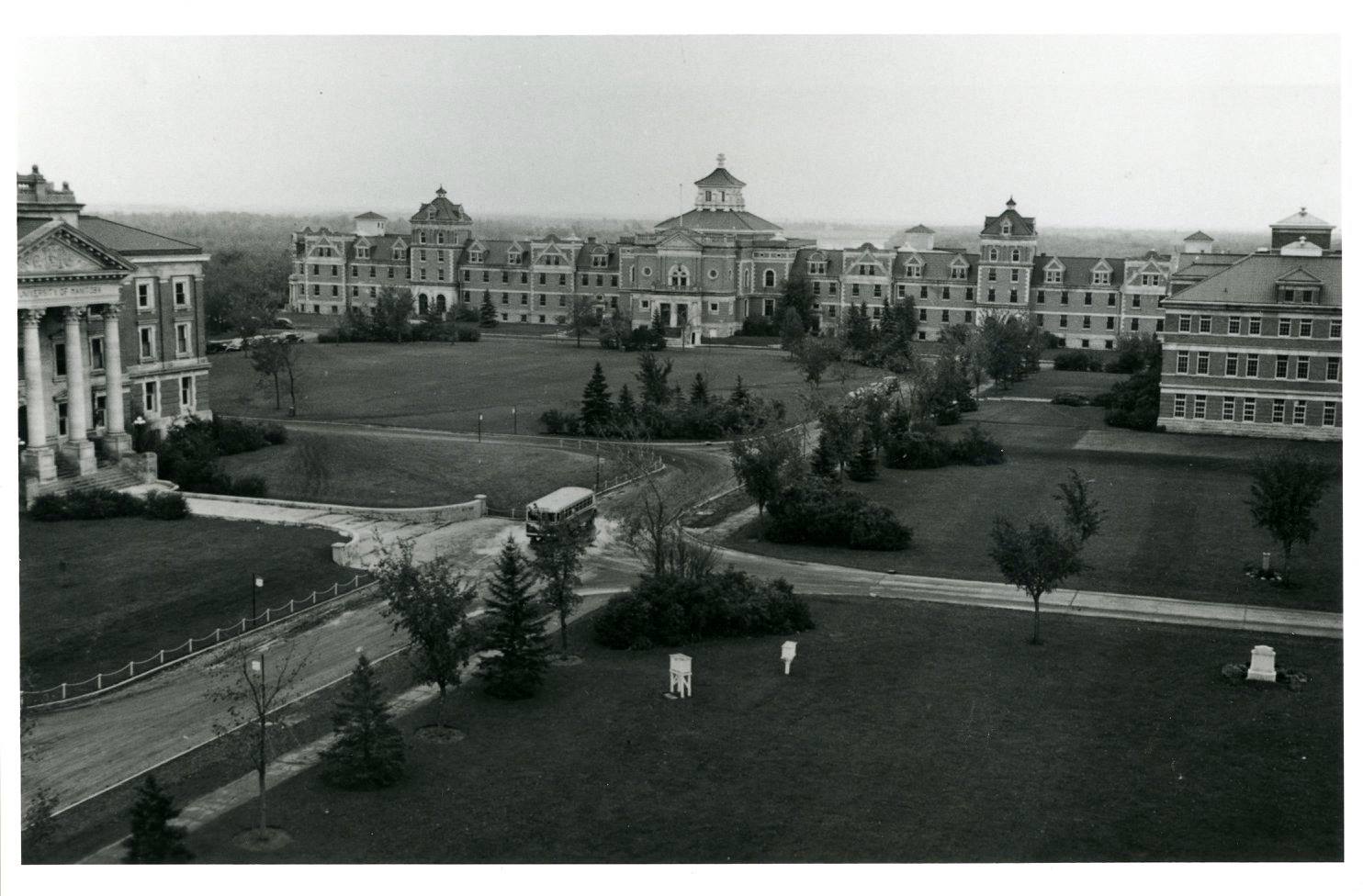
The Avenue of Elms commemorates students and staff of the Manitoba Agricultural College who were killed during military service in the First World War. The first elm trees were planted during the First World War by Home Economic students. Two hundred American saplings, proceeding from the Manitoba Agricultural College (now University of Manitoba) Administration Building to Pembina Highway, were planted on May 14, 1922, by teams comprised of graduates, staff, and students of the college and also staff from the Provincial Agricultural Department.
A monument for the Avenue of Elms was unveiled at a ceremony held on 11 November 1923, attended by 500 people including Hugh Marshall Dyer (former Chair of the Board of Directors for the Manitoba Agricultural College), Louis Wilfred Moffit of Wesley College, and Premier John Bracken.
A dozen trees were moved to the campus quadrangle in 1969. Many have since been removed to slow the spread of Dutch elm disease. Today, 55 percent of the trees are replacements (80 percent on the north side of the avenue).
On 6 June 1998, the 1922 dedication was extended to include more former students and faculty who were killed during the Second World War and the Korean War with the addition of a second plaque at Chancellor Matheson Road from Pembina Highway.
In 1918, Canadians turned to the duty of commemorating the dead. Some promoted practical memorials like Roads of Remembrance. These linear tree-lined avenues had trees that were typically a single species, regularly spaced along each side of the avenue that would grow tall and stately. American elms were chosen for many of these avenues. A small plaque was used to assign a particular tree to a specific fallen soldier. In some cases, the next-of-kin was involved in purchasing the tree and/or plaque for the deceased soldier.
Roads of Remembrance were based on two symbol-laden images. The first was France’s tree-lined country avenues: “long straight roads, with large elms on either side, beautiful and useful, and loved by the Canadians overseas.” The second symbol was a living memorial: trees represented the victory of life over death. Memorial trees became living symbols of the sacrifices made overseas.