
Conestoga Street

Edmonton, Alberta
Type
Other

Conestoga Street was dedicated to all the women who served at HMCS Conestoga by the Canada Lands Company on January 16, 2008, as part of their redevelopment of Edmonton’s former Canadian Forces Base (Griesbach Barracks).

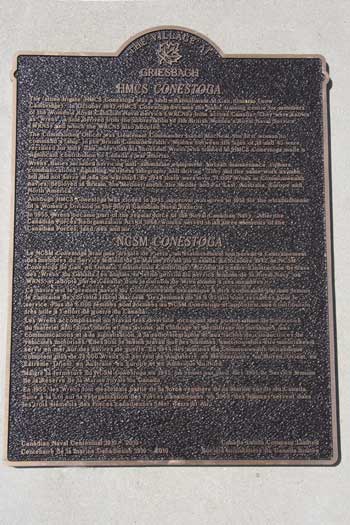
Formerly Bytown II, HMCS Conestoga was the basic training establishment for the Women's Royal Canadian Naval Service. It was established for the duration of the Second World War on 31 July 1942 at Galt, Ontario. The establishment of the Women's Royal Canadian Naval Service was the first time that women served in the Canadian Navy in any capacity other than nursing. Their officers were the first women in the Empire and Commonwealth to carry the King’s Commission in naval service, holding the same ranks and entitled to the same salutes and marks of respect as male officers. They were subject to much more stringent standards of conduct than their male peers, expected to remain feminine with exemplary conduct. For example, pregnancy was a dismissible offence.

The Commanding Officer was Lieutenant Commander Isabel Macneill, the first woman to command a ship in the British Commonwealth. More than six thousand trained at HMCS Conestoga. They made a significant contribution to Canada's war efforts, servicing anti-submarine equipment, aircraft maintenance, ciphers, communications, signaling, wireless telegraphy and driving. 

HMCS Conestoga was paid off on 31 March 1945, and the Women's Royal Canadian Naval Service was disbanded in August 1946. An invitation was extended to join the Naval Reserve in 1951, something previously denied to women, and many took up the call.

The HMCS Conestoga plaque was unveiled on June 6, 2010.

Inscription

CONESTOGA ST

[plaque]

THE VILLAGE AT
GRIESBACH

HMCS CONESTOGA

The stone frigate HMCS Conestoga was a land establishment at Galt, Ontario (now
Cambridge). In October 1942, HMCS Conestoga became the basic training centre for members
of the Women's Royal Canadian Naval Service (WRCNS) from across Canada. They were known
as 'Wrens', a title derived form the abbreviation of the British Women's Royal Naval service
(WRNS) and which the WRCNS also adopted.
The Commanding Officer was Lieutenant commander Isabel MacNeill, the first woman to
command s 'ship' in the British Commonwealth. Women between the ages of 18 and 45 were
recruited for duty. The more than six thousand Wrens who trained at HMCS Conestoga made a
significant contribution to Canada's war efforts.
wrens' duties included servicing anti-submarine equipment, aircraft maintenance, ciphers,
communications, signalling, wireless telegraphy and driving. They did the same work as men, but did not serve at sea on warships. by 1944 there were over 74,000 Wrens in Commonwealth
navies, deployed in Britain, the Mediterranean, the Middle and Far East, Australia, Europe and
North America.
Although MMCS Conestoga was closed in 1945, approval was given in 1951 for the establishment
of a Women's Division in the Royal Canadian Naval Reserve.
In 1955, Wrens became part of the regular force of the royal Canadian Navy. after the
Canadian Forces Reorganization Act of 1968, women served in all three elements of the
Canadian Forces,; land, sea and air.

NCSM CONESTOGA

Le NCSM Conestoga était une frégate de Pierre`, un établissement que servait à l`entraînement
des membres du service féminin de la Marine royale du Canada. En octobre 1942, le NCSM
Conestoga de Galt, en Ontario (maintenant Cambridge), devient le centre d`instruction de base
des Wrens` du canada (en anglais, le terme provint du service féminin de la Royal Navy, ou
WRNS, et adopté par le Canada, d`où le surnom de Wren donné à ses membres)
Ce navire est le premier navire du Commonwealth britannique à être commandé par une femme,
le capitaine de corvette Isabel macneill. Des femmes de 18à 45 ans sont recrutées pour le
service. Plus de 6,000 femmes sont formées au NCSM Conestoga et apportent une contribution
très utile à l`effort de guerre du Canada.
Les Wrens accomplissent une travail très diversifié, occupant des postes allant de l`entretien
du matériel anti-sous-marin et des avions, au chiffrage et déchiffrage de messages, aux
communications et à la signalisation, à la radiotélégraphie et aux tâches de conductrices de véhicules motorisés. Elle font le même travail que les hommes, sans toutefois être autorisées à
sExtrême-Orient, en Australie, en Europe et en Amérique du Nord.
Malgré la fermeture du NCSM Conestoga en 1945, on remet sur pied, dès 1951, le Service féminin
de la Réserve de la Marine royale du Canada.
En 1955, les Wrens fort désormais partie de la force régulière de la Marine royale du Canada.
Suite à la Loi sur la réorganisation des forces canadiennes, en 1968, des femmes servent dans
les trois éléments des Forces canadiennes (Mer, Terre et Air).

Canadian Naval Centennial 1910-2010
Centenaire de la marine Canadienne 1910-2010

Canada Lands Company Limited
Société immobilière du Canada limitée

Location
Conestoga Street

Conestoga Street
Edmonton
Alberta
GPS Coordinates
Lat. 53.6009495
Long. -113.5079296

plaque

Don Stewart
1 of 2 images

surroundings

Don Stewart
1 of 2 images
Table of contents