
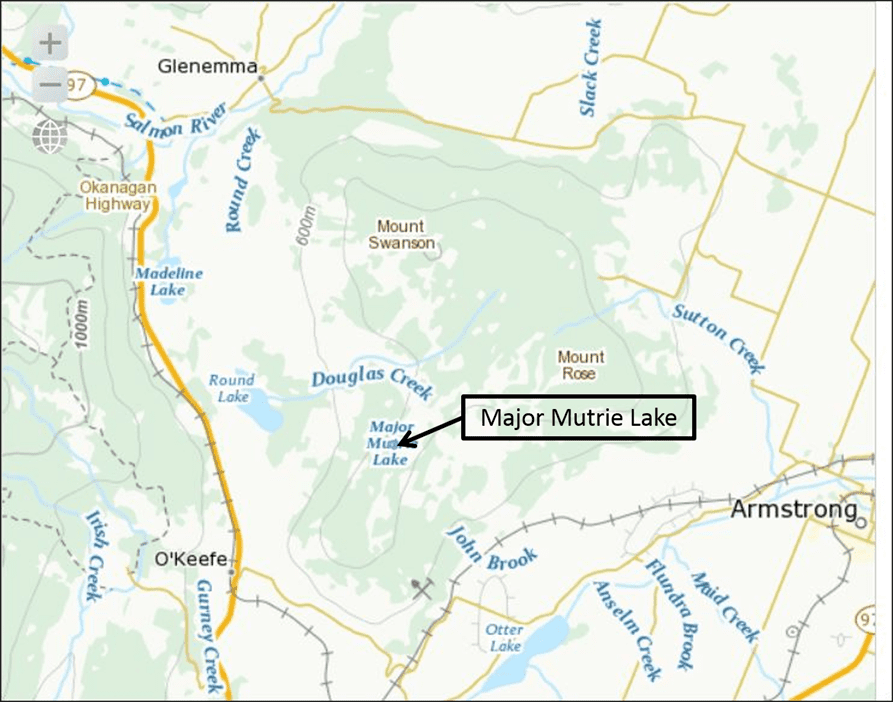
Major Mutrie Lake is named in honour of Major Robert John Mutrie. It was named by the Government of British Columbia on May 9, 1977.
Robert John Mutrie was born in April 1883 in Wellington County, Ontario to Col. John and Margaret (Dow) Mutrie. His father had served during the Fenian Raids, had risen through the ranks to command the 30th Wellington Rifles, and had occupied various civic positions in the county. Robert John Mutrie had also served with the 30th Wellington Rifles, joining the Regiment in 1909. In 1914, while working as a realtor in the Vernon area of British Columbia, he joined the 2nd Canadian mounted Rifles (British Columbia Regiment), eventually becoming the Second-in-Command of the Regiment. The 2nd CMR, along with the Canadian Corps (now 3 divisions) was moved into the Ypres salient in March 1916, to hold the line from Hooge to St. Eloi, including Hill 62, Observatory Ridge, and Mount Sorrel. On March 27, the British exploded 6 huge mines that they had been tunneling since August 1915. This marked the beginning of the battle of the St. Eloi craters. It was near the end of this battle that Major Robert Mutrie was killed by artillery fire on April 5, 1916. He is interred at Poperinghe New Military Cemetery in Belgium.