
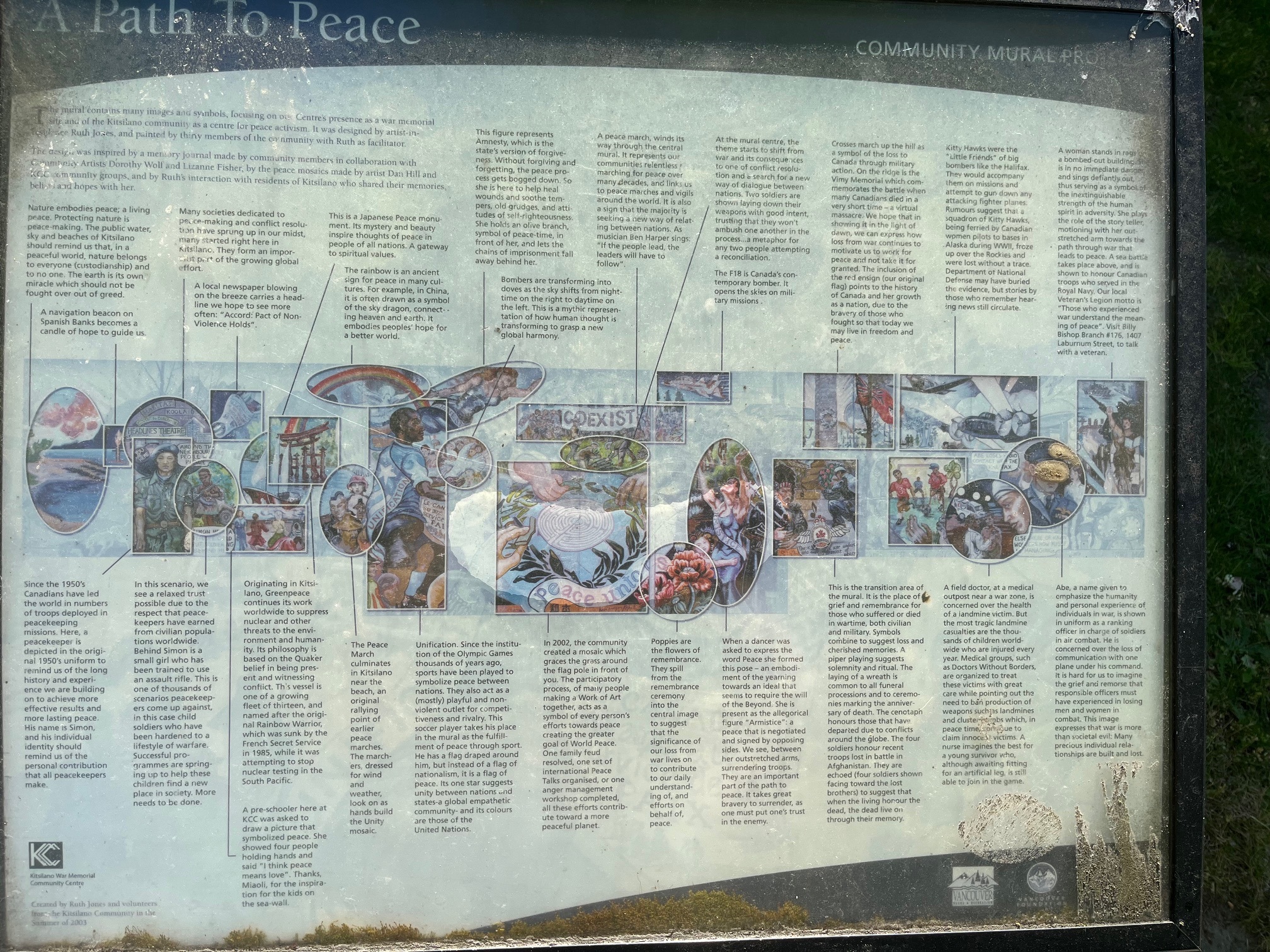
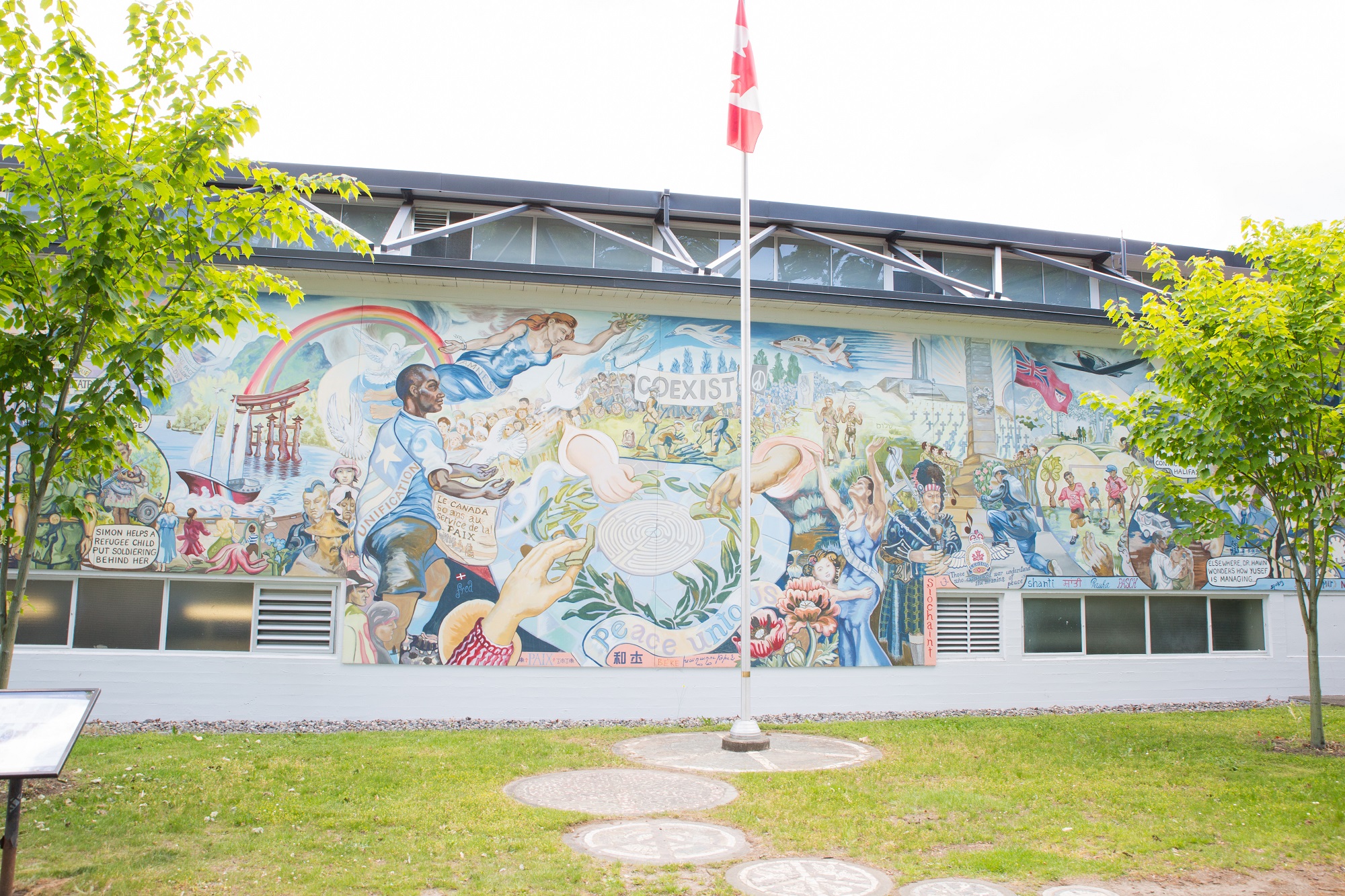
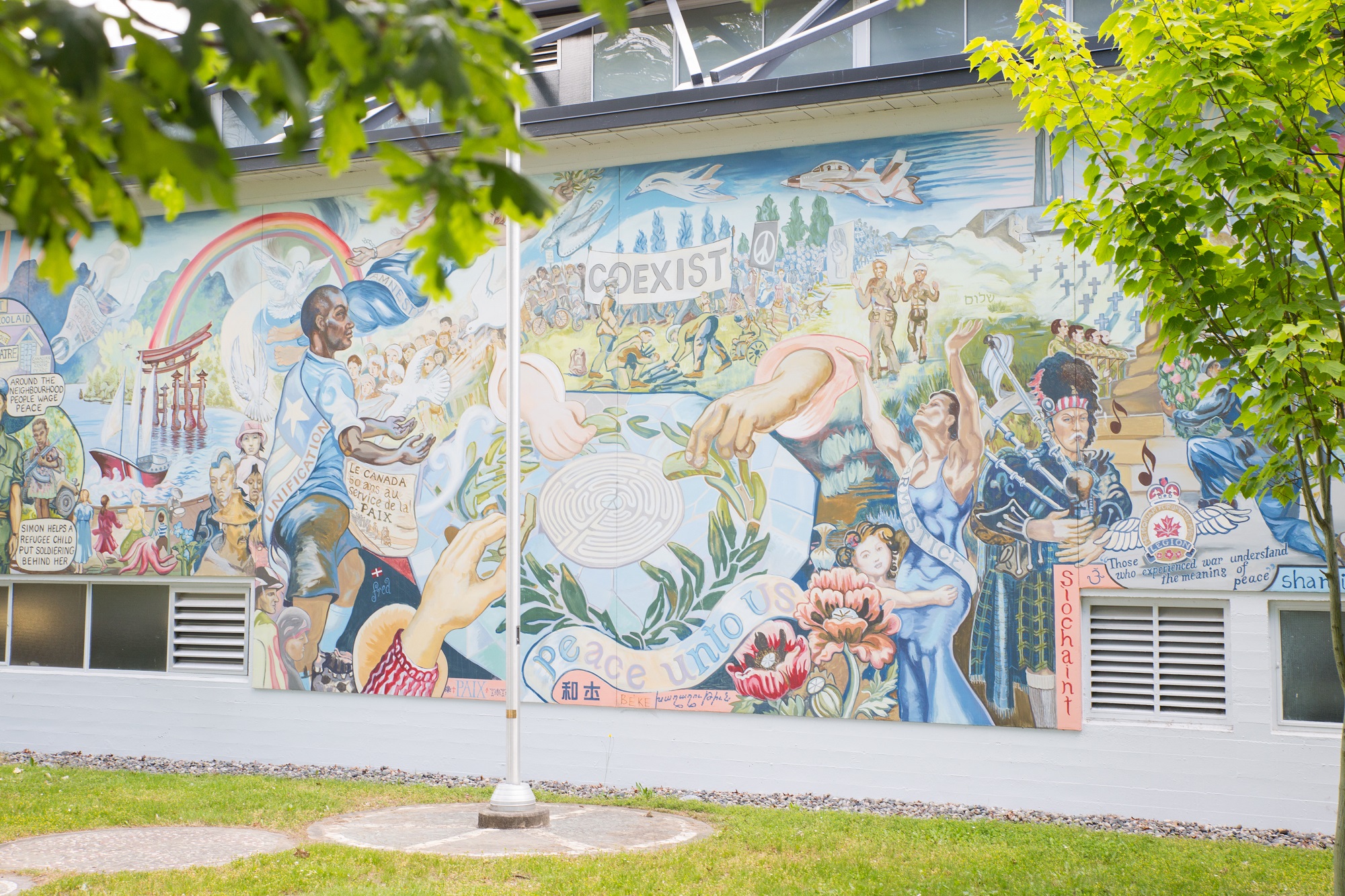
A Path to Peace was erected by Ruth Jones and volunteers from the Kitsilano Community in the summer of 2003. The mural contains many images and symbols, focusing on the Kitsilano War Memorial Community Centre's presence as a war memorial site and of the Kitsilano community as a centre for peace activism. It was designed by artist-in-residence Ruth Jones, and painted by thirty members of the community with Ruth as facilitator.
The design was inspired by a memory journal made by community members in collaboration with Community Artists Dorothy Wolf and Lizanne Fisher, by the peace mosaics made by artist Dan Hill and KCC community groups, and by Ruth's interaction with residents of Kitsilano who shared their memories, beliefs and hopes with her.
Images depicted in the mural are:
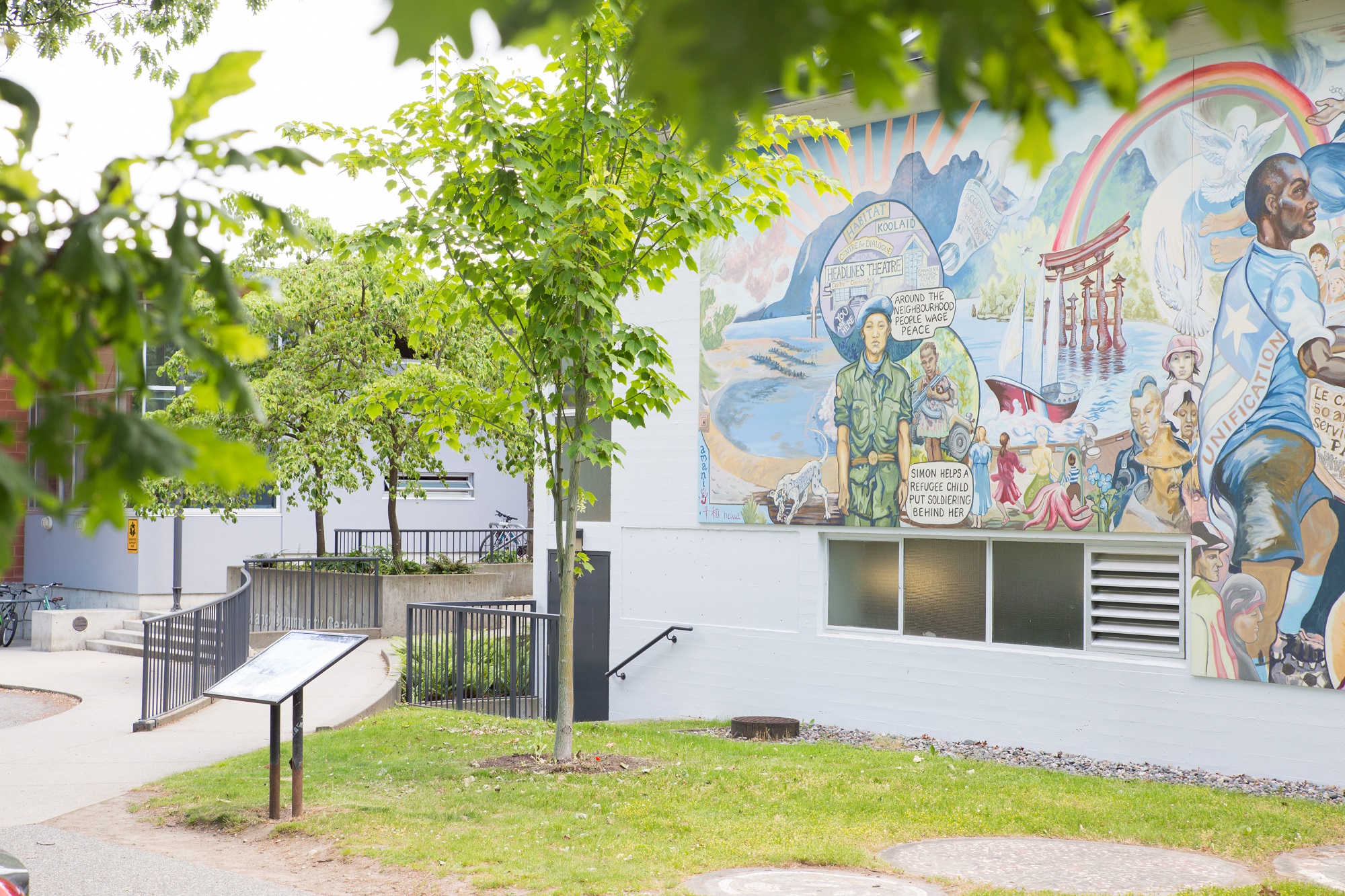
- The water, sky and beaches of Kitsilano remind us that, in a peaceful world, nature belongs to everyone (custodianship) and to no one. The earth is its own miracle which should not be fought over out of greed.
- A navigation beacon on Spanish Banks becomes a candle of hope to guide us.
- Images of Kitsilano buildings, many societies dedicated to peace-making and conflict resolution started right here in Kitsilano.
- A peacekeeper in the original 1950's uniform reminds us of the long history to achieve lasting peace. His name is Simon, and his individual identity reminds us of the personal contribution that all peacekeepers make.
- Behind Simon is a small girl who has been trained to use an assault rifle. This is one of thousands of scenarios peacekeepers come up against, in this case child soldiers who have been hardened to a lifestyle of warfare.
- A local newspaper blowing on breeze carries a headline: "Accord: Pact of Non-Violence Holds".
- A preschooler, Miaoli, inspired the image of kids on the sea-wall to symbolize peace.
- The Japanese Peace monument, its mystery and beauty inspire thoughts of peace in people of all nations. A gateway to spiritual values.
- The rainbow is an ancient sign for peace in many cultures.
- A Peace March in Kitsilano near the beach, an original rallying point of earlier peace marches. The marchers, dressed for wind and weather, look on as hands build the Unity mosaic.
- The soccer player fulfills peace through sport. He has a flag of peace draped around him. Its one star suggests unity between nations and states — a global empathetic community — and its colours are those of the United Nations.
- A figure represents Amnesty, which is the state's version of forgiveness. She holds an olive branch, symbol of peace-time, in front of her, and lets the chains of imprisonment fall away behind her.
- Bombers are transforming into doves as the sky shifts from night time on the right to daytime on the left. This is a mythic representation of how human thought is transforming to grasp a new global harmony.
- A peace march, winds its way through the central mural. It represents our communities relentless marching for peace over many decades, and links us to peace marches and vigils around the world. It is also a sign that the majority is seeking a new way of relating between nations. As musician Ben Harper sings: "If the people lead, the leaders will have to follow".
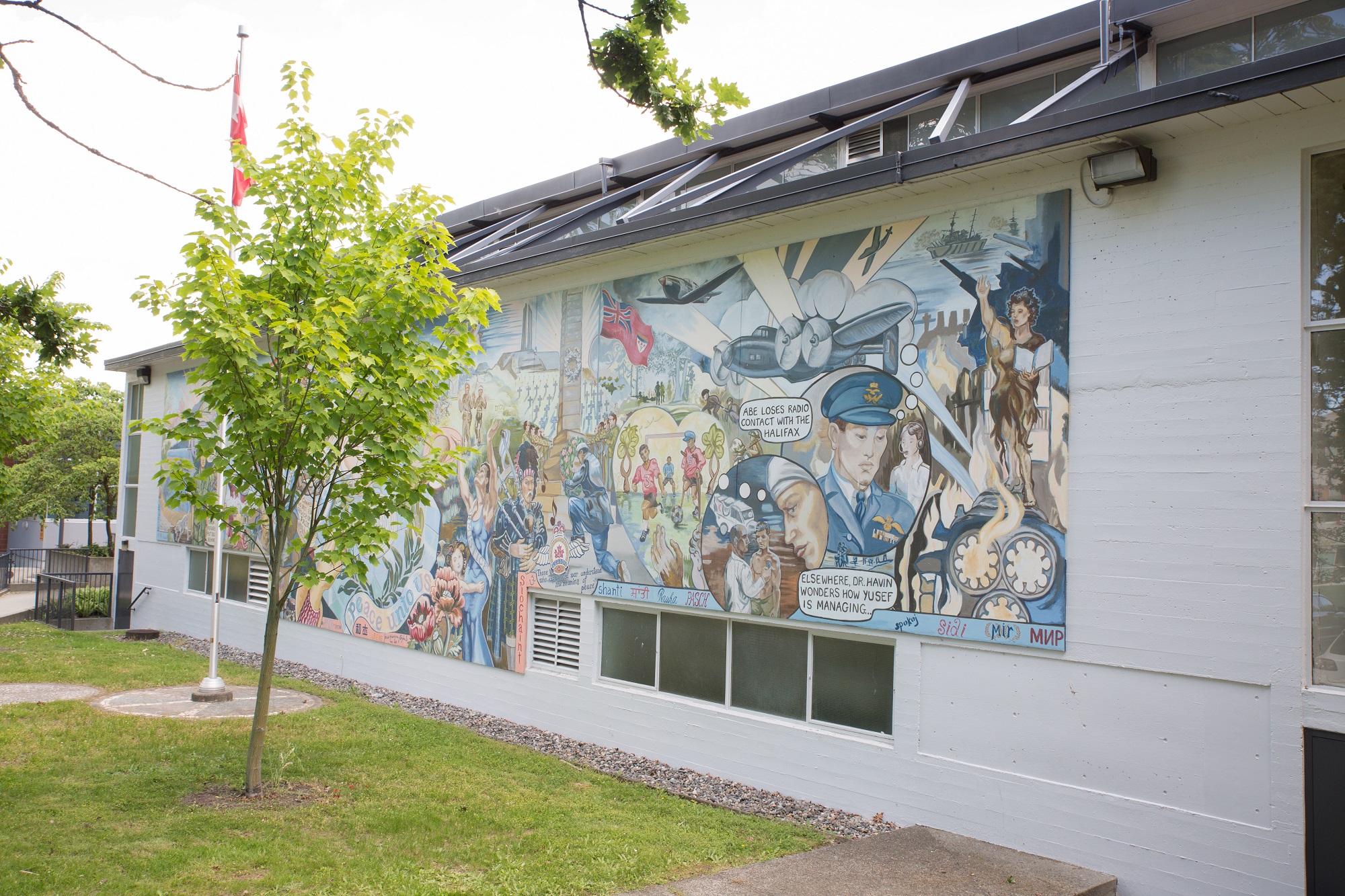
- At the mural center, the theme starts to shift from war and it consequences to one of conflict resolution and a search for a new way of dialogue between nations. Two soldiers are shown laying down their weapons with good intent, trusting that they won't ambush one another in the process... a metaphor for any two people attempting a reconciliation.
- In 2002, the community created a mosaic around the flag pole. The participatory process, of many people making a Work of Art together, acts as a symbol of every person's efforts towards peace creating the greater goal of World Peace.
- Poppies are the flowers of remembrance.
- The F18 is Canada's contemporary bomber. It opens the skies on military missions.
- A dancer inspired the allegorical figure "Armistice": a peace that is negotiated and signed by opposing sides. Surrendering troops are between her outstretched arms. It takes great bravery to surrender, as one must put one's trust in the enemy.
- Crosses march up the hill, as a symbol of the loss of Canada through military action, to the Vimy National Memorial. The red ensign (our original flag) points to the history of Canada and her growth as a nation, due to the bravery of those who fought so that today we may live in freedom and peace.
- Symbols combine to suggest loss and cherished memories. A piper playing suggest solemnity and ritual. The laying of a wreath is common to all funeral processions and to ceremonies marking the anniversary of death. The cenotaph honours those that have departed due to conflicts around the globe. The four soldiers honour recent troops lost in battle in Afghanistan. They are echoed (four soldiers shown facing toward the lost brothers) to suggest that when the living honour the dead, the dead live on through their memory.
- A field doctor, at a medical outpost near a war zone, is concerned over the health of a landmine victim. A nurse imagines the best for a young survivor who, although awaiting fitting for an artificial leg, is still able to join in the soccer game.
- Kitty Hawks were the "Little Friends" of big bombers like the Halifax. They would accompany them on missions and attempt to gun down any attacking fighter planes.
- A ranking officer, shown in uniform in charge of soldiers in air combat, is concerned over the loss of communication with one plane under his command.
- A woman stands in rags on a bombed-out building and sings defiantly out, thus serving as a symbol of the inextinguishable strength of the human spirit in adversity. She plays the role of the story teller, motioning with her outstretched arm towards the path through war that leads to peace. A sea battle takes place above, and is shown to honour Canadian troops who served in the Royal Navy.