
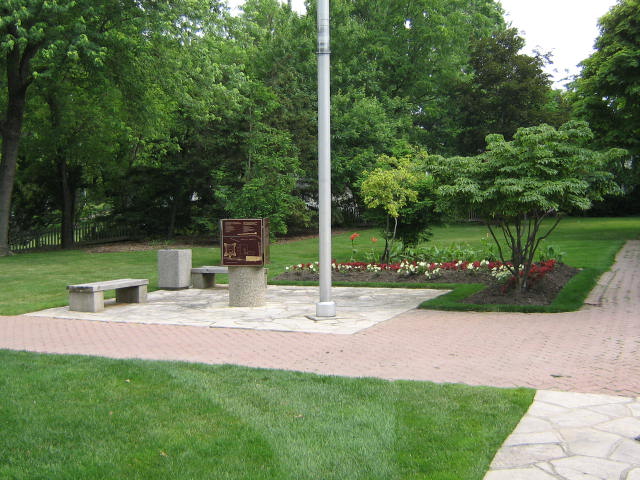
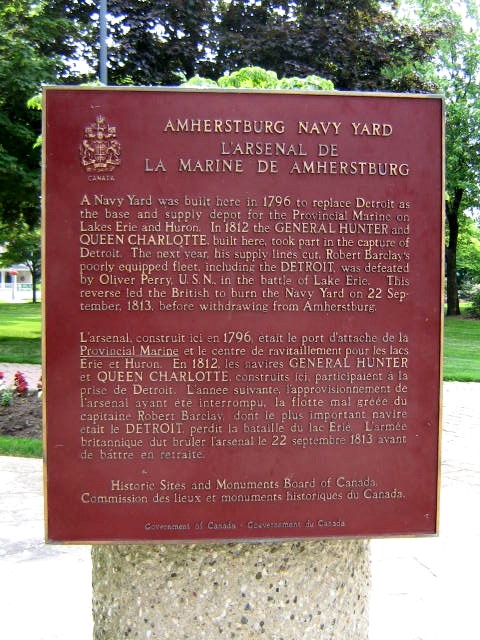
The cairn for the Amherstburg Navy Yard National Historic Site was originally erected in 1931 with a Fosbery style plaque, which was replaced around 1977 with the current Roselawn, bilingual style of plaque. There are also two illustrative plaques with images for this designation. There is another plaque on the cairn for the Pro Patria National Historic Event.
Amherstburg Navy Yard was constructed in 1796 after British forces vacated Detroit and relocated downstream to the eastern side of the Detroit River. The yard, used to construct and repair vessels, served as the hub of the British Naval presence on the Upper Great Lakes. The yard’s facilities included a large storehouse, two blockhouses, a timber yard with a saw pit, and a wharf. To the north of the naval yard, the British built Fort Amherstburg, at what is now Fort Malden National Historic Site of Canada, and to the south, a settlement, which became known as Amherstburg, sprang up to supply the fort and naval yard. For almost 20 years, the yard produced vessels ranging from small, open bateaux, to full-sized, three-masted, ship-rigged men-of-war. Amherstburg Navy Yard played a significant defensive role during the War of 1812, as the ships it produced enabled the British to maintain control of the area.
Following the British defeat at the Battle of Lake Erie in 1813, Amherstburg was evacuated and both the fort and the navy yard were burnt prior to the American capture. The Americans later built an installation named Fort Malden on the ruins of Fort Amherstburg. Although Fort Malden was returned to the British in July 1815, the area never regained its pre-war importance as a fort and naval yard. The fort was used briefly during the rebellions of 1837-38 before its closure in 1858.
Amherstburg Navy Yard was designated a National Historic Site of Canada in 1928.