
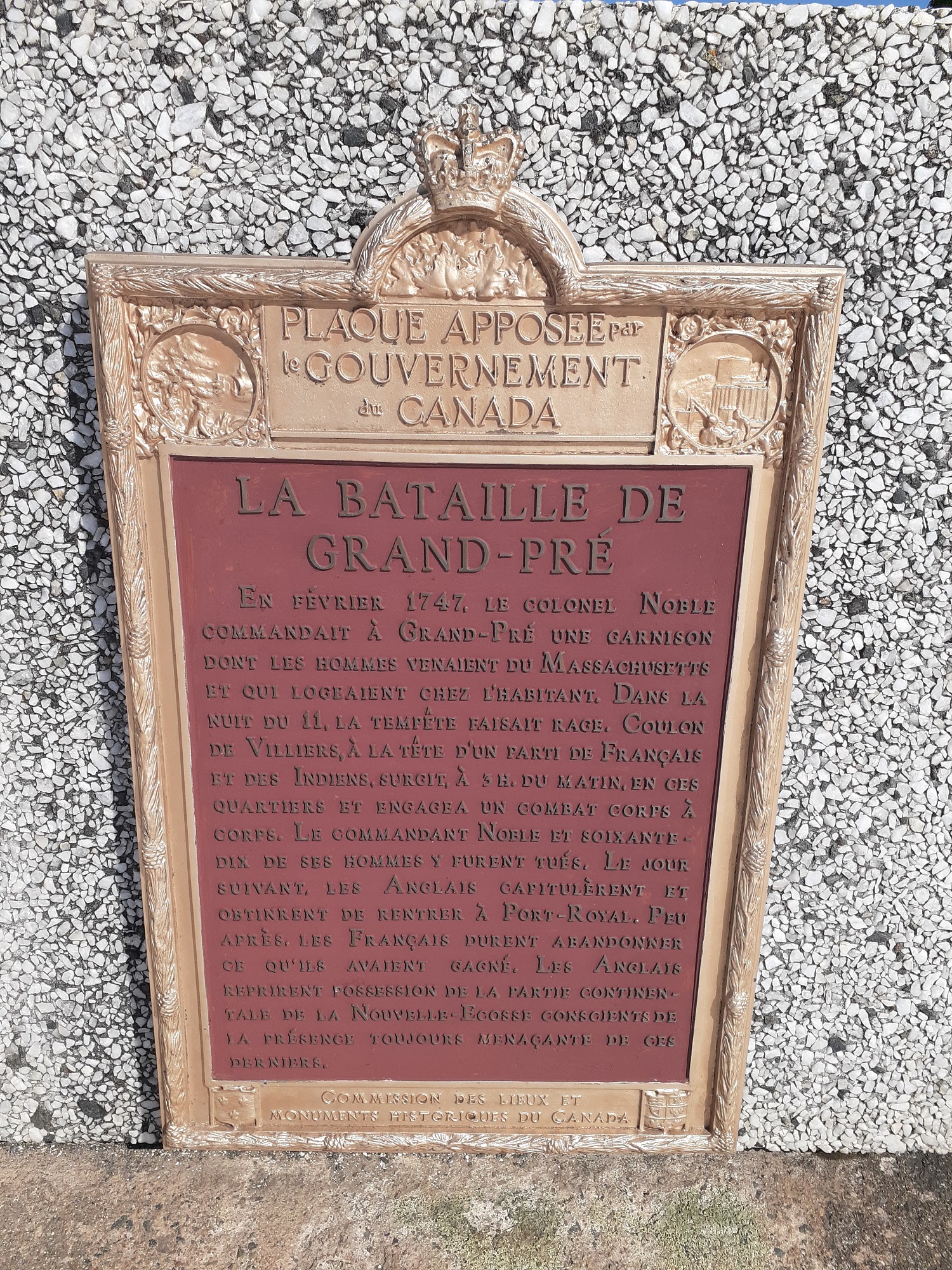
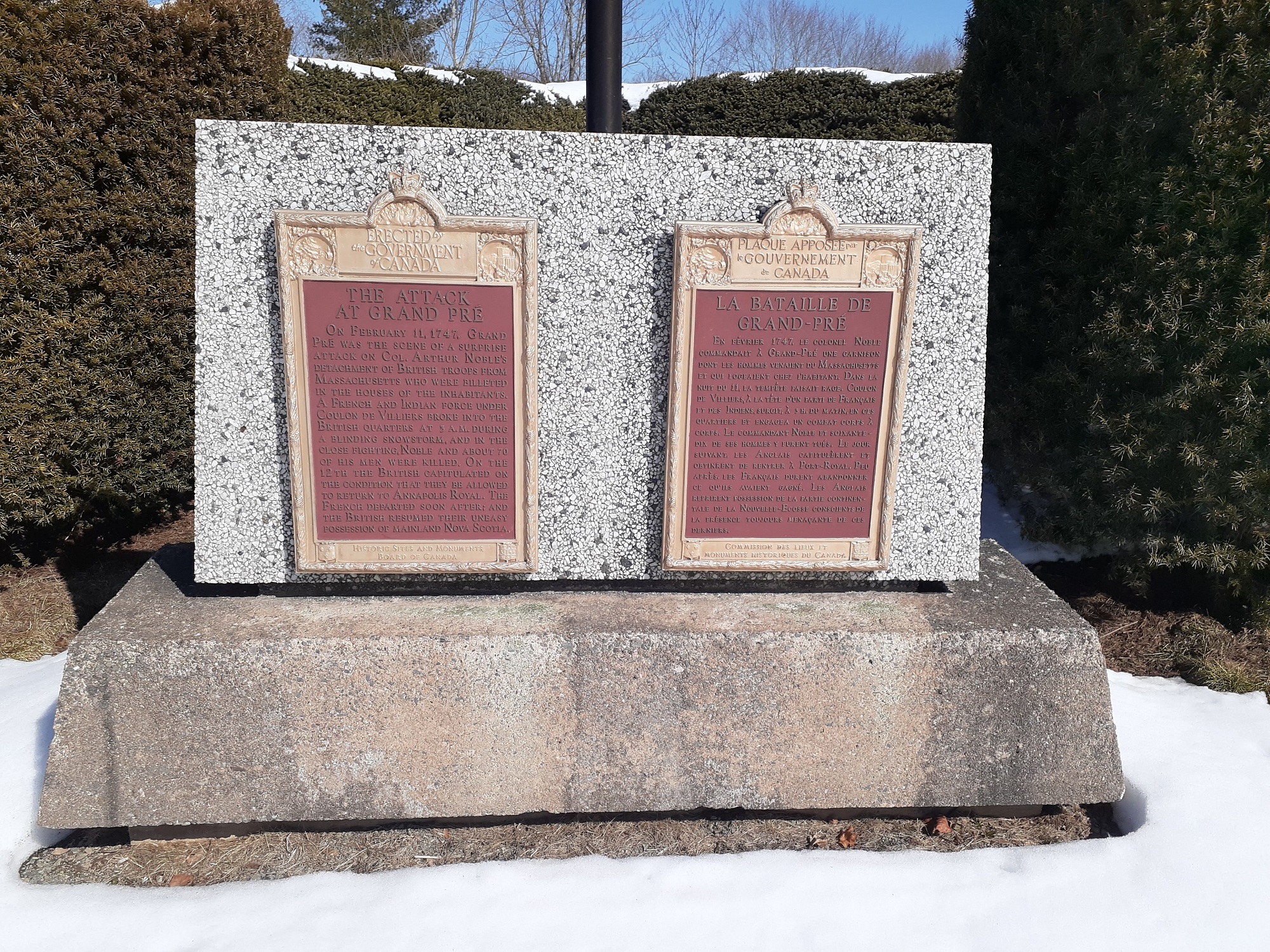
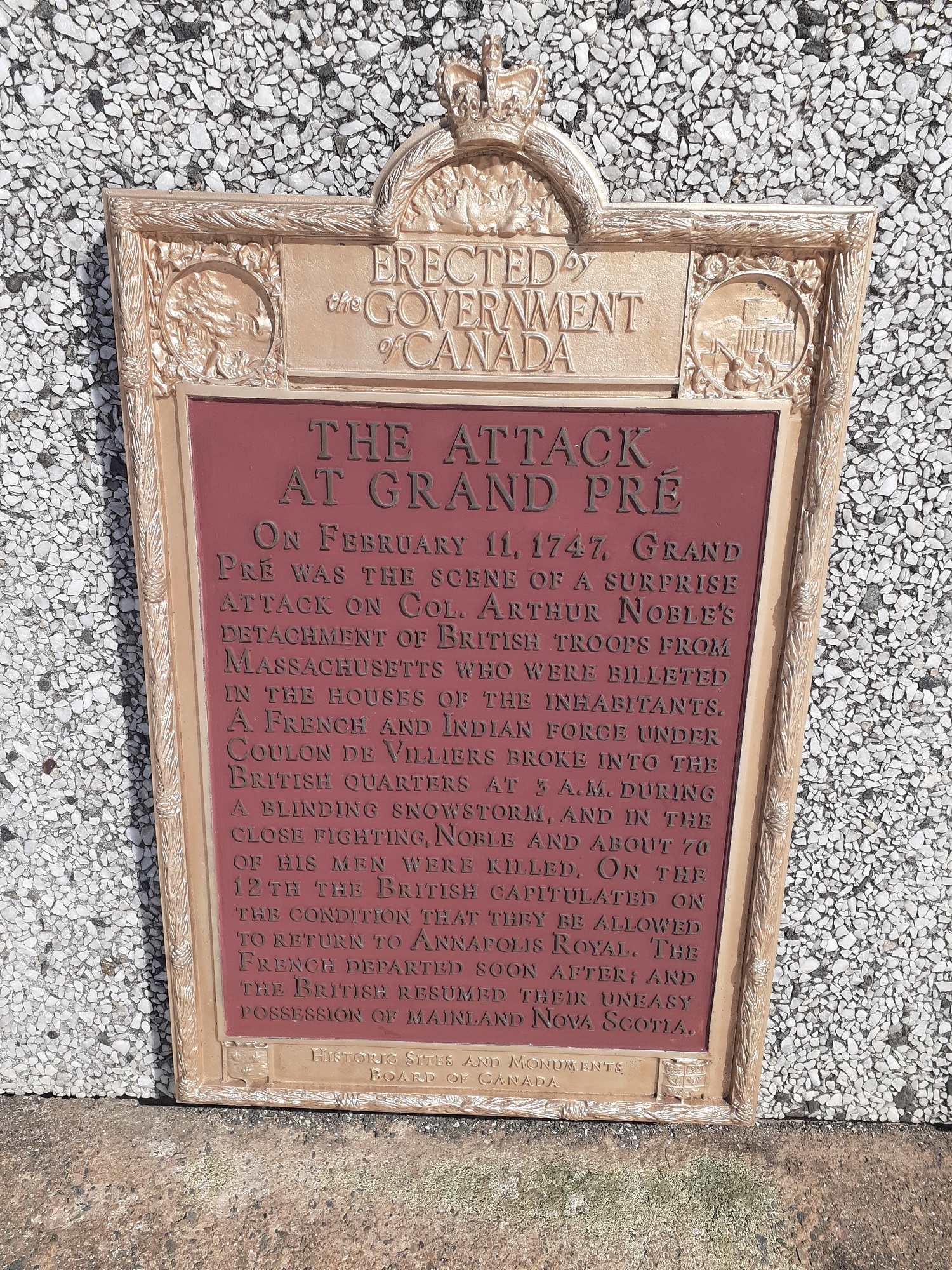
The Attack at Grand Pré Memorial was erected by the Government of Canada in memory of an attack by French and Indigenous forces on British troops at this location.
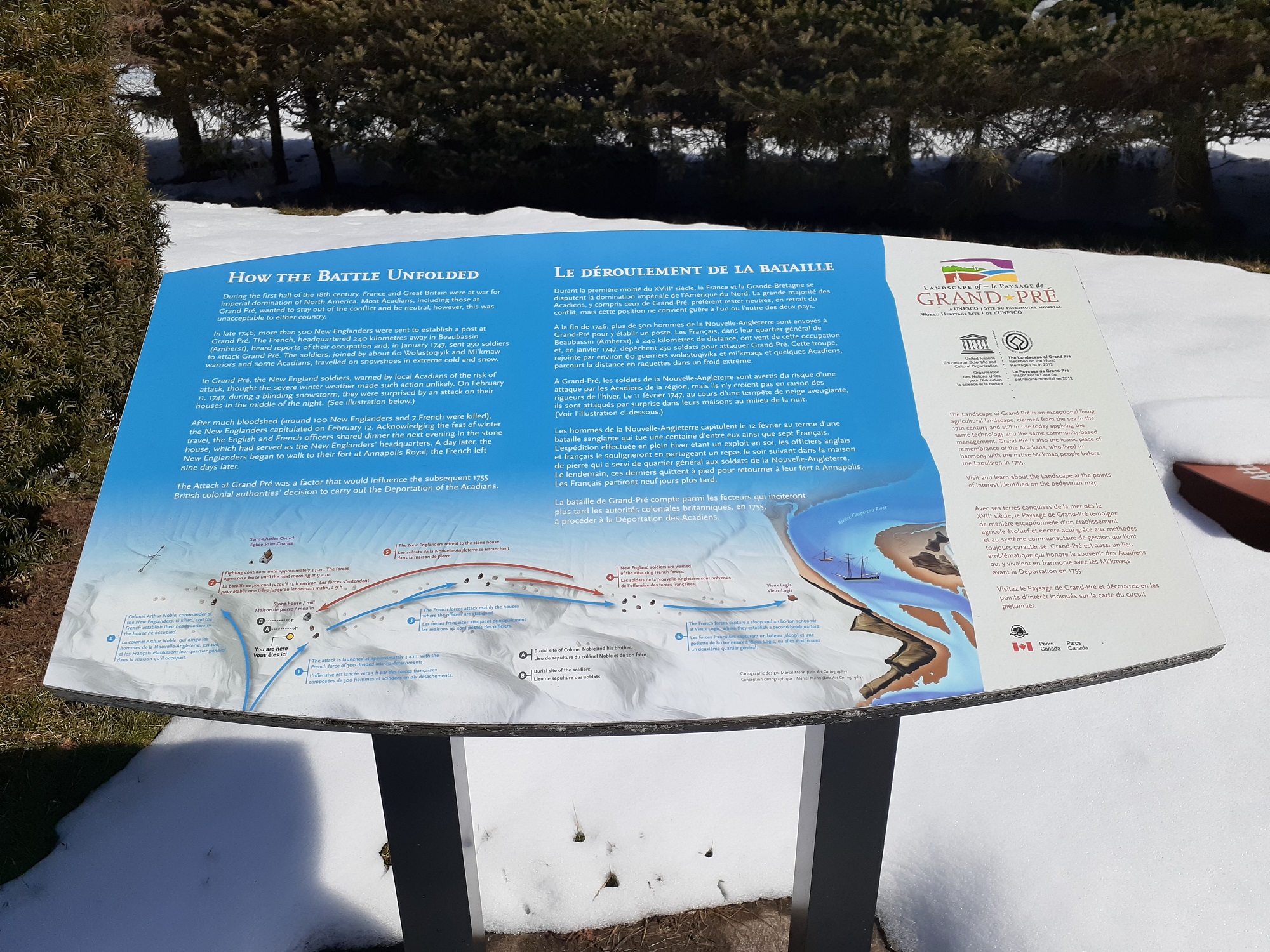
In June of 1746, French authorities at Quebec sent Jean-Baptiste-Nicolas-Roch Ramezay to Chignecto with six hundred Canadians who were joined by three hundred Malicites, under Lieutenant St. Pierre, and a large body of Micmacs, under Joseph Marin. They waited to assist in the attacks on Louisbourg and Annapolis Royal with the French navy. The New Englanders reinforced their outpost at Annapolis Royal and a force of approximately 500 Massachusetts men were settled at Grand Pré by January of 1747.
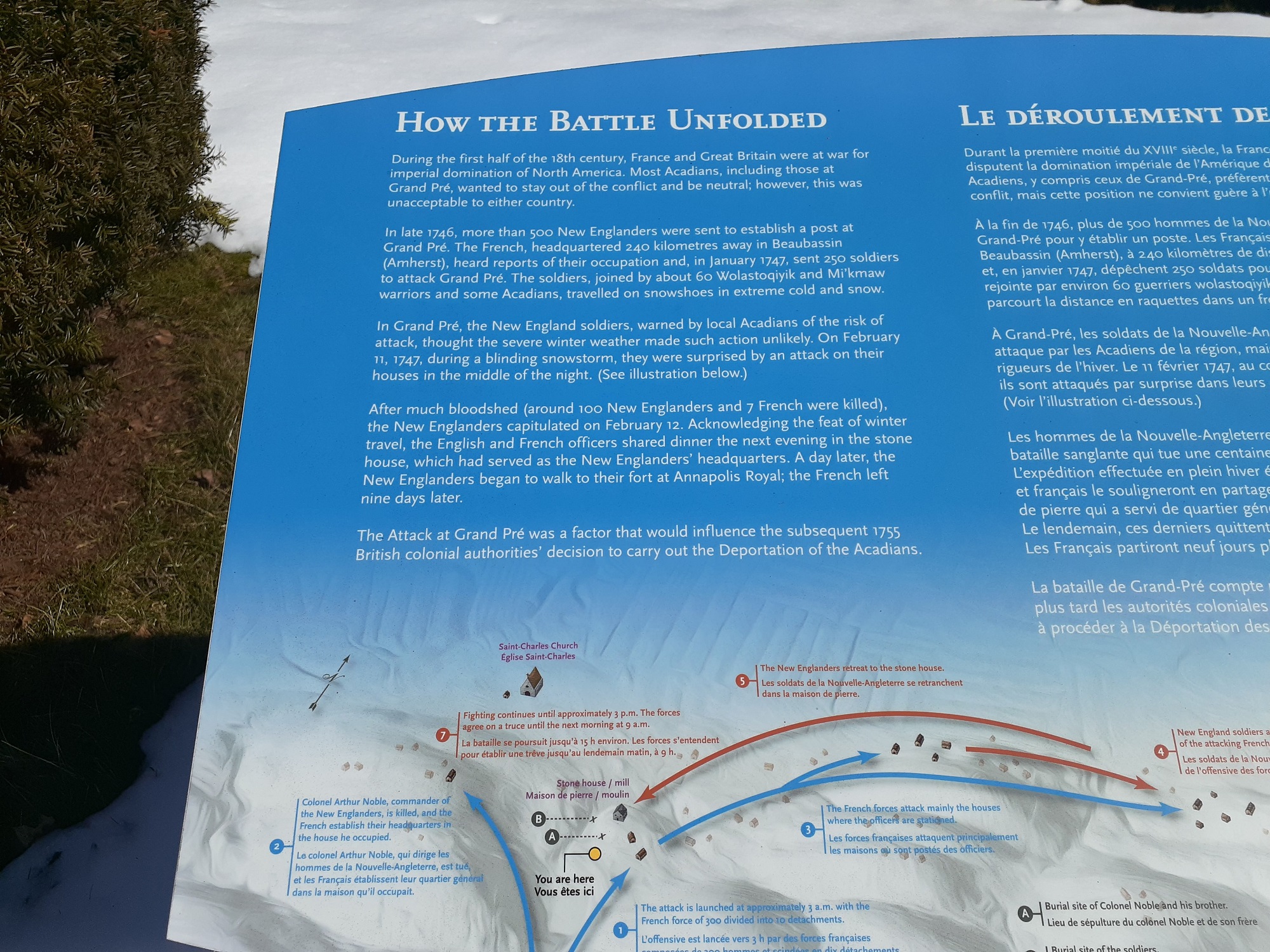
On January 23, 1747, a couple hundred snow-shoed Canadians set off for Grand Pré. They paused half way between Piziquid and Grand Pre where Nicholas Antoine Coulon de Villiers, Ramezay’s officer, divided his men into ten squads: seven of 25 each; one of 50 (headed by Villiers); one of 40 (headed de la Corne, second to Villiers), and another of 21 (headed by Lotbiniere).
The blinding snow in the early hours on February 10 confused the French and their Acadian guides. Platoons did not end up in front of their assigned house. Villiers, who had the strongest platoon, was to attack the Stone House, but ended up in front of the house which Lotbiniere's smaller platoon was to attack. Within seven minutes, the first post was taken. Twenty-one of the New Englanders were dead and three were prisoners.
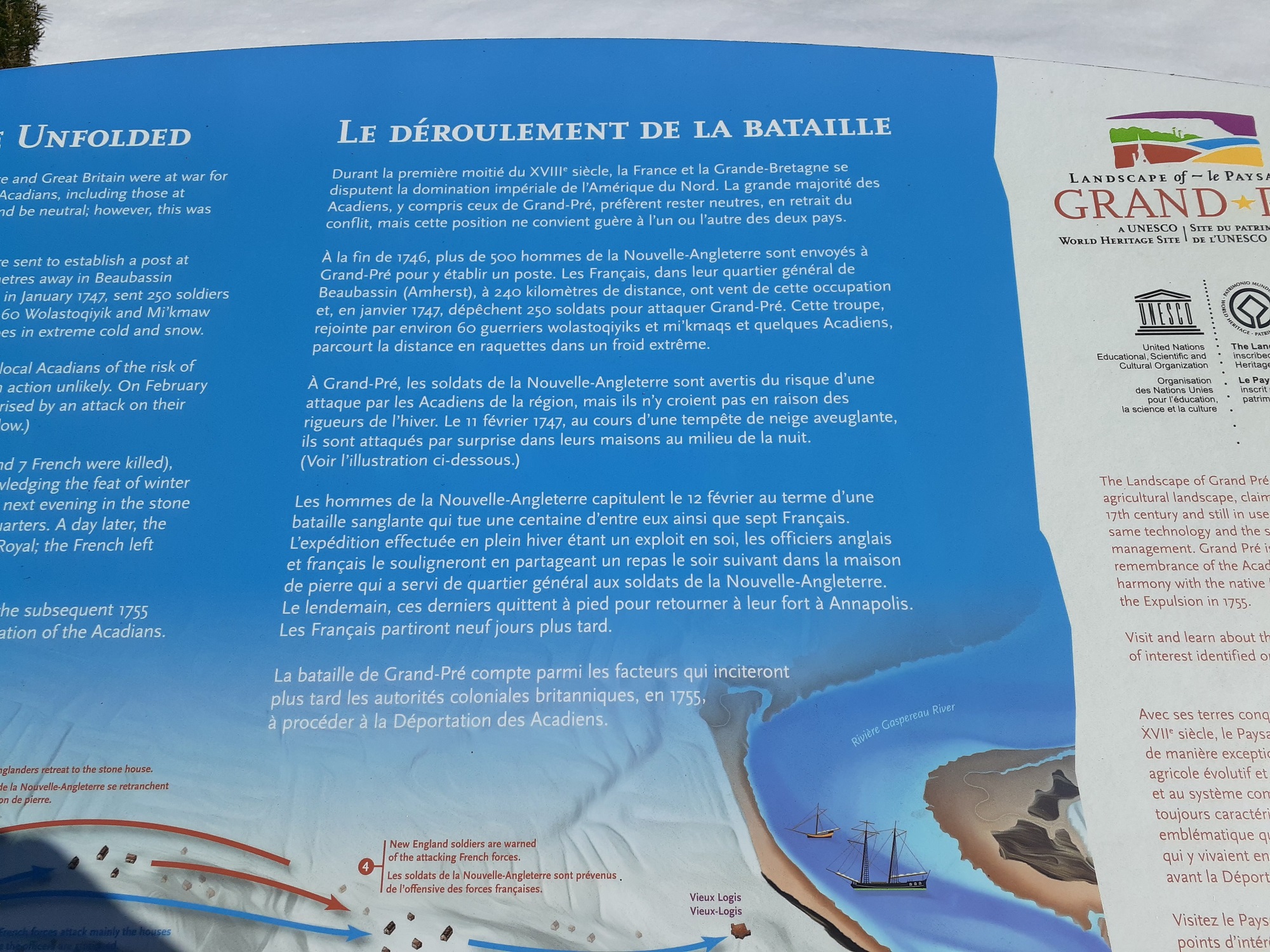
Villiers was wounded, but his platoon combined with Lotbiniere's squad and they continued to capture the remaining houses occupied by the New Englanders. The Stone House was to be the last. Visibility was still bad and neither side could make out whether the men moving about were friend or foe. The waist deep snow made movement difficult. Of the 300 or so French: 22 were dead or wounded and about 50 had run off. For the English: upwards to 75 officers and men were killed, 60 were wounded and 69 were made prisoners. The morning of the 11th was a stalemate. It was agreed the shooting would stop until 9 o'clock the following morning. On the 12th, it was agreed the English, allowed to return to Annapolis Royal, could not bear arms up the Bay for six months.
The English had the French officers to dinner that evening. It was followed by punch which was attended by the surrounding Acadian communities. The next day, Valentine's Day, was an official leave taking and the New Englanders marched out of the Stone House two by two, along a lane made by two blue-coated hedges of French soldiers with shouldered arms, drums beating and Colours flying.