
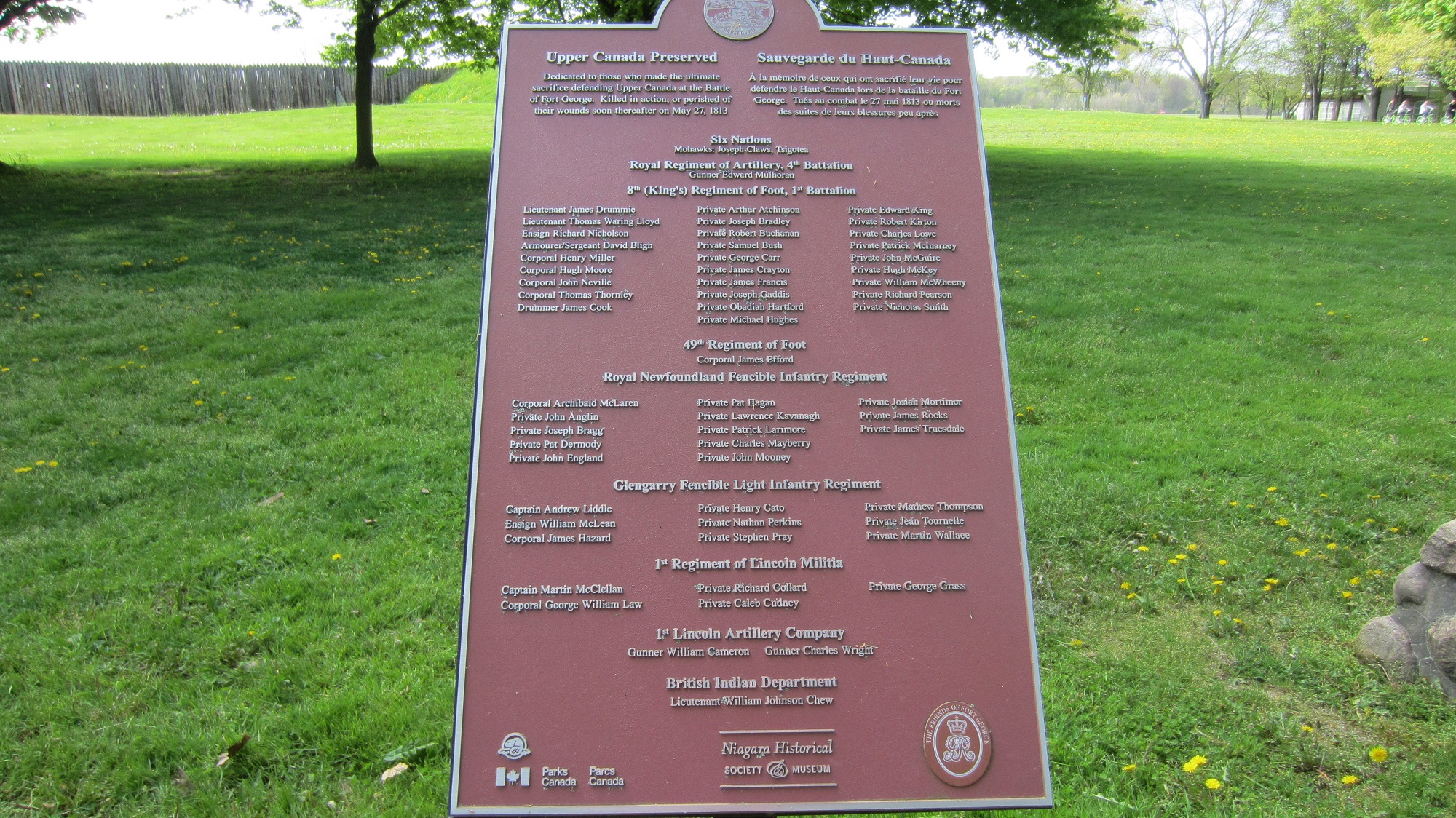
Following the attack on York, American strategy calls for an immediate amphibious landing at the mouth of the Niagara River to seize Fort George and Fort Erie, destroy the defending army, and roll up the peninsula. For this task the Americans have sixteen warships and seven thousand men. The British have eighteen hundred regulars dispersed along the Niagara Frontier; most of the militia have returned to their farms. The Americans attack on May 27, 1813.
A scene of singular carnage follows. Two lines of men face each other at a distance of no more than ten yards and for the next fifteen minutes fire away at point-blank range. On the British side, every field officer and most junior officers are casualties. The British fighting against odds of four to one are forced back leaving more than one hundred corpses piled on the bank.
During the War of 1812, Fort George served as the headquarters for the Centre Division of the British Army. These forces included British regulars, local militia, Indigenous warriors, and 'Runchey's company of coloured men'. Major General Sir Isaac Brock, the saviour of Upper Canada served here until his death at the Battle of Queenston Heights in October 1812. Brock and his aide-de-camp John Macdonell were initially buried within the fort. Fort George was destroyed by American artillery fire and captured during the Battle of Fort George in May 1813. The U.S. forces used the fort as a base to invade the rest of Upper Canada, however, they were repulsed at the Battles of Stoney Creek and Beaver Dams. After a seven month occupation, the fort was retaken in December and remained in British hands for the remainder of the war. After the war, the fort was partially rebuilt, and by the 1820's it was falling into ruins. It was finally abandoned in favour of a more strategic installation at Fort Mississauga and a more protected one at Butler's Barracks.