
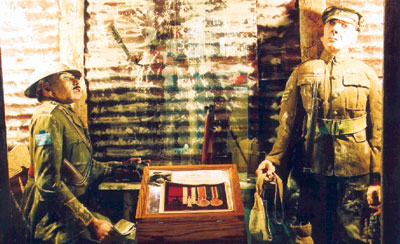
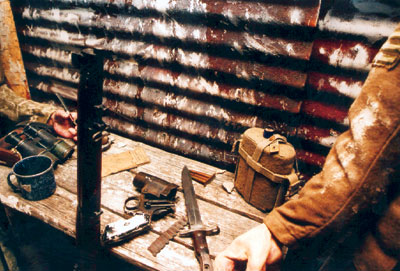
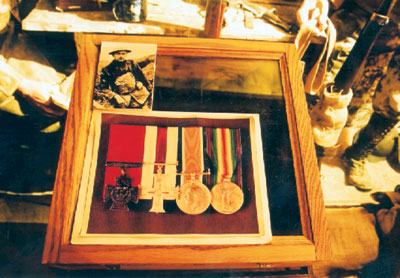
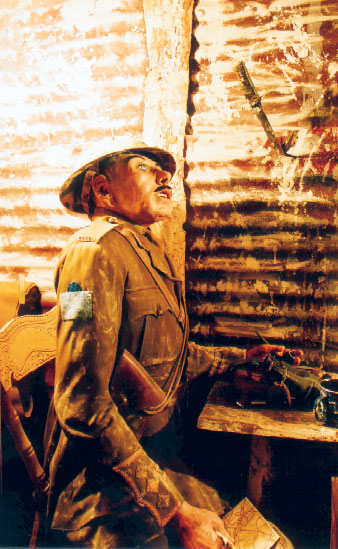
This is a permanent display recognizing the courage and tenacity of Captain O'Kelly and Sgt. Bouchard during WWI. Sgt. Bouchard was awarded the Military Medal and the Distinguished Conduct Medal for his actions at Passchendaele.
Cpt. O'Kelly was awarded the Victoria Cross and the Military Cross as well as the War and Victory Medals. The following is from the "Daily Orders, Part II" dated 23 Jan 1918: 8.
Honours and Awards Lieut. (A/Captain) C.P.J. O'Kelly (M.C.) Awarded the VICTORIA CROSS. For most conspicuous bravery in an action in which he led his company with extraordinary skill and determination. After the original attack had failed and two companies of his unit had launched a new attack, Capt. O'Kelly advanced his command over 1000 yards under heavy fire without any artillery barrage, took the enemy positions on the crest of the hill by storm, and then personally organized and led a series of attacks against "Pill-boxes", his company alone capturing six of them with 100 prisoners and ten machine guns. Later on in the afternoon, under the leadership of this gallant officer his company repelled a strong counter-attack taking more prisoners, and subsequently during the night captured a hostile raiding party consisting of one officer, 10 men and a machine gun. The whole of these achievements were chiefly due to the magnificent courage, daring and ability of Capt. O'Kelly (Authy:-London Gazette Supplt.No.30471 dated 11-1-18.)
The following is a newspaper article from 1922, Northern Wilderness could be as Dangerous as War, by Rob Neff:
November 11 is a day for remembering. It's a time to resurrect the great wars of our century from the shallow dust of history, and to reflect for a moment on man's brutality to man. It's time to tell the tales of courage under fire that produced a special breed of men known as heroes. One such man was Christopher Patrick John O'Kelly.
His story, as told by Ken Johnston, began in the spring of 1916, when he joined the 144th Battalion, Royal Winnipeg Riffles as a young lieutenant. He sailed to England with his unit a year later. When the 144th was placed on reserve duty, O'Kelly joined the 52nd Battalion of the Lake Superior Regiment. Within a month, the 52nd was knee-deep in mud on the battlefields of France.
Passchendaele Ridge was a highly coveted Allied objective in the autumn of 1917. However, their advance was hindered by incessant cloudbursts that washed out trenches and turned shell holes to mini-ponds. So it was at dawn, Friday, October 26 when the final assault began. A raw, sleet-filled wind stung the faces of the Allied attack force. Overhead, enemy planes strafed the beleaguered columns.
The Canadians, with the 52nd in a supporting role, were delegated to capture Bellevue Spur, a westerly projection of the main ridge. Bellevue proved a stubborn nut to crack. The position was stoutly defended by machine gun batteries in the cellars of an abandoned village. The nearby cross-road bristled with enemy pill-boxes. By 8:30 a.m., when the bitter fighting began taking its toll, the 52nd was pressed into the thick of the fray. Lieut. O'Kelly was in charge of "A" Company, storming through a German barrage toward the crest of the ridge. As "A" Company topped the hill, they surprised a German force attacking the flank of a nearby Canadian Battalion, the 43rd. O'Kelly and his men turned the German onslaught into a full retreat back down the ridge. "A" Company then slipped under the muzzles of the German guns and wiped out half a dozen pill-boxes that were still shredding the oncoming Canadian columns.
Later in the afternoon, O'Kelly and his men repelled a strong counterattack. During the night, they seized an enemy raiding party. When the fighting was over, Bellevue Ridge and Passchendaele were snatched from enemy hands. "A" Company of the 52nd Battalion had captured nine officers, 275 men, and 21 machine guns. Lieut. O'Kelly was cited "for most conspicuous bravery in action..." and awarded the Victoria Cross.
The Christopher O'Kelly story concluded under a shroud of mystery. In 1922, he joined the rush for gold in the Red Lake area. On November 14, he and fellow prospector Bill Murray arrived at the Hudson's Bay Pine Ridge Post (later known as Gold Pines) at the western end of Lac Seul. The pair stocked up on provisions, then paddled into a gathering storm toward their winter camp of Bluffy Lake. They were never seen alive again. Next spring, their canoe was found on a reef near Goose Island. Murray's body had washed onto a shore nearby, but there was never a trace of O'Kelly. He survived the worst the Germans could throw his way in World War I, only to vanish without a trace on a choppy Northern Ontario lake in 1922.