
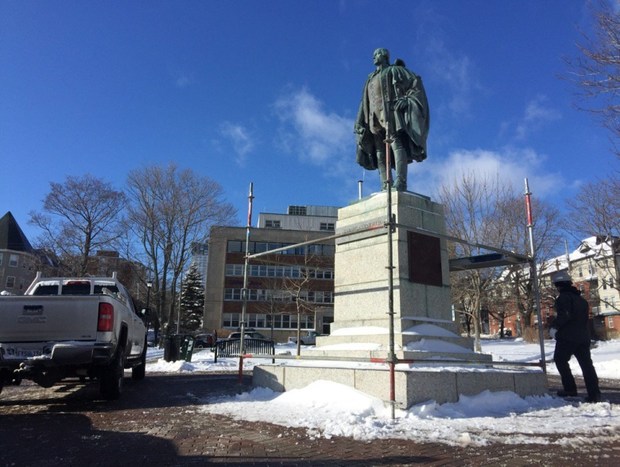
In 1749, British military officer Edward Cornwallis was appointed governor of Nova Scotia and sent to found the settlement of Halifax. He established the new capital to protect British settlers from the French fort at Louisbourg and to strengthen Britain’s hold on Nova Scotia.
Cornwallis became entangled in fighting with the Mi’kmaq, who also claimed the land on which he established Halifax. After Mi’kmaq warriors attacked and killed British settlers in the summer of 1749, Cornwallis issued a proclamation promising a cash bounty for every Mi’kmaq person taken or killed in the province. It later became known as the scalping proclamation.
In October 1929, J. Massey Rhind was selected by the Cornwallis Memorial Committee as the sculptor for a statue to honour Edward Cornwallis. The statue arrived in May 1931 and was dedicated on June 22 in Cornwallis Park (now known as Peace and Friendship Park). The $20,000 sculpture was paid for by Canadian National Railways, the province of Nova Scotia, and the City of Halifax.
J. Massey Rhind was a Scottish-American sculptor. He began his studies under his father then attended the prestigious Royal Scottish Academy as a 15-year old prodigy and continued his studies with Jules Dalou in Lambeth, England. He continued his studies in England, then two more years in Paris and moved to New York in 1889 when he was 29. After the First World War, Rhind lived in Chester, Nova Scotia. His work in Nova Scotia includes the Halifax Grand Parade Cenotaph, New Glasgow Cenotaph, and Chester Cenotaph.
In 1974, Cornwallis was declared a national historic person by the federal government, based on the recommendation of the Historic Sites and Monuments Board of Canada. In 1985, the Monuments Board installed a plaque on the statue’s plinth.
The public's perception of Edward Cornwallis was challenged in 1993, when Mi’kmaq elder Daniel Paul described Cornwallis’ hostile actions toward the Mi’kmaq as genocide. Paul wrote that Cornwallis’ 1749 scalping proclamation showed he was well endowed with a heartless cruelty.
In January 2018, Halifax council voted 12-4 to take down the statue and place it in temporary storage, while it considers the statue's long-term future.