
Mountain Memorial Community Park is dedicated to the memory of the citizens of Mountain and Mountain Township who died in the First World War. It was unveiled on November 12, 1925, by the Town of Mountain.
Hill 70 Memorial is located in the park.
Sign in to My VAC Account
Sign in to My VAC Account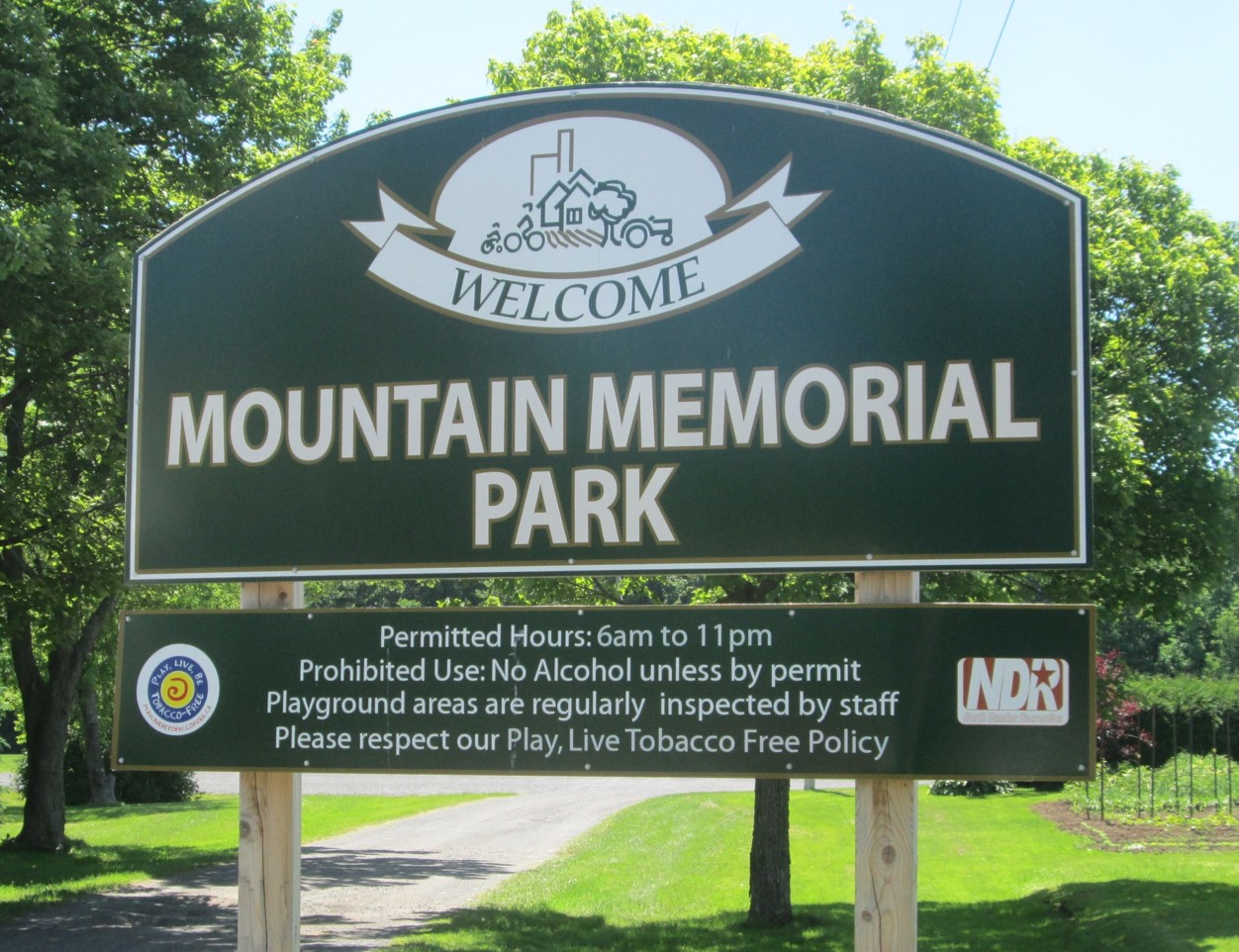
Mountain Memorial Park sign
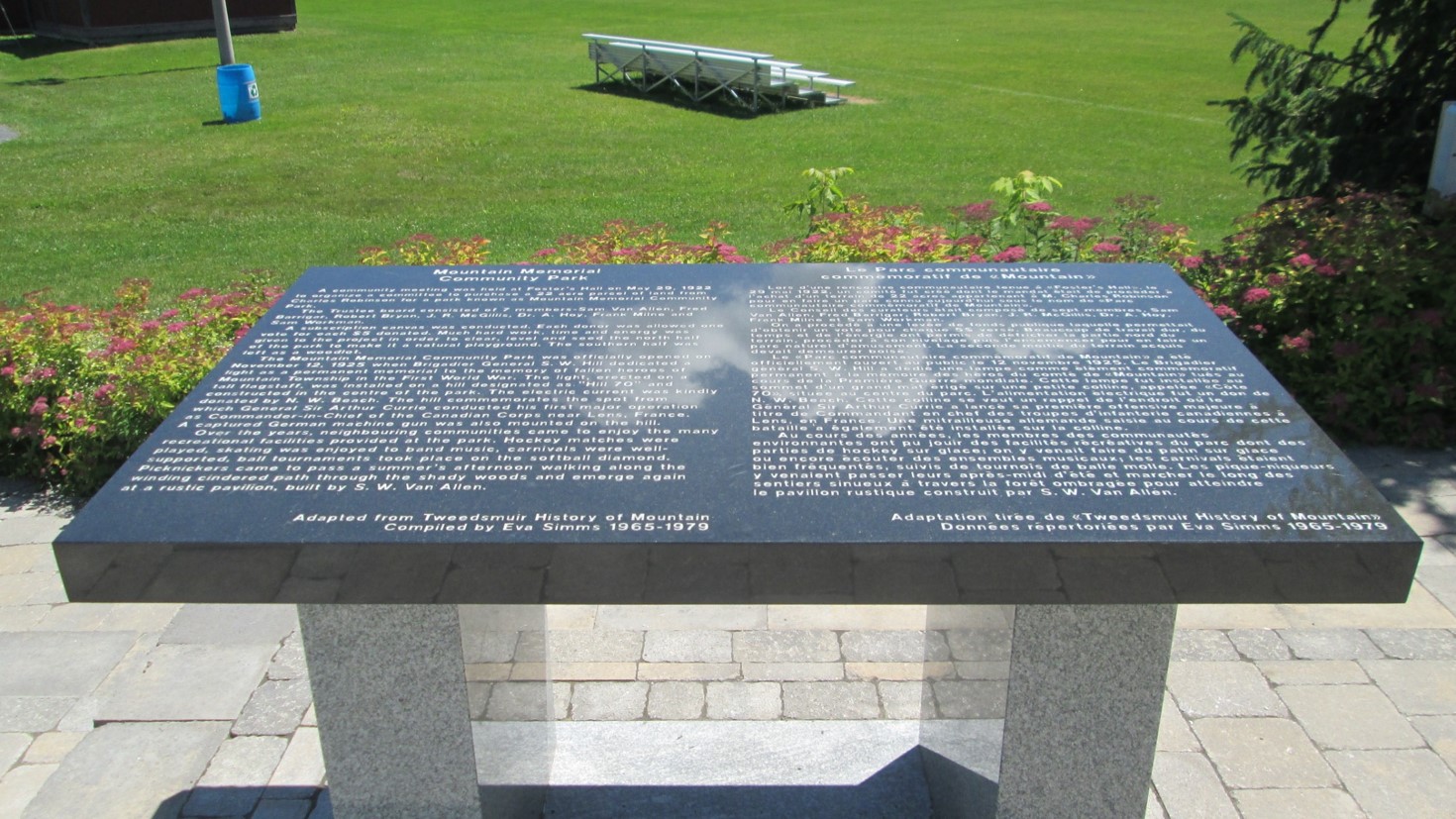
dedication tablet
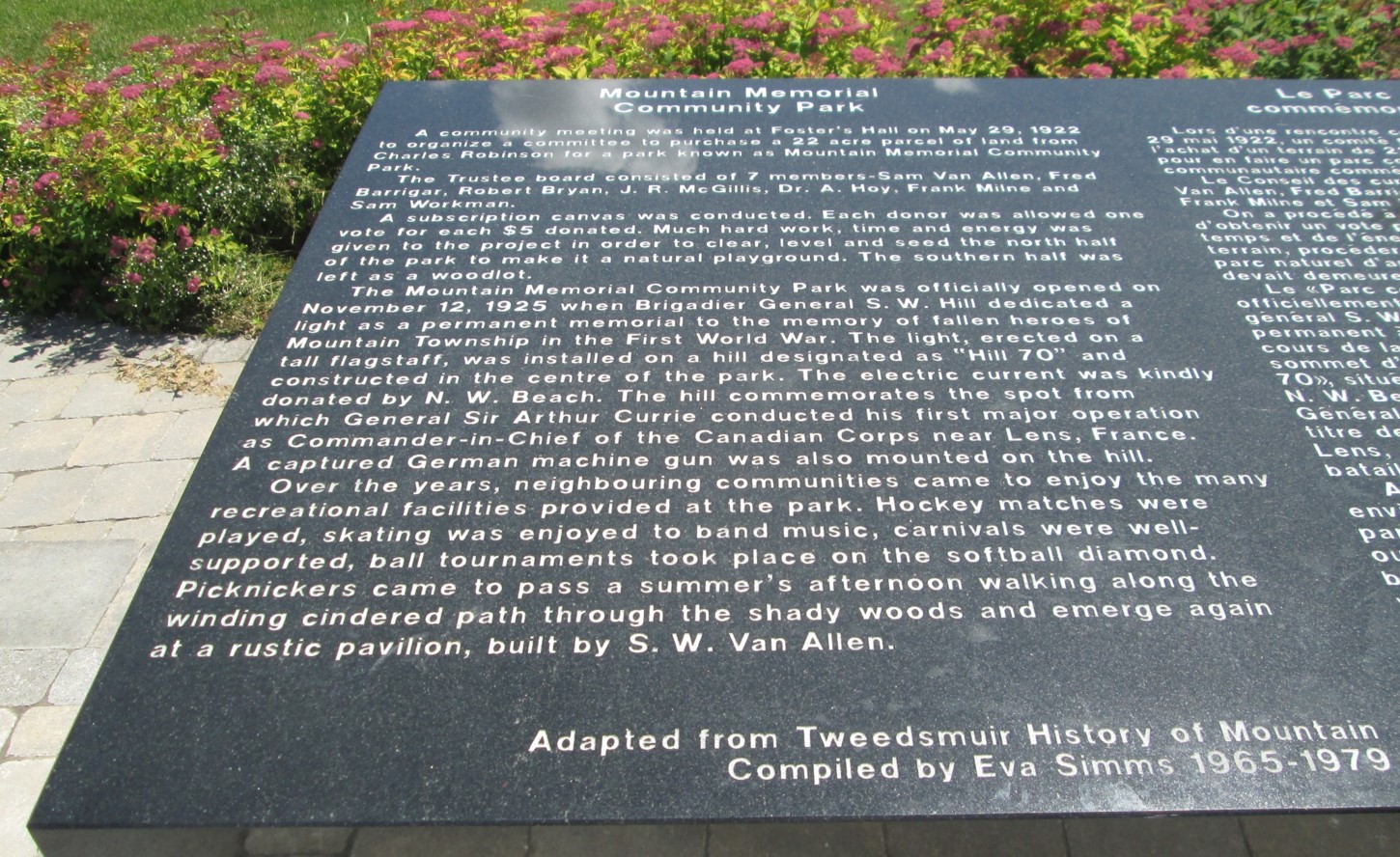
inscription - English
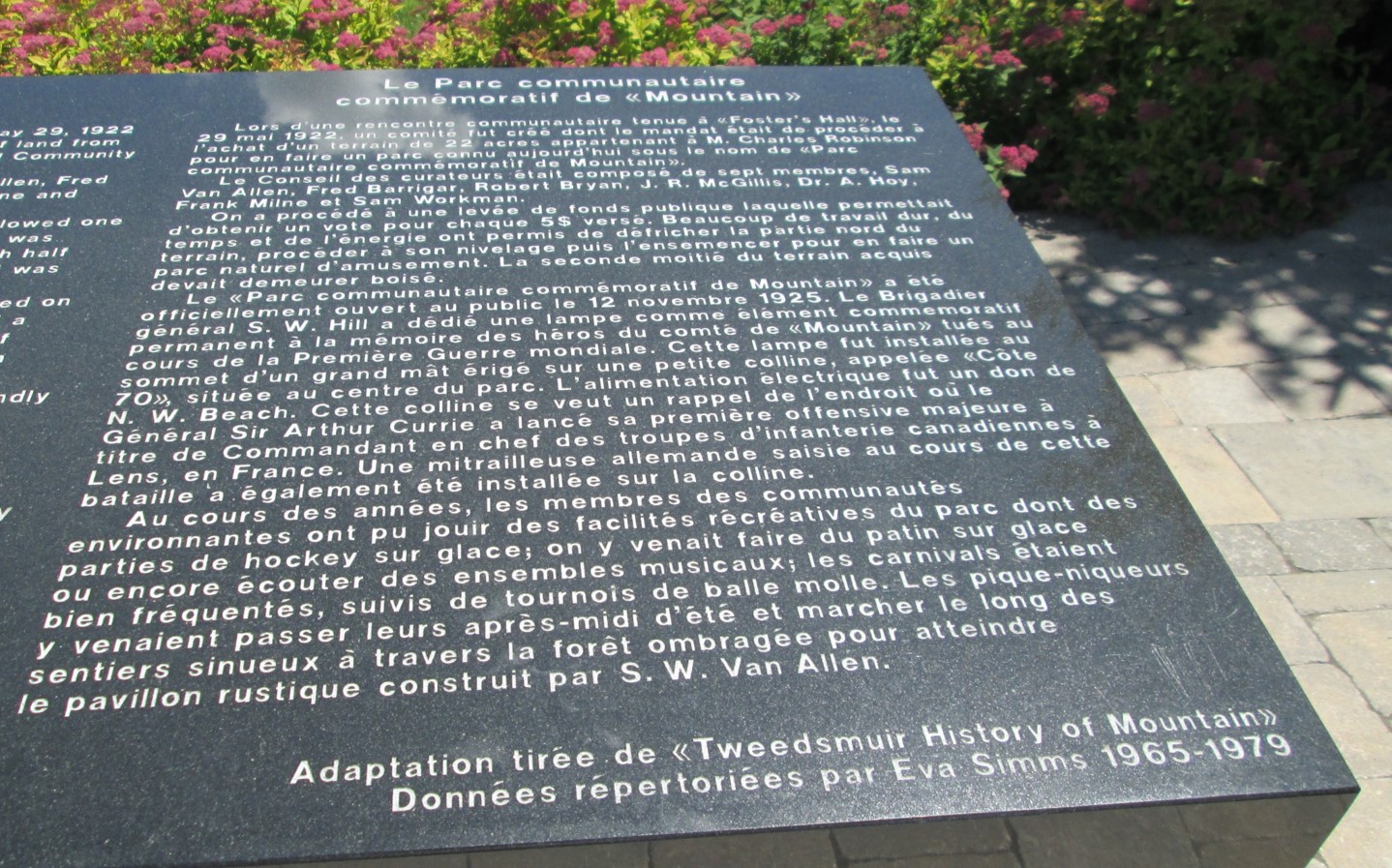
inscription - French
Mountain, Ontario
Notice:
The National Inventory of Canadian Military Memorials is a public, crowd-sourced registry that helps Canadians learn about memorials in their communities. Inclusion in the Inventory does not imply VAC ownership or authority. Responsibility for the care, management, and any changes to a memorial rests with its owning or governing organization.
Mountain Memorial Community Park is dedicated to the memory of the citizens of Mountain and Mountain Township who died in the First World War. It was unveiled on November 12, 1925, by the Town of Mountain.
Hill 70 Memorial is located in the park.
[park sign/enseigne du parc]
WELCOME
MOUNTAIN MEMORIAL
PARK
[dedication tablet/plaque commémorative]
Mountain Memorial
Community Park
A community meeting was held at Foster’s Hall on May 29, 1922 to organize a committee to purchase a 22 acre parcel of land from Charles Robinson for a park known as Mountain Memorial Community Park.
The Trustee Board consisted of 7 members – Sam Van Allen, Fred Barrigan, Robert Bryan, J.R. McGillis, Dr. A. Hoy, Frank Milne and Sam Workman.
A subscription canvas was conducted. Each donor was allowed one vote for each $5 donated. Much hard work, time and energy was given to the project in order to clear, level and see the north half of the park to make it a natural playground. The southern half was left as a woodlot.
The Mountain Memorial Community Park was officially opened on 12 November 1925 when Brigadier General S.W. Hill dedicated a light as a permanent memorial to the memory of fallen heroes of Mountain Township in the First World War. The light, erected on a tall flagstaff, was installed on a hill designated “Hill 70” and constructed in the centre of the park. The electric current was kindly donated by N.W. Beach. The hill commemorates the spot from which General Sir Arthur Currie conducted his first major operation as Commander-in-Chief of the Canadian Corps near Lens, France. A captured German machine gun was also mounted on the hill.
Over the years, neighbouring communities came to enjoy the many recreational facilities provided at the park. Hockey matches were played, skating was enjoyed to band music, carnivals were well-supported, ball tournaments took place on the soft ball diamond. Picknickers came to pass a summer’s afternoon walking along the winding cindered path through the shady woods and emerge again at a rustic pavilion built by S.W. Van Allen.
-Adapted from Tweedsmuir History of Mountain
Comiled by Eva Simms 1965 – 1979.
Le parc communautaire
commémoratif de « Mountain »
Lors d’une rencontre communautaire tenue à «Foster’s Hall» le 29 mai 1922, un comité fut crée dont le mandat était de procéder à l’achat d’un terrain de 22 acres appartenant à M. Charles Robinson pour en faire un parc connu aujourd’hui sous le nom de « Parc communautaire commémoratif de Mountain »
Le conseil des curateurs était composé de sept membres, sam Van Allen, Fred Barrigan, Robert Bryan, J.R. McGillis, Dr. A. Hoy, Frank Milne et Sam Workman.
On a procédé à une levée de fonds publique laquelle permettait d’obtenir un vote pour chaque 5$ versé. Beaucoup de travail dur, du temps et de l’énergie ont permis de défricher la partie nord du terrain, procéder à son nivelage puis l’ensemencer pour en faire un parc naturel d’amusement. La seconde moitié du terrain acquis devait demeurer boisé.
Le « Parc communautaire commémoratif de Mountain » a été officiellement ouvert au public le 12 novembre 1925. Le Brigadier général S.W. Hill a dédié une lampe comme élément commémoratif permanent à la mémoire des héros du comté de «Mountain» tués au cours de la Première Guerre mondiale. Cette lampe fut installée au sommet d’un grand mât érigé sur une petite colline appelée «Côte 70» située au centre de parc. L’alimentation électrique fut un don de N.W. Beach. Cette colline se veut un rappel de l’endroit où le Général Sir Arthur Currie a lancé sa première offensive majeure à titre de Commandant en chef des troupes d’infanterie canadiennes à Lens, en France. Une mitrailleuse allemande saisie au cours de cette bataille a également été installée sur la colline.
Au cours des années. Les membres des communautés environnantes ont pu jouir des facilités récréatives du parc dont des parties de hockey sur glace; on y venait faire du patin sur glace ou encore écouter des ensembles musicaux; les carnavals étaient bien fréquentés, suivis de tournois de balle molle. Les pique-niquers y venaient passer leurs après-midi d’été et marcher le long des sentiers sinueux à travers la forêt ombragée pour atteindre le pavillon rustique construit par S.W. Van Allen.
- Adaptation tirée de « Tweedsmuir History of Mountain »
Données répertoriées par Eva Simms 1965-1979