
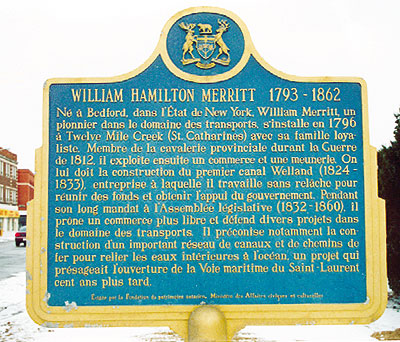
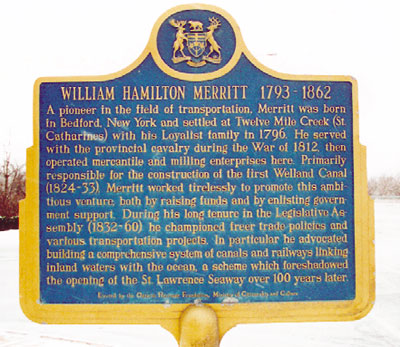
A young farmer near Grantham Township before the war, William Merritt was appointed Lieutenant in the Niagara Light Dragoons, a volunteer company. They were expected to provide their own horses although they did receive a few British armaments. Their duties included carrying dispatches, long range patrols, calling in militia men and pursuing enemy raiders. Under command of his father, Thomas, the Sheriff of Niagara, Merritt and his troop were assigned to guard duty along the Niagara River. He was asked to join Brock at Detroit but was delayed and hence arrived after the capture of Fort Detroit. Nevertheless, he was awarded the special Detroit Medal. At the Battle of Queenston Heights, Merritt fought alongside Brock and years later was instrumental in the erection of Brock’s Monument.
The Dragoons were briefly disbanded in February 1813, but Merritt was instructed to raise a troop of cavalry again in March and become its Captain. During the American occupation of Niagara in 1813, the Dragoons were involved in a number of skirmishes with the United States Forces and also fought at the Battle of Stoney Creek in June.
When the Town was burnt by the United States in December, Merritt saw a glare in the sky from Twelve Mile Creek. Upon his approach, he described it as “nothing but heaps of coal and the streets full of furniture that the inhabitants had been fortunate enough to get out of their homes.”
Merritt fought at the Battle of Lundy’s Lane in July 1814 and was captured. He remained a prisoner until the end of the war. Afterwards, Merritt returned to farming and was involved in the mercantile trade in Niagara. Merritt is famous for promoting the Welland Canal between Lakes Erie and Ontario which bypassed Niagara Falls and the Portage Road.