
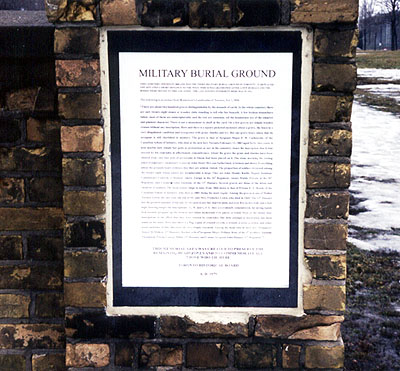
This plaque describes the history of this Military Burial Ground. The plaque was erected by the Toronto Historical Board.
Military Burial Ground Plaque
Toronto, Ontario
Notice:
The National Inventory of Canadian Military Memorials is a public, crowd-sourced registry that helps Canadians learn about memorials in their communities. Inclusion in the Inventory does not imply VAC ownership or authority. Responsibility for the care, management, and any changes to a memorial rests with its owning or governing organization.
Inscription
MILITARY BURIAL GROUND
THIS CEMETERY OPENED IN 1860 AND WAS THE THIRD MIITARY BURIAL GROUND IN TORONTO. IT REPLACED
ONE SITUATED A SHORT DISTANCE TO THE WEST, WHICH WAS ABANDONED AFTER A FEW BURIALS AND THE
BODIES WERE MOVED THIS LOCATION. THE LAST KNOW INTERNMENT HERE WAS IN 1911.
The following is an extract from Robertson’s Landmarks of Toronto, Vol, 1, 1894:
"There are about two hundred graves distinguishable by the mounds of earth. In the whole cemetary there
are only twenty-eight stones or wooden slabs standing to tell who lies beneath. A few broken stones have
fallen
most of them are indecipherable and the rest are nameless. All the headstones are of the simplest
and plainest character. There is not a monument or shaft in the yard. On a few graves are simple wooden
crosses without any inscription. Here and there is a square picketed enclosure about a grave, the fence in a
very dilapidated condition and overgrown with grass, thistles and ivy. But one grave bears token, that its
occupant is still cherished in memory. The grave is that of Sergeant-Major F.W. Gathercole of the
Canadian School of Infantry, who died at the new fort, Toronto February 13, 1883 aged forty-two years. A
neat marble slab, simple but quite as pretentious as any in the cemetery, bears the inscription that it was
erected by his comrades in affectionate remembrance. About the grave the grass and thistles have been
cleared away and four pots of geraniums in bloom had been placed on it. The stone marking the resting
place of assistant Commissary-General John Moirs McLean Sutherland, is broken and down. Everything
about the grounds bears evidence that they are seldom visited. The proportion of soldiers drowned among
the twenty-eight whose names are decipherable is large. They are John Manley Rattle, Deputy-Assistant
Commissary-General, J. Ramsey Akers, Ensign in the 16th Regiment, James Walsh, Private in the 30th
Regiment, and Corporal John Smeeton, of the 13th Hussars. Several graves are those of the wives and
children of soldiers. The head stones range in date, from 1860 down to that of Private E.A. Heath, of the
Canadian School of Infantry, who died in 1885, being the most recent. Among the graves is one of Walter
Toronto Lewis, the one-year old son of Mr. and Mrs. Frederick Lewis, who died in 1868. The 13th Hussars
has the greatest number of burials. At two graves are tiny marble slabs, not over five inches wide and a foot
high, bearing simply the inscription ‘G.M. and G.F.S.’ they are evidently remembered, for loving hands
had recently propped up the broken and fallen memorials with pieces of wood. Most of the stones bear
inscriptions to the effect that they were erected by comrades. But little attempt at decoration has been
made on the slabs. Here and there is a flag, a pair of crossed swords, a wreath, a cross, a crown, and other
usual emblems of this character, all very simply executed. Among the dead who lie here are: Trumpeter
James McMahon, 13th Hussars
Rachel, wife of Sergeant-Major William Ross, of the 4th Artillery
Isabella
Thompson, Private George Miller, 13th Hussars, and Colour-Sergeant John Hanney, 47th Regiment."
THIS MEMORIAL AREA WAS CREATED TO PRESERVE THE
REMAINING HEADSTONES AND TO COMMEMORATE ALL
THOSE WHO LIE HERE.
TORONTO HISTORICAL BOARD
A.D. 1970
Street View
Location
Military Burial Ground Plaque
250 Fort York Boulevard
Toronto
Ontario
Military Burial Ground Plaque
250 Fort York Boulevard
Toronto
Ontario
GPS Coordinates
Lat. 43.639033
Long. -79.403621
Lat. 43.639033
Long. -79.403621