
Introduction
It began not with formal directives from high offices but through dreams—literal, spiritual dreams—and the shared determination of a few Indigenous service members to bring something sacred to life.
As the smell of sweetgrass filled the air and Mi’kmaq dancers performed for a large crowd of uniformed military brass at Halifax’s HMCS Scotian, the creators of the sacred, official Canadian Armed Forces/DND Eagle Staff stood proudly as they passed the symbol on to a new generation of Canadian Armed Forces members.
In doing so, they trust these members will protect and honour it with the dignity it deserves.
They know it is not just a staff.
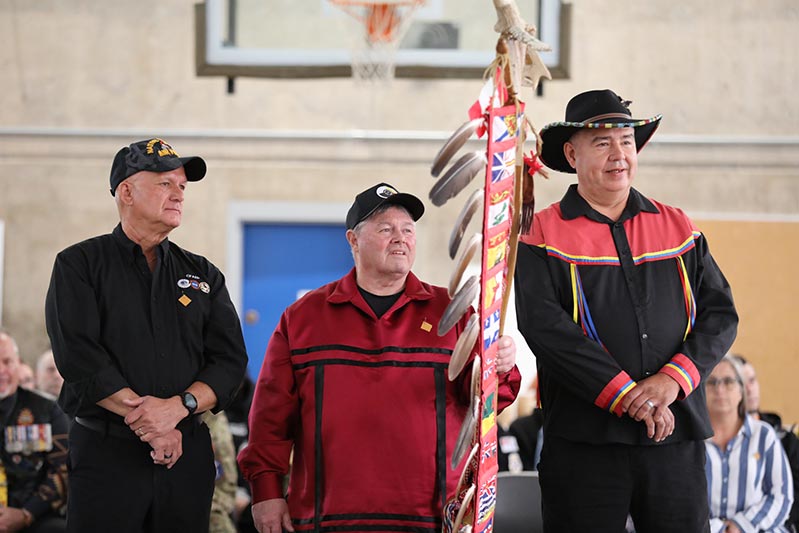
Sergeant (retired) Tony Parsons, Warrant Officer (retired) Kenneth Bennett and Petty Officer second class (retired) Chris Innis stand with the Eagle Staff
A living symbol
In Indigenous culture, the Eagle Staff is a living entity—carried with pride, purpose and the prayers of generations. For many Indigenous CAF members, it represents identity, unity and the resilience of a people long denied visibility in the ranks of Canada’s military.
In 1998, Petty Officer Second Class (retired) Chris Innis was serving aboard HMCS Montreal when he made a personal decision to grow his hair long and braid it, a quiet act of self-identification and cultural reclamation.
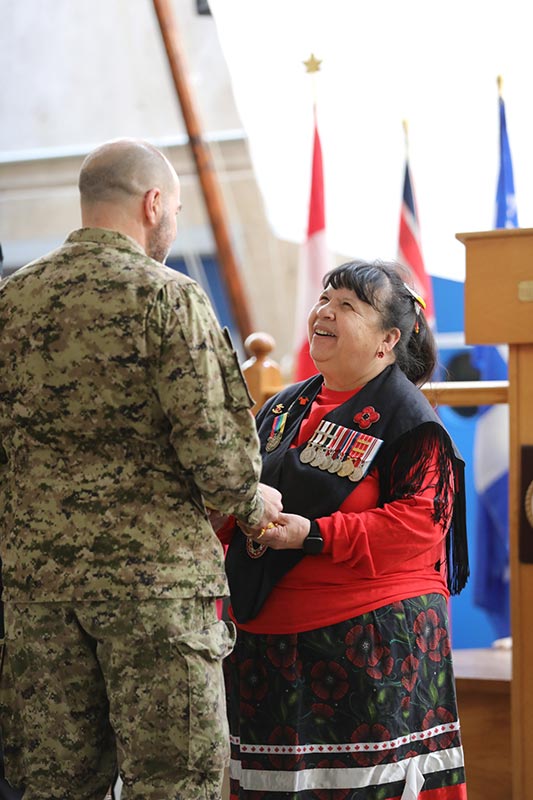
Chief Petty Officer (Retired) Elder Debbie Eisan greets Army Commander Lieutenant-General Michael Wright at the ceremony in Halifax.
Aboard a naval ship, such expressions of identity were sometimes unwelcome. But that act helped reintroduce Innis to his Ojibway heritage and set him on a path that would lead to the birth of the Eagle Staff.
Soon after, he met Chief Petty Officer Debbie Eisan, an Anishinaabe woman who had become a spiritual guide and mentor to many. Together, they began hosting regular meetings to discuss issues facing Indigenous members—and the absence of a cultural symbol to unite them and honour their identity.
Then something extraordinary happened.
Innis had a vivid dream of an Eagle Staff, complete with specific elements: an eagle’s head, feathers and symbolic representation of all Indigenous peoples across Canada. When he described it to Eisan, she was stunned. She had the same dream the very same night.
“We took a napkin and we drew the exact same thing,” Innis said.
“We don’t live in the same house. We don’t even live in the same county. But we had the same dream.”
Building the staff, binding a community
What followed was a deeply collaborative and spiritual process. Innis and Eisan, along with longtime friends Sergeant (retired) Tony Parsons (Mi’kmaq) and Warrant Officer (retired) Elder Kenneth Bennett (Mi’kmaq), formed a working group to create what would become the Canadian Armed Forces (CAF)/Department of National Defence (DND) Eagle Staff.
Each of the four brought knowledge, materials and purpose.
They cut the ash (a wood traditionally used for bows because it bends but doesn’t break) from the woods behind Bennett’s rural Nova Scotia home and let it soak in a brook.
When the wood was ready, they started sanding down the bow to reveal some meaningful markings.
“Right in the centre was a heart within a heart within a heart,” Eisan said.
“That to us was the clue that we were headed on the right path. Those are our Veterans who have gone before us. They said, ‘you guys are doing a good thing here, for our people and gathering our young people together and showing them that they are supported and that they’re not alone on this journey.’”
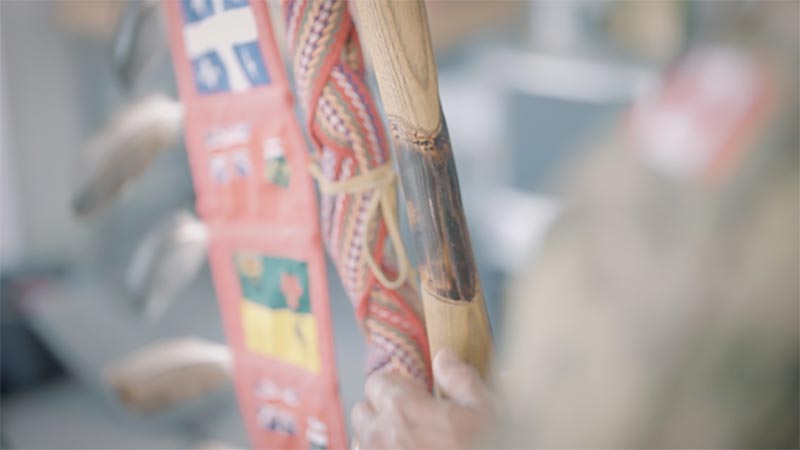
A section of the ash bow of the Eagle Staff with three hearts.
The sacred eagle
Parsons, who refers to Innis and Bennett as his “brothers,” recalls going on feather gathering trips with reverence. Eagles are sacred in many Indigenous cultures because they carry prayers to the creator.
“Not everybody is allowed to hold a feather,” he said, “it’s a spiritual thing.”
“We always pray to the eagles because they take our prayers up to the heavens. I always say whenever you see an eagle, it’s always looking after you or looking out for you.”
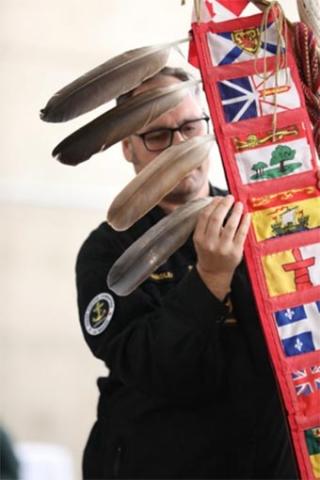
Together, they made sure that no animals were harmed in creating the 62-pound, seven-foot, deer-hide wrapped staff. The eagle head was carved, and they included an imitation narwhal tusk to connect the staff’s spirit with Inuit people.
“Our motto is many people, one nation,” Eisan explained, adding the Métis sash was an essential element.
Thirteen small flags representing the ten provinces and three territories their members represent is also appropriate for Mi’kmaq people because it is a sacred number (there are thirteen new and full moons each year).
Every part was intentional, every step ceremonial.
The result wasn’t just a physical object, it was a spiritual being.
“The Eagle Staff is a living entity,” Innis said. “It has a life of its own.”
Symbols are a big part of every military unit. Flags, crests and insignia carry deep meaning. The staff brought Indigenous members of the CAF and DND together, as a family, at a time when members still faced racism and discrimination.
The finished staff made its first appearance at a Veterans Affairs Canada event in 2002 and has since become a regular and respected presence at Remembrance Day ceremonies, change of command parades, powwows, and commemorative events across the country and around the world.
The Eagle Staff has been presented to various leaders within the CAF, ensuring its message of unity and respect is carried forward to future generations. It is also used in conjunction with Indigenous-focused programs and events within the CAF.
What sets the Eagle Staff apart is not just what it represents, but how it is treated. The staff is not simply “owned” by the military—it is cared for.
That distinction matters deeply. Its caretakers follow protocols rooted in First Nations law and spirituality. It is smudged regularly, never left alone and transported with great care.
“They have to look after it. It’s a huge responsibility. And these [Indigenous members] don't take that lightly,” Eisan said.
From the parade deck to the SkyDome
It stood tall at the SkyDome Powwow in Toronto and traveled to Europe for various commemorative ceremonies, honoring the sacrifices of Indigenous soldiers in the Canadian military. It became a beacon of Indigenous presence in a military structure that had long rendered that presence invisible.
Chris Innis remembers vividly a parade in Gagetown, a stronghold of army tradition. He was told he would be marching with the Staff, but under strict protocols. Then, in a moment of respectful defiance, Chris was given permission by the regimental Sergeant Major to follow the drum rather than the rigid parade command.
“I two-stepped the Eagle Staff across the sacred parade deck,” he laughed.
“Never been done before. I’m in front of everybody. I do the honour beats and everything. And at the end of the ceremony, the parade commander comes up and he goes, ‘That was the right thing to do.’ And I thought — Wow. We’ve come a long way, baby.”
Learning the history
After it was built, its creators had to learn to be Eagle Staff carriers.
“We needed to learn how to respect it. We knew from our teachings, but we had to combine our traditional teachings from our elders, from our grannies, from our grandpas and aunties and uncles,” Eisan said.
“But we also had to include the military way of doing this. We started to share the teachings across the country and have Eagle Staff holders and carriers across the country.”
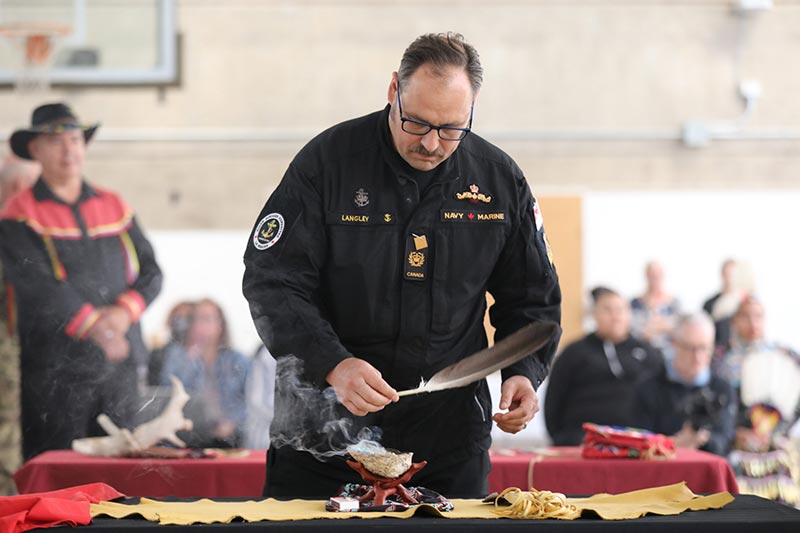
One of the new Eagle Staff carriers smudges a feather as part of the disassembly/reconstruction ceremony in Halifax.
A legacy passed on
In May 2025, an event was held in Halifax to pass the staff on to the next generation of caretakers. They took it apart, then smudged each part of it before reassembling it with great ceremony.
For Tony Parsons, the handoff of the Eagle Staff to a new generation was deeply emotional.
He spoke of feathers falling during ceremonies and the need to treat them like fallen soldiers, honoring them with the same reverence.
“We’re all part of everything,” he said. “The grass, the rocks—we’re all connected. That Eagle Staff, it carries all of us.”
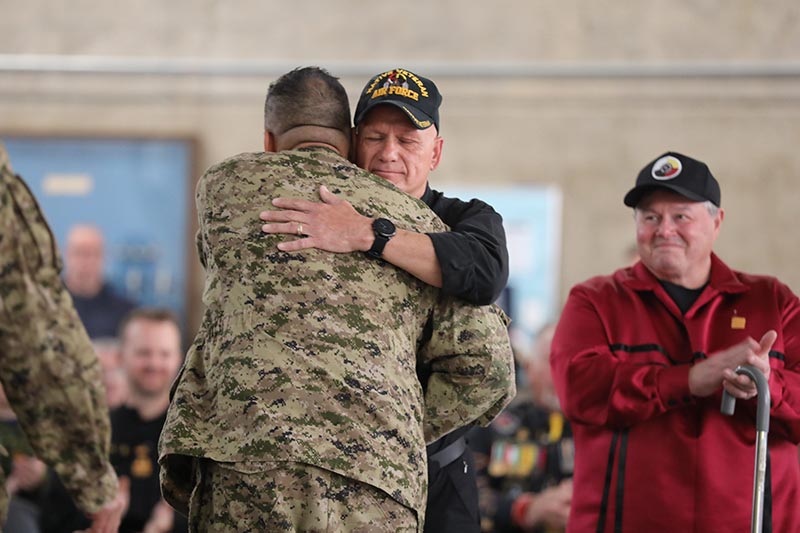
Tony Parsons hugs one of the new Eagle Staff carriers (as Kenneth Bennett looks on) after it was reassembled during the ceremony in Halifax.
This is the first time the staff has had new caretakers. Its creators have been responsible for it since its creation.
Ken Bennett said his heart was pounding as he handed the Eagle Staff over to its new caretakers. It was the first time he had held it in 15 years and said it felt like being in the presence of an old friend.
“We were following our own hearts and spirits. I'm so proud of being a part of that … that part of our ancient culture, that source of pride and honour that's been invited to events all over the world,” he said.
Bennett said the DND/CAF Eagle Staff remains a national symbol of reconciliation in action—where Indigenous protocol meets military tradition in a powerful act of mutual respect.
“This Eagle staff represents surely our past, our present and our future going forward in such a good way. There's so much that went into the Eagle Staff, I don't know if the whole story can ever be told.”
Bennett said the entire experience changed him.
“As we were building and creating the Eagle Staff, it was helping build and create me.”
Debbie Eisan, Kenneth Bennett, Chris Innis and Tony Parsons are Canadian Armed Forces Veterans and the creators of the sacred Canadian Armed Forces Eagle Staff.
Their efforts mean a new generation of Indigenous CAF members can see their cultural identity reflected in military ceremony.
They are Canadian Armed Forces Veterans.
The well-being of Canadian Veterans is at the heart of everything Veterans Affairs Canada does. As part of this, we recognize, honour and commemorate the service of all Canadian Veterans. Learn more about the services and benefits that we offer. If you contact VAC and self-identify as an Indigenous Veteran, you have the option to be connected with Indigenous Services Canada to receive culturally-safe and mental wellness services in addition to existing VAC benefits and services, including Peer Support.
If you are a Veteran, family member or caregiver, the support of a mental health professional is available anytime at no cost to you. Call 1-800-268-7708.