
A project that brings history to life
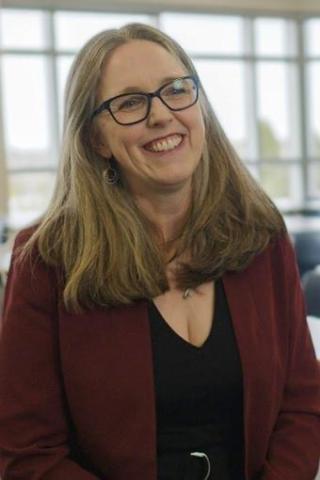
Vanessa Kirtz teaches history to grade 10 students at All Saints High School in Kanata, Ontario. The Second World War is near and dear to her heart and Kirtz has a special project to help her students understand the role Canadians played in that war. She pairs up her students to research one of the Canadians buried at Groesbeek Canadian War Cemetery in the Netherlands.
Their task: to comb through the enlistment papers, war diaries, pay records, and any other records, to find as many details as they can about their assigned soldier. Once they’ve found all they can, the pairs split up to write the soldier’s story: one writes about the soldier’s life prior to enlistment, while the other writes about the war period until their death. Both sections are then combined to be the soldier’s biography.
Sarah Tremblay, grade 12, and Hritika Pandey, grade 10, are two of Kirtz’s previous students. Both came to her class with a greater than average understanding of the importance of remembrance. Sarah’s father served in the Navy until his retirement a few years ago, and Hritika is an Air Cadet.

Sarah Tremblay (left) and Hritika Pandey (right) talk about the impact the Faces to Graves project had on them.
However, neither student expected to have such a strong response to their soldiers’ stories when they entered Kirtz’s class.
“I thought this was just like any other project we had to do,” says Sarah.
But it’s not. Hritika explains: “Writing these stories gives the soldiers and their families a voice that they may not have had beforehand.”
Thanks to this project, the students leaving Kirtz’s class know details about the lives of these fallen Canadian soldiers.
Hritika found a heartbreaking detail about her soldier, Roy Drake. Drake was a 23-year-old husband and father to two girls, with a third child on the way, when he was sent overseas. “But he never met his third daughter, Ola,” Hritika recalls.
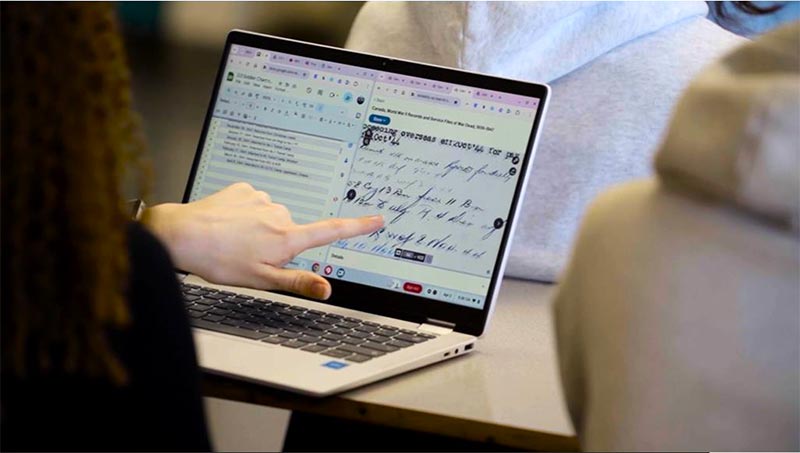
Researching the soldier’s lives includes reading handwritten records from soldiers’ letters and war records.
Just like her students, Kirtz also adopted a soldier. For the soldier she wrote about, she was able to connect with his niece, Donita. (Kirtz researches deeply into all the soldiers and tries to connect with family members each semester.)
Donita’s family knew very little about either Alexander McIntosh or his brother, Donald , Donita’s father, who also died in the war, before she was born. Through her research, Kirtz found old letters written by Donald, giving Donita a connection to him that she’d never had before.

Donald (left) and Alexander (right) McIntosh, the soldiers Kirtz researched.
The Dutch connection: Faces to Graves
What becomes of these projects once the students have finished their assignment? And, considering there are cemeteries across Western Europe where Canadians fought and died, why Groesbeek? Both questions lead to the same answer: the Dutch foundation, Faces to Graves.
In 2015, Kirtz participated in the 70th anniversary of the Liberation of the Netherlands, in which she and students from All Saints visited Groesbeek Canadian War Cemetery.
After returning home, a representative from Faces to Graves reached out to her and the students who travelled there. The foundation wanted to publish the student’s biographies on its website. Now, for the 80th anniversary of Victory in Europe Day, the Faces to Graves Foundation is creating a book of stories about the soldiers buried at Groesbeek. This book includes some of the biographies written by Kirtz’s students.
Thanks to the connection she made with Faces to Graves, Kirtz’s students are now researching names from the Algonquin Regiment’s fallen.
Additional benefits
This experience is teaching students that their work matters. That the facts and figures they find have a real-world meaning and impact. Their work is shared with families of the soldiers (if they can be found) as well as Legions and historical societies from the hometowns of the fallen.
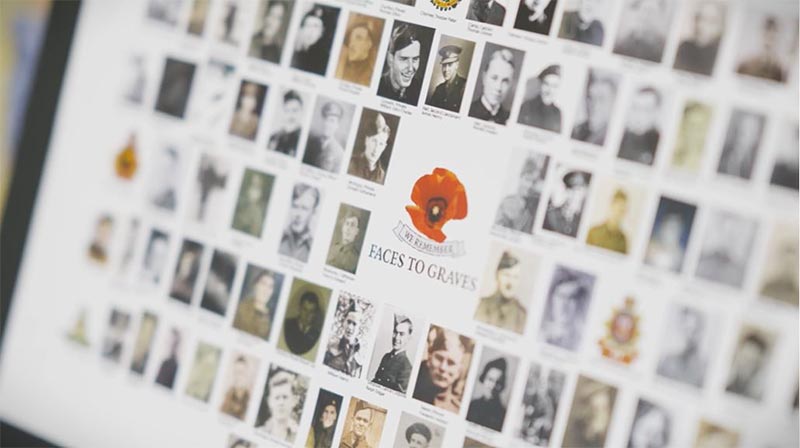
A collection of photos of soldiers Kirtz’s students have written biographies about for the Faces to Graves foundation.
One of the biggest payoffs of the project for students is, “They realize that they can do this, they can do hard things,” said Kirtz.
Despite time and distance, this project is a promise to keep the memory and the sacrifice of the fallen alive for generations to come.
With courage, integrity and loyalty, Vanessa Kirtz and her students are leaving their mark. Discover more stories