

Joined
1970

Postings
- RMC Kingston
- CFB Calgary
- NDHQ Ottawa
- CBF Lahr Germany
- CDLS London UK
- 1 BR Corps (UK) Lippstadt Germany
- CFB Petawawa
- CFB Kingston
- CFB Toronto
- UNHQ – New York, NY

Deployments
- UNEF II - Egypt
- UNICYP - Cyprus
- SFOR - Bosnia
- UNAMIR - Rwanda
- UNAMID - Sudan
- UNSOA - Somalia
- MINUSCA - Central African Republic
Introduction
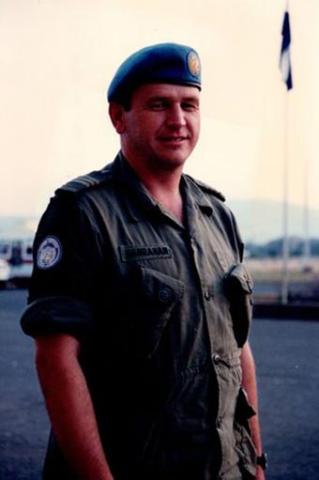
Taking part in complex peacekeeping missions in unstable regions of the world can be a challenging assignment, but Colonel (Retired) Michael Edward Hanrahan says he could always rely on his troops.
Canada’s unique approach to peacekeeping, with ingenuity and a genuine desire to help, makes the Canadian Peacekeepers valued on international missions such as the 1994 United Nations Assistance Mission for Rwanda (UNAMIR), the Colonel said.
This is rooted in Canada’s multicultural identity and a “can-do” mindset that values collaboration.

Hanrahan, a self-proclaimed “air force brat” who served 37 years with the Canadian Army as a Signals Officer, commanded at each rank level. He conducted operational and technical staff assignments, instructed at the army staff college, went on exchange tours with the UK and a diplomatic tour with the Permanent Mission of Canada to the United Nations.
He worked as a peacekeeper in Egypt, Cyprus, Rwanda, Bosnia, Darfur, Somalia, and Central Africa Republic where he was often one of the first to arrive.
This content involves painful subject matter about the horrors of war. Some readers may be personally affected by this content. If you are impacted, help is available.
If you are a Veteran, family member or caregiver the support of a mental health professional is available 24/7, 365 days a year at no cost to you. Call 1-800-268-7708.
Setting up missions
In 1994, he deployed as the Canadian Contingent Commander to support Major-General Dallaire, who was commanding UNAMIR. The Canadian contingent was responsible for supporting the mission headquarters, maintaining communications with all UN deployed units, providing logistical support to newly arriving units, and running the Kigali International Airport.
“I'm a mission start-up type guy,” he said with a smile.
Between 1993 and 1996, approximately 1,300 members of the Canadian Armed Forces served in Rwanda.
Starting up a new peacekeeping mission is more an art than a science, Hanrahan explains. He says, when the UN arrives, it gives people a sense of safety and hope.
“That’s a big thing with most missions, is you have to get people out and amongst the people very quickly.

During his time there, the contingent adopted nine orphanages. At Christmas, 50 tons of clothes and toys received from Canada were distributed to Rwandan children.
Hanrahan says Canadian soldiers, with adaptability and eagerness, offered their help wherever they saw a need – and the need was everywhere. With so many children orphaned because of the genocide, Non-Governmental Organizations (NGO), who were in Rwanda to provide humanaritian support, saw the need as well and Canadians helped them set up these spontaneous orphanages.
“The orphanages in Rwanda, they just happened almost through osmosis. Somebody saw a kid by the road, saw a Non-Governmental Organization (NGO) with 10 or 15 kids and said, ‘what are you doing starting an orphanage?’ Can we come and help?’”
“So, three or four guys would jump in a vehicle and go down and help and get the water going or the electricity going or whatever.”
Peacekeeping challenges
Hanrahan emphasized that each peacekeeping mission involves facing challenges like scarcity of resources (fuel, food and drinking water), lack of transportation infrastructure (airports, roads, and seaports), slow deployment of military, police and civilian personnel, political interference, bad weather and violence. But, he says when the line between combatants and civilians blur, things get extra tricky.
In Rwanda, Canadian soldiers had to deploy in small groups to isolated areas where they saw the horrifying after-effects of the genocide, with horrific loss of life everywhere.

New infantry battalions were deployed to their sectors before the arrival of their vehicles. One battalion had to move 270 kilometres west of Kigali through the mountains and there were no passenger vehicles or buses available to move them. Hanrahan was able to secure a couple of commercial flatbed trucks and a few dump trucks for the soldiers to stand on for the whole trip. He explained, although it was far from an ideal mode of travel, all of them agreed it was better than marching.
Hanrahan and his troops supported logistics, communication and humanitarian efforts and tried to keep the morale up while they attempted to police, disarm and offer humanitarian aid.
He also had to manage expectations between field ops and UN HQ in New York.
Reflecting on Rwanda
Thirty years after Rwanda, Hanrahan reflects on humanity’s capacity for cruelty and the efforts of so many to mitigate the violence and hatred that erupted there.
“The human race has tried to destroy itself since there were two cavemen,” he said.
“To this day, I don't know how a human being can develop so much hatred and do such cruel things to another human being. But it's definitely a flaw in every human because we've seen it in the Holocaust. We've seen it in Rwanda. You’re seeing there's a switch in humans that takes them from being civilized back to a very basic animal, they do very stupid things, and that gene hasn't left the human race yet.”
“Veterans who lived through the atrocities of genocide and war need support,” he said. That’s why Hanrahan advocated for embedding mental health support within units and training sergeants and corporals to recognize symptoms and guide support.
Getting Veterans help and support
Hanrahan believes that stigma, pride and systemic hurdles hinder access to the mental health support Veterans need.
“One thing that really, bothers me is when we do send people out, some don’t come back, some of them come back damaged. And the degree of damage depends on what they see and do,” he said.
“And I think in Rwanda's case, it was a lot more mental.”
Hanrahan believes that long-term care for Veterans has to evolve to meet changing expectations. We have gone from the “shell shock” after the Second World War to the complex psychological and social needs of a newer generation of peacekeepers.
He remains an advocate for continued Canadian engagement in international peacekeeping and proper supports for Veterans with PTSD.
He retired from the army in 2007 and immediately deployed as a civilian staff member to the UN. Upon retirement from there, he set up a consultancy service, which was leveraged by the UNHQ and UN peacekeeping missions to assist them in developing and implementing their supply chain management policies, processes, and procedures.
Hanrahan is now retired and lives in Victoria with Ellen, his wife of 47 years, and their 90-pound Labrador. They enjoy travelling, cycling, and cheering on their grandchildren’s athletic and artistic endeavors.
The well-being of Veterans is at the heart of everything we do. As part of this, we recognize, honour and commemorate the service of all Veterans. Learn more about the services and benefits that are available to Veterans and their families.