Description
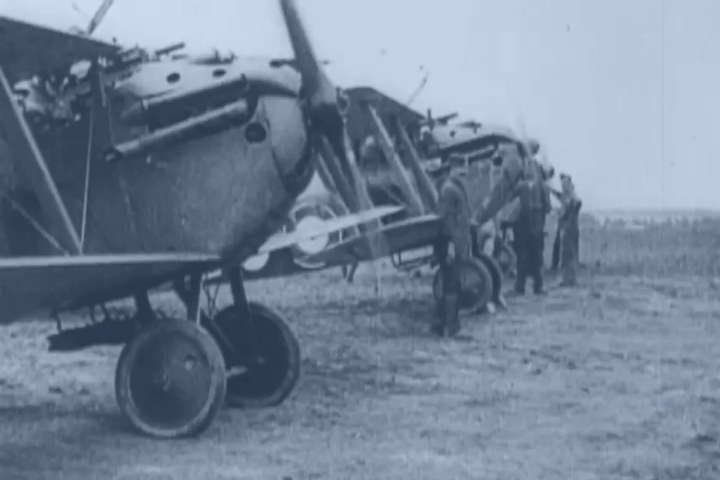
Narration on archival footage depicting the life in the trenches during the First World War.
Transcript
Trenches of the First World War were not the great killers we were led to believe.
Throughout the war, no more than one out of nine or ten casualties was attributed to living in the trenches.
Most men were wounded or killed going over the top, on patrols and attacks.
But this by no means implies that trenches were pleasant, on the contrary.
The noise was awful, nothing seemed coherent ... our heavy and light artillery, trench mortars, Stokes guns and machine guns made a ceiling of rushing steel above our heads.
Corporal Charlie Ross Francis 90th Canadian Infantry Battalion
Enemy shells peppered the trenches almost every day.
About noon we began to get some heavy shells put over at us. It blew one of our boys to pieces, wounded another and temporarily buried two others.
Corporal Charlie Ross Francis 90th Canadian Infantry Battalion
Exposure to the elements and lack of rest became a psychological torment.
Four days in the front line with little or no sleep is no joke. I have no hesitation in taking the rum these days and I feel it is quite necessary under the nervous strain, sleeplessness, cold and dampness.
Corporal Charlie Ross Francis 90th Canadian Infantry Battalion
Antibiotics had not been discovered, and even minor injuries could fester and cause death. Some would even injure themselves just to get out of there…
(visual – war diaries)
Bodies of the dead would lie nearby until rot made them unidentifiable.
She's a terrible war isn't she? But we all look on the humorous side of things if even it's a stiff being buried.
Gunner Bertram Howard Cox 60th Canadian Artillery Battery
Dysentery, typhus and cholera were common place. Soldiers had parasites.
We get a bath every 2 weeks … we hand in the dirty underwear and get ‘so called’ clean ones. I pity the poor fellow who gets mine as I am horribly lousy.
Gunner Bertram Howard Cox 60th Canadian Artillery Battery
Poor hygiene meant fungal infections, the worst and best known of which were trench mouth and trench foot.
My socks were embedded in my feet with caked mud and filth and had to be removed with a knife.
Private Harold Saunders
So trenches weren’t killers as such, but they were awful, nasty places where death and injury could come at any time, and where there was little or nothing you could do about it.
Oh, how we'll appreciate freedom and liberty, if we ever get out of this thing.
Gunner Bertram Howard Cox 60th Canadian Artillery Battery
Throughout the war, no more than one out of nine or ten casualties was attributed to living in the trenches.
Most men were wounded or killed going over the top, on patrols and attacks.
But this by no means implies that trenches were pleasant, on the contrary.
The noise was awful, nothing seemed coherent ... our heavy and light artillery, trench mortars, Stokes guns and machine guns made a ceiling of rushing steel above our heads.
Corporal Charlie Ross Francis 90th Canadian Infantry Battalion
Enemy shells peppered the trenches almost every day.
About noon we began to get some heavy shells put over at us. It blew one of our boys to pieces, wounded another and temporarily buried two others.
Corporal Charlie Ross Francis 90th Canadian Infantry Battalion
Exposure to the elements and lack of rest became a psychological torment.
Four days in the front line with little or no sleep is no joke. I have no hesitation in taking the rum these days and I feel it is quite necessary under the nervous strain, sleeplessness, cold and dampness.
Corporal Charlie Ross Francis 90th Canadian Infantry Battalion
Antibiotics had not been discovered, and even minor injuries could fester and cause death. Some would even injure themselves just to get out of there…
(visual – war diaries)
Bodies of the dead would lie nearby until rot made them unidentifiable.
She's a terrible war isn't she? But we all look on the humorous side of things if even it's a stiff being buried.
Gunner Bertram Howard Cox 60th Canadian Artillery Battery
Dysentery, typhus and cholera were common place. Soldiers had parasites.
We get a bath every 2 weeks … we hand in the dirty underwear and get ‘so called’ clean ones. I pity the poor fellow who gets mine as I am horribly lousy.
Gunner Bertram Howard Cox 60th Canadian Artillery Battery
Poor hygiene meant fungal infections, the worst and best known of which were trench mouth and trench foot.
My socks were embedded in my feet with caked mud and filth and had to be removed with a knife.
Private Harold Saunders
So trenches weren’t killers as such, but they were awful, nasty places where death and injury could come at any time, and where there was little or nothing you could do about it.
Oh, how we'll appreciate freedom and liberty, if we ever get out of this thing.
Gunner Bertram Howard Cox 60th Canadian Artillery Battery
Metadata
Life in the Trenches
Medium
Video
Owner
Veterans Affairs Canada
Duration
2:58