Description
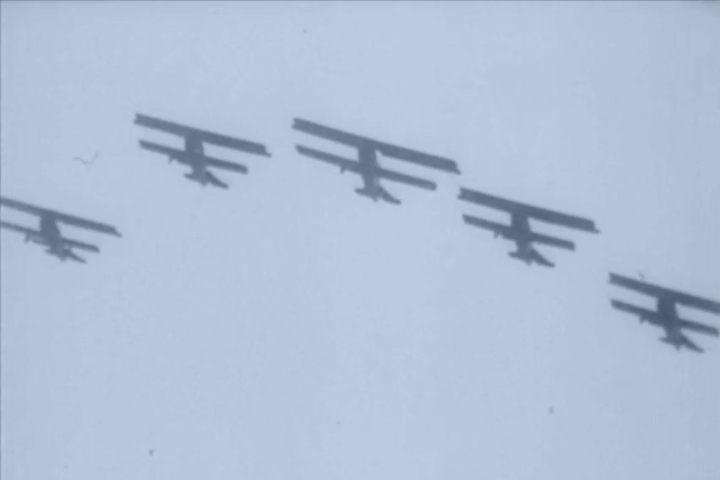
Narration on footage explaining the rapid evolution of the use of aircraft during the First World War, first as a means of observation, then as a weapon.
Transcript
It’s truly amazing to think that the Wright Brother’s first flight was in 1903…
…and that by the end of the First World War, just 15 years later, planes had changed the way wars are waged.
In 1914, planes had limited military value. Reliable civilian models weren’t suited to military operations. Critics thought they could only be useful to glean information about the enemy, but never as an offensive weapon!
For the first two years of the war, critics were more or less right.
Some bombing was done, but the failures outnumbered the symbolic successes.
Planes were rickety, bombs dangled loosely, and guns were carried on board, sometimes in holsters, making aerial combat seem like fiction.
But the exacting military necessities of war soon made reality stranger than fiction.
When it came to reconnoitering in fair weather, dirigibles had an advantage over planes: they could stay put, hovering over a position to acquire intelligence. But when fog, rain, or mist forced them to lower altitudes…
(image of blow up, ground to air)
On the other hand, the ever increasing speed of planes meant they could fly lower to the ground in relative safety.
I saw the German anti-aircraft shoot … for 3/4 of an hour and our airman … just kept on going and the sky was just full of little puffs of smoke, and they never touched him.
Gunner Bertram Howard Cox 60th Royal Canadian Artillery Battery
Over a short time, better bombs and bombing systems made for better bombers. Airmen became experts in the guidance of artillery fire, and when men in the trenches saw a hostile plane, they hid. To do otherwise was asking for a big gun outburst.
But it’s the dog fights that truly show how astoundingly fast planes and pilots were evolving at that time.
Like nearly all other pilots… in the air…, I could hardly realize that these were real live, hostile machines. I was fascinated by them and wanted to circle about and have a good look at them.
William ‘Billy’ Bishop Canadian Ace pilot
Stronger airframes and better wings meant more battle maneuverability.
Frame-mounted machine guns also helped, but sighting a moving plane from another moving plane was so difficult that gun-fire had to be absolutely point blank. Hence the wonderful displays of tactical operations when hostile planes dogged it out.
Encounters in the sky were merciless. Pilots didn’t wear parachutes, there was no question of surrender up there.
And it was cold, real cold.
So the human element can’t be ignored. The personal quality of the aviator was often the decisive factor in aerial battles… even though some humble flying aces would disagree.
The most important thing in fighting was shooting, next the various tactics in coming into a fight and last of all flying ability itself.
William ‘Billy’ Bishop Canadian Ace Pilot
Think about it. Over the relatively short period of the First World War, men in planes had achieved something that seemed impossible only four years before, and contests between enemy planes hundreds of feet above the earth now seemed as matter-of-fact as a bayonet melee between infantry forces.
…and that by the end of the First World War, just 15 years later, planes had changed the way wars are waged.
In 1914, planes had limited military value. Reliable civilian models weren’t suited to military operations. Critics thought they could only be useful to glean information about the enemy, but never as an offensive weapon!
For the first two years of the war, critics were more or less right.
Some bombing was done, but the failures outnumbered the symbolic successes.
Planes were rickety, bombs dangled loosely, and guns were carried on board, sometimes in holsters, making aerial combat seem like fiction.
But the exacting military necessities of war soon made reality stranger than fiction.
When it came to reconnoitering in fair weather, dirigibles had an advantage over planes: they could stay put, hovering over a position to acquire intelligence. But when fog, rain, or mist forced them to lower altitudes…
(image of blow up, ground to air)
On the other hand, the ever increasing speed of planes meant they could fly lower to the ground in relative safety.
I saw the German anti-aircraft shoot … for 3/4 of an hour and our airman … just kept on going and the sky was just full of little puffs of smoke, and they never touched him.
Gunner Bertram Howard Cox 60th Royal Canadian Artillery Battery
Over a short time, better bombs and bombing systems made for better bombers. Airmen became experts in the guidance of artillery fire, and when men in the trenches saw a hostile plane, they hid. To do otherwise was asking for a big gun outburst.
But it’s the dog fights that truly show how astoundingly fast planes and pilots were evolving at that time.
Like nearly all other pilots… in the air…, I could hardly realize that these were real live, hostile machines. I was fascinated by them and wanted to circle about and have a good look at them.
William ‘Billy’ Bishop Canadian Ace pilot
Stronger airframes and better wings meant more battle maneuverability.
Frame-mounted machine guns also helped, but sighting a moving plane from another moving plane was so difficult that gun-fire had to be absolutely point blank. Hence the wonderful displays of tactical operations when hostile planes dogged it out.
Encounters in the sky were merciless. Pilots didn’t wear parachutes, there was no question of surrender up there.
And it was cold, real cold.
So the human element can’t be ignored. The personal quality of the aviator was often the decisive factor in aerial battles… even though some humble flying aces would disagree.
The most important thing in fighting was shooting, next the various tactics in coming into a fight and last of all flying ability itself.
William ‘Billy’ Bishop Canadian Ace Pilot
Think about it. Over the relatively short period of the First World War, men in planes had achieved something that seemed impossible only four years before, and contests between enemy planes hundreds of feet above the earth now seemed as matter-of-fact as a bayonet melee between infantry forces.
Metadata
AirForce
Medium
Video
Owner
Veterans Affairs Canada
Duration
3:55