Description
Narration on archival images that evoke the upheavals that marked the recruitment and training of Canadian airmen during the First World War and the importance of Canadians in the success of the Royal Air Force (RAF).
Transcript
When war broke out in 1914, Canada had an Aviation Corps of three men and one plane.
By the end of that same year, this first attempt at a national air force had… well… plummeted.
We tried again in 1916, but in 1918, when the war ended, we still had no air force.
So how did we end up with so many pilots and flying aces?
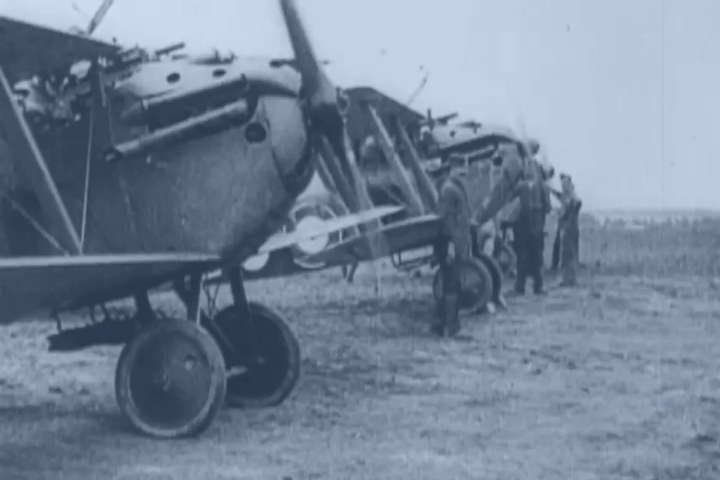
Well, many Canadians served with the British Royal Flying Corps, the Royal Naval Air Service and the RAF - the Royal Air Force.
But in the beginning, they only recruited men with a valid pilot’s license and aviators had to pay for their own training.
That didn’t fly long.
Soon, more pilots were needed than British and Canadian civilian training schools could supply.
So in 1917 the Royal Flying Corps opened three training stations in Canada: Borden, Deseronto and North Toronto.
In no time at all, Canada became one of the world’s leading training facilities for pilots.
When the United-States joined the war, Canada lost two of these facilities to Fort Worth, Texas, but in early 1918, the Royal Air Force returned to Canada and invested in even more advanced training units.
At the end of the war, after only twenty-one months in Canada, the RAF had recruited over 16,000 personnel, and trained more than 3,000 pilots.
Even though the life expectancy of a wartime pilot was about three weeks, these Canadians served with skill and gut.
Of the 27 allied pilots with more than 30 combat victories, 10 were Canadians, and 3 won the Commonwealth’s highest award of valour, the Victoria Cross.
By the end of that same year, this first attempt at a national air force had… well… plummeted.
We tried again in 1916, but in 1918, when the war ended, we still had no air force.
So how did we end up with so many pilots and flying aces?
Well, many Canadians served with the British Royal Flying Corps, the Royal Naval Air Service and the RAF - the Royal Air Force.
But in the beginning, they only recruited men with a valid pilot’s license and aviators had to pay for their own training.
That didn’t fly long.
Soon, more pilots were needed than British and Canadian civilian training schools could supply.
So in 1917 the Royal Flying Corps opened three training stations in Canada: Borden, Deseronto and North Toronto.
In no time at all, Canada became one of the world’s leading training facilities for pilots.
When the United-States joined the war, Canada lost two of these facilities to Fort Worth, Texas, but in early 1918, the Royal Air Force returned to Canada and invested in even more advanced training units.
At the end of the war, after only twenty-one months in Canada, the RAF had recruited over 16,000 personnel, and trained more than 3,000 pilots.
Even though the life expectancy of a wartime pilot was about three weeks, these Canadians served with skill and gut.
Of the 27 allied pilots with more than 30 combat victories, 10 were Canadians, and 3 won the Commonwealth’s highest award of valour, the Victoria Cross.
Metadata
Aviation
Medium
Video
Owner
Veterans Affairs Canada
Duration
2:06