
ISBN 978-0-660-98050-8
March 6-7, 2025
Table of contents
- This publication is available upon request in alternate formats.
Executive Summary
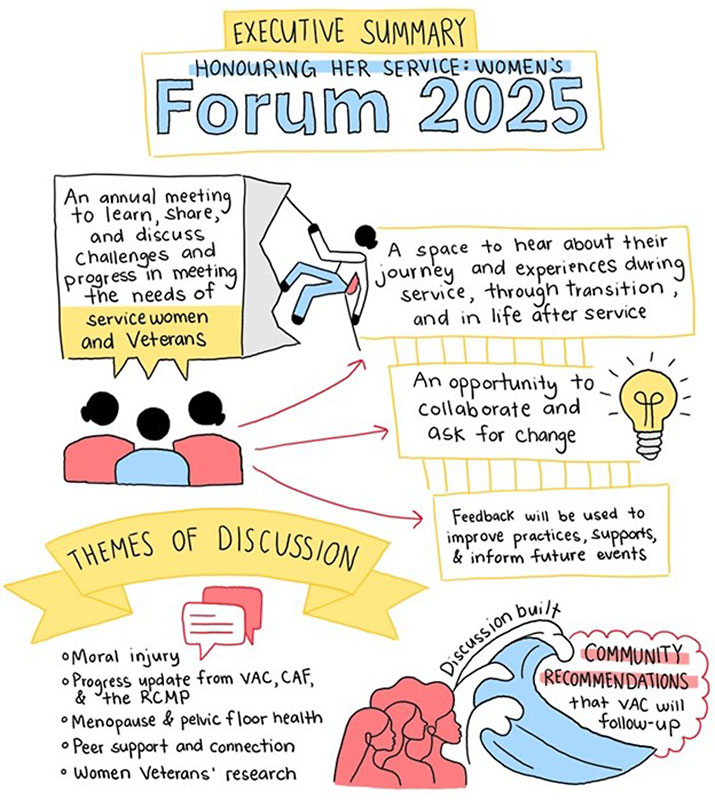
Figure 1: Graphic visualization summarizing the key aspects covered in this report
Transcript - Figure 1
Infographic titled "Executive Summary-Honouring Her Service: Women’s Forum 2025" at the top. Below, a speech bubble from three silhouetted figures reads "an annual meeting to learn, share, and discuss challenges and progress in meeting the needs of servicewomen and Veterans." The bubble transitions into a mountain with a person climbing, featuring long hair in a bun. Adjacent, a text box reads "a space to hear about their journey and experiences during service, through transition, and in life after service," linked by yellow lines to another box reading "an opportunity to collaborate and ask for change" with a glowing lightbulb. A third box, connected by yellow lines, notes "feedback will be used to improve practices, supports, and inform future events." A yellow banner at the bottom reads "Themes of Discussion: moral injury, progress updates from VAC, CAF, and the RCMP, menopause and pelvic floor health, peer support and connection, women Veterans' research.” A blue wave connects to a section on the right stating " discussion built, community recommendations that VAC will follow up".
Introduction
Veterans Affairs Canada (VAC) would like to start by acknowledging and thanking all Veterans and their families, across Canada, for their service to this country.
From coast to coast to coast, we acknowledge the ancestral and unceded territory of all the Inuit, Métis, and First Nations people that call this land home.
We acknowledge the harms and mistakes of the past. We all have a responsibility to consider how we can, in our own way, move forward in a spirit of reconciliation and collaboration. We reaffirm our commitment to improving relationships between nations and improving our own understanding of Indigenous peoples and their cultures.
VAC acknowledges the adversity that women Veterans have faced, and continue to encounter, in their service and would like to reaffirm its commitment to listen and enact change.
The Women Veterans Council
In early 2025, the first Women Veterans Council was stood up to offer the Minister of Veterans Affairs and Associate Minister of National Defence insight into the unique points of view and lived/living experiences of women (still-serving and Veterans).
The mandate of this work is to identify systemic barriers, sources of discrimination and provide advice and recommendations to the Minister on a wide variety of issues, including but not limited to:
- Transition supports for CAF and RCMP women (in-service and Veterans);
- Equitable access to all benefits administered by VAC for women; and,
- The identification of research priorities to ensure VAC funded research with respect to health equity, data equity, economic equity, outreach and recognition.
The Women Veterans Council played a key role in the planning and delivering of the Honouring Her Service: 2025 Women’s Forum.
Notes to the reader
- The “Honouring Her Service: 2025 Women’s Forum” will be referred to throughout the rest of the report as “the Forum”. All acronyms will be spelled out the first time they are introduced.
- Digital artwork was created by an artist/analyst in real time during the event and refined for presentation in the report.
- Quotes featured throughout this report highlight anonymous and open discussion that occurred throughout the event, not to be attributed to individuals in the photos included.
Event structure
The Forum was a two-day event, with optional activities for in-person participants on March 6, 2025 and main event discussions on March 7, 2025.
Optional activities included: trauma-informed yoga, a meeting with VAC representatives to assist with benefits and services, an exhibit hall with 18 community organization exhibits sharing resources available to women Veterans, a therapeutic horticulture activity, an education session on peer support, and a sharing circle with Grandmother Irene Compton.
The main event included two sessions where speakers addressed the entire group (group discussions), and three sessions delivered to smaller groups three times (breakout sessions) – intent being that each participant had the chance to listen to every speaker.
Participant questions were managed using an online platform (Slido) to support audience interaction. They could submit questions anonymously at any time during the main group discussions. Questions were read out loud and many were answered. Unanswered questions were collected and answers will be shared by Veterans Affairs Canada. Questions asked in the breakout sessions were all answered in real time during those sessions.
Built by the community - 2025 Women’s Forum Consultation
A core part of planning this event was engaging with women Veterans, women serving in the Canadian Armed Forces (CAF), and women serving in the Royal Canadian Mounted Police (RCMP), to hear what topics they would like to see on the agenda. An online questionnaire ran from October 28 to November 20, 2024, gathering 499 responses from primarily English-speaking women with diverse service backgrounds. The findings were shared with the Women Veterans Council, who collaborated to create an agenda that aimed to address the diverse interests of the community and facilitate meaningful discussions on their most pressing areas of interest.
Discussion topics
- Group discussion: Understanding and addressing moral injury (RCMP focus)
- Group discussion: Invisible No More: Progress update from VAC, CAF, and RCMP
- Breakout session 1: Menopause and pelvic floor health
- Breakout session 2: The power of connection for women experiencing isolation
- Breakout session 3: Workshop on the Women Veterans' Research Plan
Forum participants
VAC extended invitations to a diverse group of Veterans and community partners, with the majority of participants being women. There were 66 participants in-person and an additional 173 were invited to participate online among all the different discussions. There were 39 additional attendees from the exhibitor organizations, many of whom were Veterans.
Forum objectives
Transcript - Forum objectives
- Objective 1 - Meaningful engagement with women Veterans and the stakeholder community
- Objective 2 - Learn, share, and discuss challenges and progress in meeting the individual needs of women Veterans
- Objective 3 - Develop community-based solutions to drive change and achieve equity
Minister’s welcome
The Honourable Darren Fisher, Minister of Veterans Affairs and Associate Minister of National Defence, opened the Forum. The Minister started by sharing a clear intention for the event: to have crucial dialogue, to collaborate, and to make progress towards equitable outcomes for women Veterans. The importance of these Forums to progress this, which has been sought by women for decades, was emphasized, as was the immense effort and resiliency that has been required of them along the way.
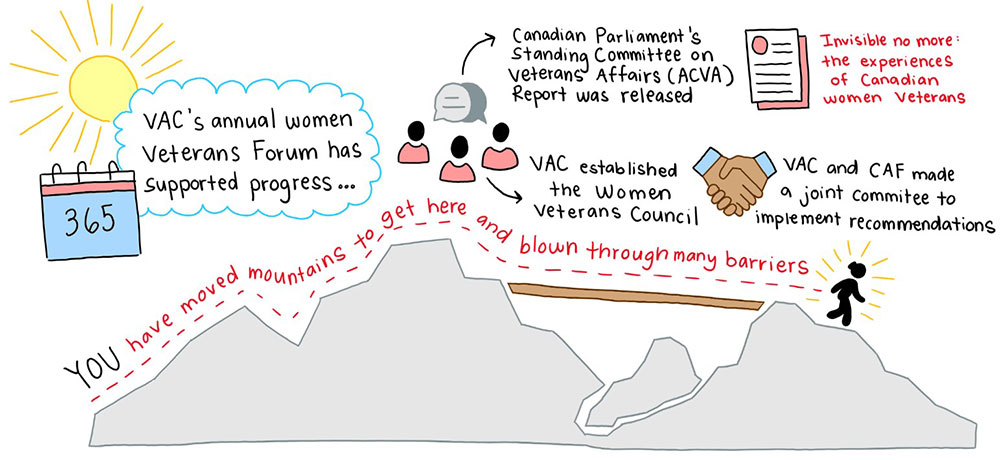
The Minister highlighted key progress milestones since last year (2024 Forum), including the launch of the Women Veterans Council at Veterans Affairs Canada (VAC) and the release of the report from the Standing Committee on Veterans Affairs (ACVA) – Invisible no more: the Experiences of Canadian Women Veterans. The Minister concluded by saying that work is far from over and asked that women continue to use their voice to shape a policy legacy.
Figure 2: Graphic visualization of the Minister’s opening remarks at the Forum
Transcript - Figure 2
Infographic depicting progress for Canadian women Veterans, with a mountain range symbolizing barrier. At the top left, a sun shines over a blue speech bubble reading "VAC's annual women Veterans Forum has supported progress..." with a calendar showing "365." Below, text states "You have moved mountains to get here and blown through barriers" in red, with a dotted line tracing the path. On the left, an arrow points to text that reads "Canadian Parliament's Standing Committee on Veterans Affairs (ACVA) Report was released," linked to a document titled "Invisible no more: the experiences of Canadian women Veterans" in pink. Center-left shows three silhouetted figures, with an arrow to "VAC established the Women Veterans Council." On the right, a handshake icon connects to "VAC and CAF made a joint committee to implement recommendations," with a figure walking down the hill and a burst of light around her.
Group discussion : Understanding and addressing moral injury (RCMP focus)
This session took place as part of the optional activities on the first day of the Forum.
Overview of presentation
Researchers spoke about what moral injury is, how it develops, and options for treatment. Many RCMP members and first responders who have experienced moral injury describe it as feelings of guilt, anger, and deep sorrow. It was highlighted that while public safety personnel are at an increased risk of moral injury, it is not limited to just the military, RCMP, and others who rush to danger.
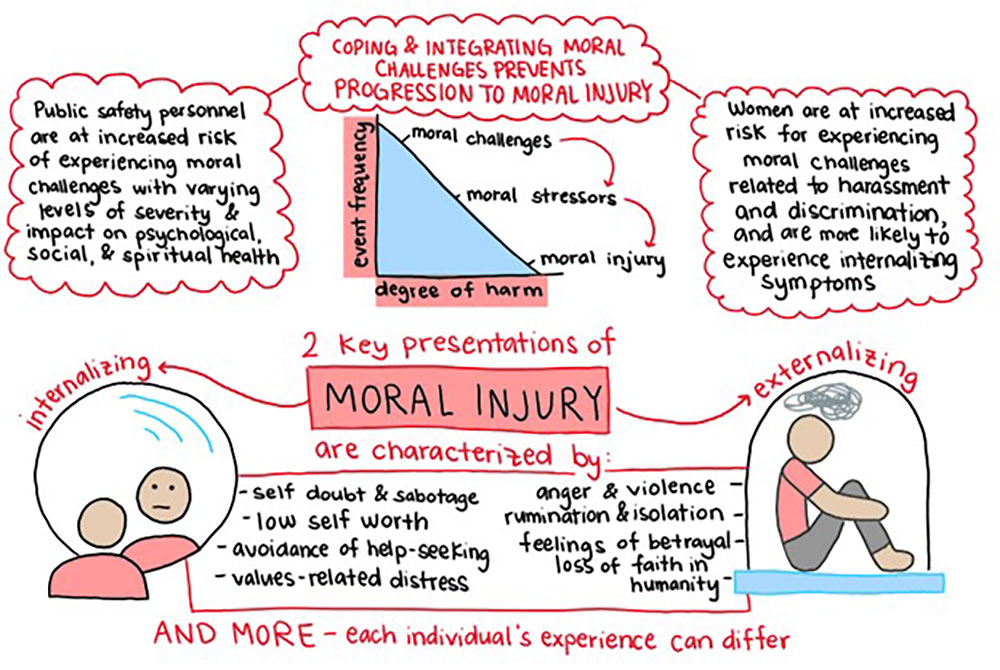
Figure 3. Graphic visualization of the group discussion: understanding and addressing moral injury at the Forum
Transcript - Figure 3
Infographic on moral injury. Top left, a pink speech bubble states "public safety personnel are at increased risk of experiencing moral challenges with varying levels of severity and impact on psychological, social, and spiritual health." Top right, a red speech bubble reads "women are at increased risk for experiencing moral challenges related to harassment and discrimination and are more likely to experience internalizing symptoms." Center, a blue right-angled triangle illustrates "coping and integrating moral challenges prevents progression to moral injury," with the left side labeled "event frequency," the bottom base labeled "degree of harm," and the hypotenuse labeled "moral challenges”, "moral stressors" and "moral injury”. Below, "2 key presentations of moral injury are characterized by" is written, with two figures: one labeled "internalizing" with text "self-doubt and sabotage, low self-worth, avoidance of help-seeking, values-related distress," and another labeled "externalizing" with text "anger and violence, rumination & isolation, feelings of betrayal, loss of faith in humanity." A note at the bottom reads "and more - each individual's experience can differ."
Moral injury presents differently depending on identity factors such as sex and gender, with a well-studied difference existing between men and women. Women were cited as being at increased risk for moral injury due to harassment and discrimination. Researchers also pointed out that while often associated with PTSD, moral injury can be an independent condition – and one that is associated with twice the risk of suicide.
Key takeaways from discussion
- The importance of community connection and belonging are crucial supports for public safety personnel who are at increased risk for moral injury.
- Moral injury supports will be unique to the experiences of each individual, with particular consideration for gender and other identity-based differences.
- Preventive measures exist to curb distress and prevent moral injury, such as proactively providing resources, listening and validating concerns when they are raised.
- Resources available to Canadian serving members and former members to treat moral injury include the national Operational Stress Injury Clinic Network, a free online self-forgiveness workbook, and a free resource for guided Mantram repetition exercise.
Group discussion: Invisible No More: Progress update from VAC, CAF, and the RCMP
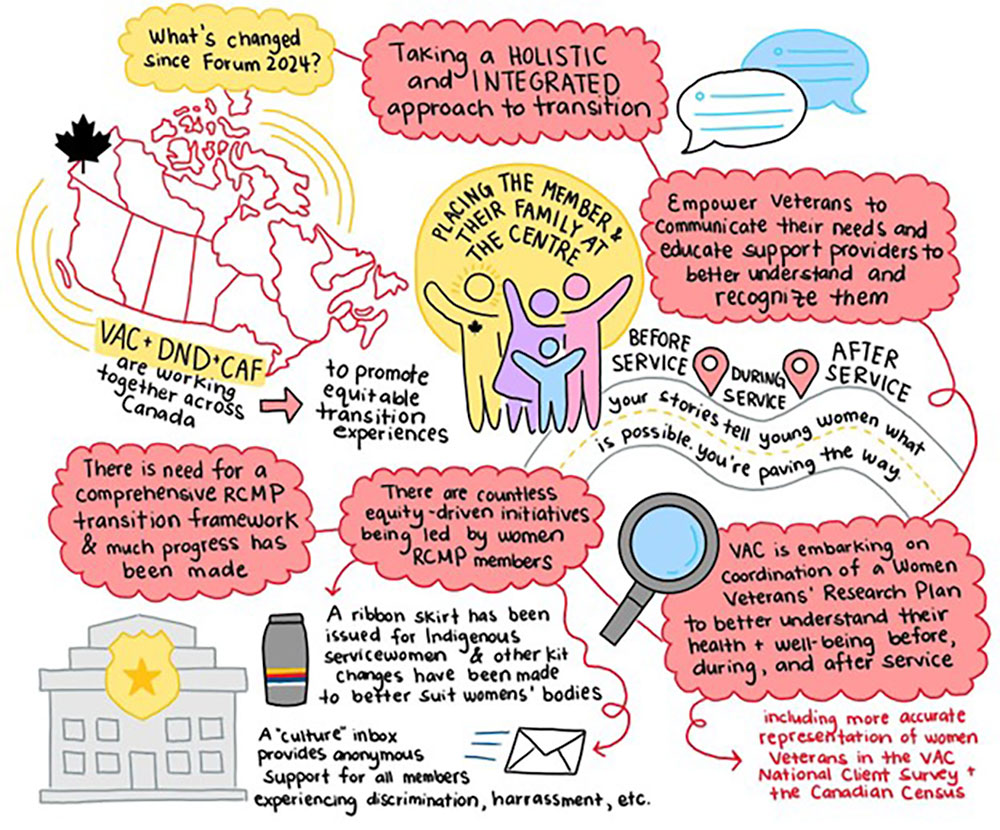
This group discussion brought together representatives from the Canadian Armed Forces (CAF), Royal Canadian Mounted Police (RCMP), and Veterans Affairs Canada (VAC) to share progress made since the 2024 Forum in support of servicewomen, Veterans, and former RCMP members.
Overview of presentation
All three representatives provided an update on changes being made in their respective organizations to support service women, members and Veterans.
The Canadian Armed Forces
The CAF is focused on identifying service women who are facing disproportionate challenges in service and creating innovative solutions to improve retention and supports during their military careers. For women transitioning out of the Armed Forces, the new transition approach includes:
- Holistic assessment across the seven domains of Veteran health and well-being;
- Integration with VAC services;
- Dedicated family transition advisors at transition centres; and,
- Standardization across provinces and territories.
The recently created National Resource Directory, recommends specific, verified services available to servicemembers and Veterans at low or no cost in their own community.
Royal Canadian Mounted Police
Currently, the RCMP is working to address the gaps that exist with their transition processes. Progress has been made with the creation of a specialist team that works with retirees to support them throughout transition. Recent initiatives to support women serving in the RCMP include:
- New fitness assessments and kit;
- A mobile app to direct RCMP Veterans and families to wellness services; and
- Cadet programs that promote diversity, inclusion, equity, and accessibility in the recruitment process.
Veterans Affairs Canada
Recent initiatives to support service women and Veterans include:
- An updated women specific research website;
- Increased recognition of women’s service and lived/living experiences; and,
- Updates to the Table of Disabilities and Entitlement Eligibility Guidelines as part of a full review of these policies through a lens of gender-based analysis plus (GBA+).
Specifically, the definition of trauma was updated, and new sections were added for cervical, urinary, and breast conditions. Overall, VAC’s policies were emphasized as becoming more trauma-informed and holistic to include all aspects of women Veterans’ experiences, beyond biological and anatomical differences.
The importance of research, trust-building, engagement, recognition, and awareness was emphasized as we progress towards equitable health and well-being outcomes for women who have served.
Figure 4. Graphic visualization of the group discussion: Invisible No More: Progress update from VAC, CAF, and RCMP at the Forum
Transcript - Figure 4
Infographic titled "What's changed since Forum 2024? Taking a holistic and integrated approach to transition." At the top left, a Canadian map with "VAC, DND/CAF together working across Canada to promote equitable transition experiences". Below, a pink speech bubble reads "there is need for a comprehensive RCMP transition framework and much progress has been made." Center, a family icon with "placing the member and their family at the centre," to the right of the family icon are following three texts: "before service", "during service" and “after service”. Above these three texts is a pink bubble reads “ empower Veterans to communicate their needs and educate support providers to better understand and recognize them” and underneath the three texts is the following wording, "your stories tell young women what is possible, You are paving the way”, Below, a magnifying glass with "VAC is embarking on coordination of a women Veterans’ Research Plan to better understand their health and well-being before, during, and after service,” with the following text beneath the pink bubble: “ including more accurate representation of women Veterans in the VAC National Client Survey and the Canadian Census”. To the left of the magnifying glass is pink bubble with the following text “there are countless equity -driven initiatives being led by women RCMP members”. Bottom left, a text reading "a ribbon skirt has been issued for Indigenous servicewomen & other kit changes have been made to better suit women’s bodies." Bottom middle, a letter icon with the follow text "a culture inbox provides anonymous support for all members experiencing discrimination, harassment, etc." Red lines connect elements across the infographic.
Key takeaways from discussion
“Since 2014, we've had… 1,600-ish female RCMP officers retire. And I can tell you that about half of that, over that decade, was due to medical retirement.”
- The ACVA report, Invisible no More: the Experiences of Canadian Women Veterans was cited as a catalyst and culmination of advocacy efforts, leading to significant change for servicewomen – both CAF and RCMP.
- There is need for more specific research into RCMP member's well-being. Consulting this evidence will be pivotal in the creation of a new national transition framework (underway) and other needed supports.
- Initiatives to educate civilian providers about treating Veterans and navigating transition are ongoing.
- Career services, peer support, and targeted supports for single Veterans are important for successful transition and continued well-being.
- Sustained support to military sexual trauma survivors.
Breakout session 1: Menopause and pelvic floor health
This breakout session was designed to educate participants regarding two critical aspects of women’s health: menopause and pelvic floor health.
Overview of presentation
Pelvic floor health
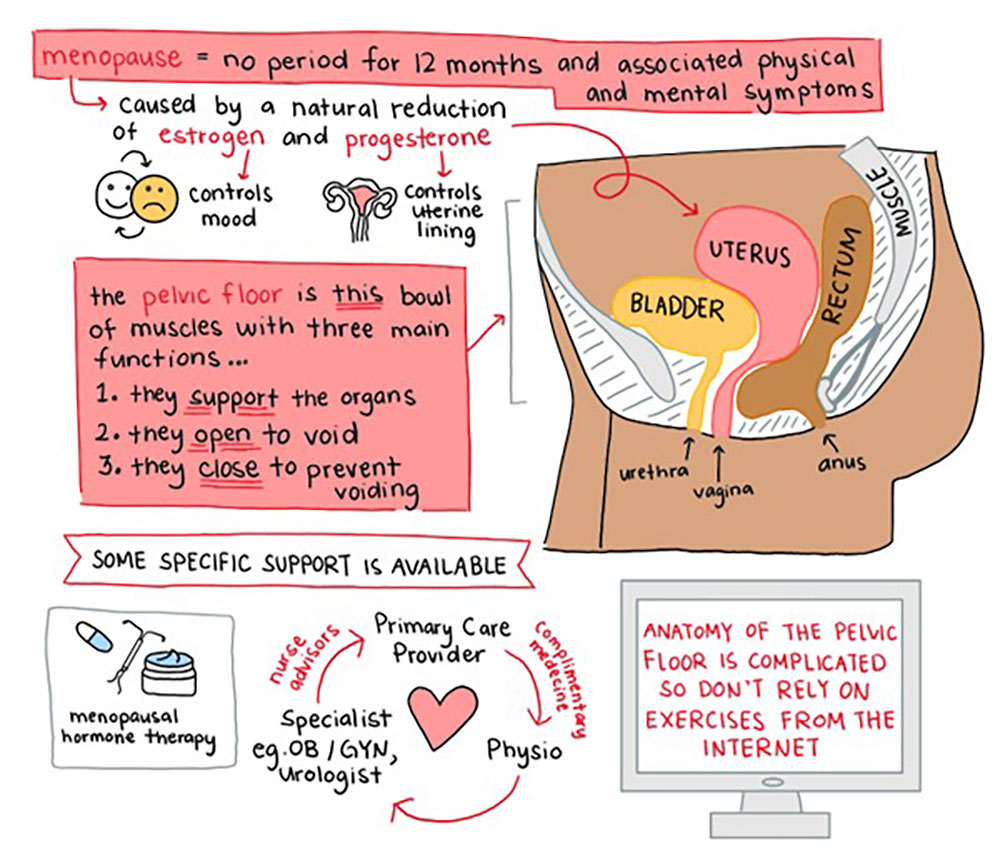
The muscles and connective tissues that hold the pelvic floor in place are responsible for coordinating important functions such as urination, defecation, menstruation, and childbirth. Pelvic floor disorders fall into one of four categories – urinary symptoms; prolapse symptoms; bowel symptoms; and pelvic pain. Due to the unique anatomy of a woman’s pelvic floor, women are at higher risk of pelvic floor disorders. Risk factors include genetics, aging, pregnancy, high body weight, smoking, and strenuous physical activity.
Menopause
Symptoms associated with the onset of menopause include: 12 months without a period and other physical and psychological symptoms (including hot flushes, night sweats, insomnia, difficulty concentrating, mood changes, vaginal dryness, and pain with intercourse).
Menopause hormonal therapy is safe and effective for treating these symptoms and is an evidence-based treatment shown to reduce the risk of coronary heart disease and osteoporosis. While there are some risks, including stroke, blood clots, and breast cancer, each were observed in less than 1 per 1,000 women taking the medication per year. Non-hormonal therapies are also available to treat menopause symptoms.
Menopause isn’t something that is “wrong with women” or something they simply have to “just go though”. It is important for all women to self-advocate and leverage primary care providers and physiotherapists to help find a treatment that works best for them.
Figure 5. Graphic visualization of the breakout session: Menopause and pelvic floor health: empowering women through education
Transcript - Figure 5
Infographic on menopause and pelvic floor health. Top left, red text defines "menopause = no period for 12 months and associated physical and mental symptoms caused by a natural reduction of estrogen and progesterone," with a diagram showing " controls mood " and "controls uterine lining" connected to a uterus illustration labeled "uterus, bladder, rectum, muscle, urethra, vagina, anus." Below, a speech bubble explains "the pelvic floor is this bowl of muscles with three main functions: 1. they support the organs, 2. they open to void, 3. they close to prevent voiding." Bottom left, a pink speech bubble lists "some specific support is available" including "nurse advisors, primary care provider, complimentary medicine, physio, specialist (e.g., OB/GYN, urologist)," with a heart icon. The text to the left of the heart icon reads "menopausal hormone therapy", Bottom right, a laptop icon with text "anatomy of the pelvic floor is complicated so don’t rely on exercises from the internet," highlighted in red.
Key takeaways from discussion
“We do know that women in the CAF, for example, are more likely to have PTSD compared to a civilian population and are also more likely to have pelvic organ prolapse and urinary incontinence, depending on their trade.”
- Pelvic floor disorders and symptoms of menopause affect women’s overall well-being.
- Servicewomen do show higher rates of certain pelvic floor disorders and mental health conditions than their civilian counterparts.
- VAC offers support for pelvic floor disorders that are attributable to service.
- Safe and effective hormonal and non-hormonal treatments are available to all women in Canada experiencing menopausal symptoms.
- Women need to self-advocate and be empowered to find a treatment that works best for them.
Breakout session 2: The power of connection for women experiencing isolation
This breakout session focused on creating and sustaining peer support networks for women who have served.
Overview of presentation
A speaker from Boston University Medical Campus’ Women Veterans Network (WoVeN) provided a brief history of this unique peer support program and lessons learned from creating such a network in the United States (US). WoVeN started as a grassroots initiative, supporting local women Veterans with their mental health and feelings of loneliness and isolation. Guided by the principle that women-specific peer support fosters a sense of community, trust, and understanding, the program quickly grew through word of mouth and online presence.
At the time of the presentation, the organization had connected over 5,000 women across the US in-person and online, trained over 400 peer leaders, and partnered with over 100 other community-based organizations that support women Veterans across all domains of their well-being. Scientific evaluation of WoVeN programming showed health benefits for women experiencing PTSD and depression.
Key takeaways from discussion
“Servicewomen are a minority in the Forces, but are an even bigger minority when they transition into civilian society.”
"There are various [peer support networks] happening in Canada, they just aren't ‘woven’ together yet."
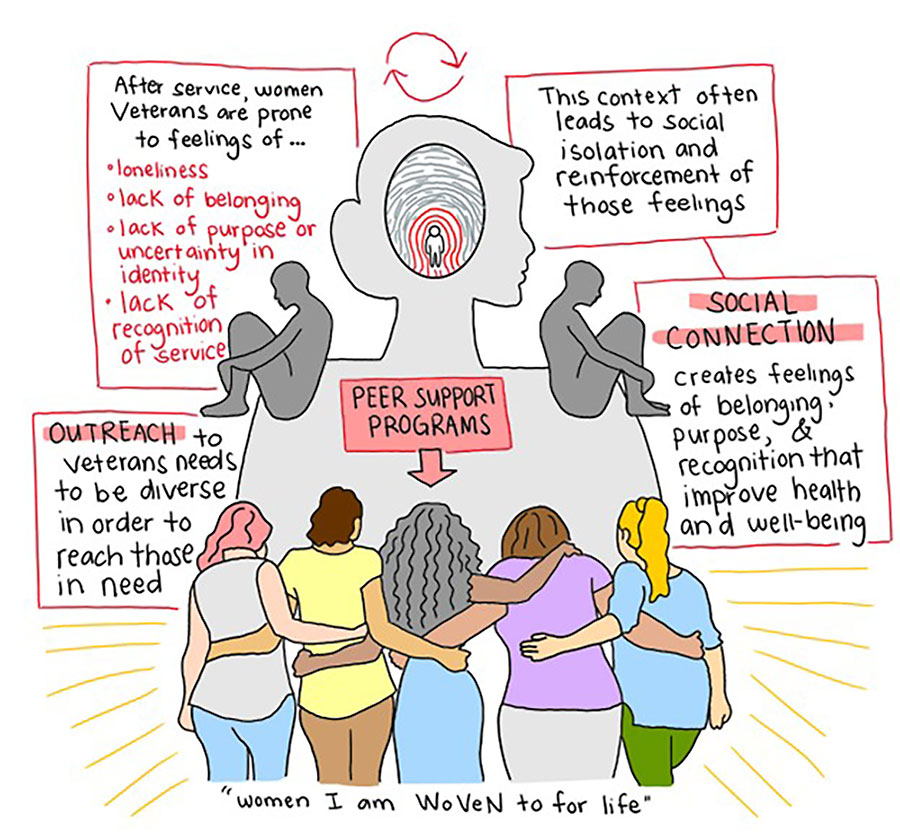
- Servicewomen and Veterans regardless of where they served are at high risk for feelings of isolation, lack of belonging and recognition, and pulling back from their Veteran identity (particularly during their transition).
- Peer support networks for Veterans are understudied but have shown overwhelmingly positive impacts on Veteran health and well-being, with the feeling of belonging and purpose that these types of connections provide being central to the healing journey.
- While some peer programming exists in Canada, more are required.
- Real growth for peer support networks seems to come from word of mouth and networking.
- Past successful peer support network models have included:
- A variety of engagement methods (online, in-person, hybrid, formal/structured, and informal)
- Flexible and inclusive participation policies
- Collaboration among governmental and non-governmental stakeholders
- Inclusion of grassroots initiatives and activists
- It is important to reinforce acceptance of gender expression, sexuality, culture, and other identity factors
Figure 6. Graphic visualization of the breakout session: The power of connection for women experiencing isolation
Transcript - Figure 6
Infographic on peer support for women Veterans after service. At the top, to the left of the head is a text box reading "after service, women Veterans are prone to feelings of loneliness, lack of belonging, lack of purpose or uncertainty in identity, lack of recognition of service", to the right of the head is a text box reading "this context often leads to social isolation and reinforcement of those feelings." Below, "peer support programs" is written in the center, with two silhouetted figures on either side. At the bottom, five diverse women are shown from behind, standing side by side with their arms around each other in a show of solidarity and support, with the following text underneath them saying "women I am WoVen to for life." On the left, text reads "outreach to Veterans needs to be diverse in order to reach those in need." On the right, a red box highlights "social connection creates feelings of belonging, purpose, and recognition that improve health and well-being."
Breakout session 3: collaborative workshop on the Women Veterans' Research Plan
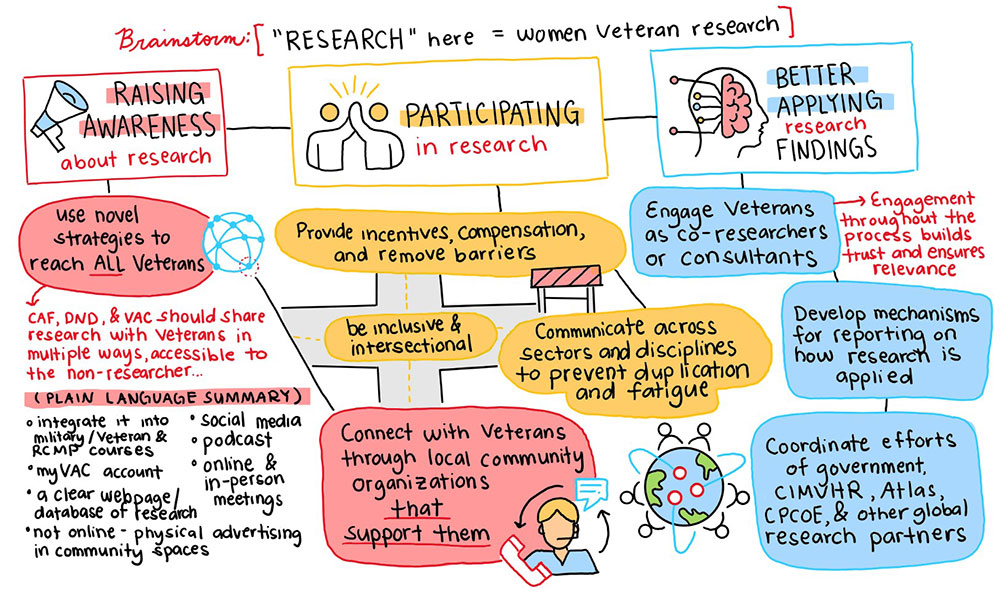
In this breakout session, participants were asked to brainstorm around the following questions verbally, via sticky note, or online chat:
Overview of presentation
- How might we raise awareness about women Veterans research?
- How would you like to participate in women Veterans research?
- How might we better apply women Veterans research findings?
Key takeaways from discussion
“Ensure all Veterans know they are Veterans, then you will reach further.”
“A code of “ethics” for those researching Veterans [is needed] – many are turned off from past experiences.”
- It is important to engage with all equity-deserving groups in the promotion of research, using plain language and novel engagement strategies that reach coast-to-coast-to-coast.
- Research projects about servicewomen and Veterans should always include their intersectionality, opinions, and perspectives in the planning process.
- Women Veterans may be reluctant to participate in research due to past experiences, and reaching them through local Veteran organizations may be most successful.
- Women Veterans have concerns about their ethical inclusion in research and asked that VAC officially adopt an adapted version of the Tri-Council Policy Statement (2022) as part of all research.
- Groups including racialized women Veterans, RCMP, reservists, and rangers felt more research is needed to better understand their experiences, the friction points they encounter with the system, and solutions.
Figure 7. Graphic visualization of the breakout session: Collaborative workshop on the Women Veterans' Research Plan
Transcript - Figure 7
Infographic titled "Brainstorm: [“RESEARCH” here = women Veteran research] with a flowchart. Top left, a red megaphone reads "raising awareness about research", to achieve this purpose, VAC would need to “use novel strategies to reach ALL Veterans, CAF, DND, and VAC should share research with Veterans in multiple ways, accessible to the non-researcher.” Texts below the “plain language summary” reads: “integrate it into military, Veteran and RCMP courses, myVAC account, a clear webpage/database of research, not online - physical advertising in community spaces, social media, podcast, online and in-person meetings.” Center, a yellow box reads "participating in research" with "provide incentives, compensation, and remove barriers", "be inclusive and intersectional" and “communicate across sectors and disciplines to prevent duplication and fatigue”, each in an individual yellow box. Below center, a red box says "connect with Veterans through local community organizations that support them" with a figure speaking. Right, a blue brain reads "better applying research findings" with "engage Veterans as co-researchers or consultants" and "engagement throughout the process builds trust and ensures relevance." Bottom right, a blue text box reads “develop mechanisms for reporting on how research is applied”, with another box below it reads "coordinate efforts of government, CIMVHR, Atlas, CPCOE, & other global research partners."
Community recommendations
- The Women Veterans Forum generated valuable recommendations to enhance support for servicewomen and Veterans, and VAC commits to reviewing these recommendations and sharing an update on our progress at the next Forum. This list is not exhaustive, and our efforts to support servicewomen and Veterans will continue to evolve.
- Approximate timeline from March 2025:
- Short term < 12 months
- Medium term: 12 – 24 months
Appendix A: Forum feedback
As is standard procedure after an event, VAC sent participants an online questionnaire to provide feedback about the event. Questions asked offered Veterans the opportunity to share their opinion on the format and content of the Forum, as well as provide suggestions for improvement in future years. Of respondents to the questionnaire, 59% attended in-person and 41% attended virtually. Key results are reviewed in this section and all 69 responses have been retained.
- Many respondents shared positive feedback, describing the event as well-organized, informative, and a notable improvement from the previous year.
- Some respondents commended the efforts of the organizing team, highlighting the value of incorporating past feedback, creating meaningful engagement opportunities, and fostering a welcoming environment.
- While many respondents found the sessions informative, some emphasized the need for stronger, clearer connections to military service and the lived experiences of Veterans, as well as deeper exploration of links to service-related injuries, mental health impacts, and available VAC supports.
- Some respondents expressed a preference for content that prioritizes Canadian Veteran perspectives rather than relying on international examples, highlighting the significant differences in experiences and available services between countries.
- 85% of respondents visited the community organization exhibits, with 88% finding them very or extremely valuable.
- Respondents shared various potential topics for future Forums, including: women’s health and well-being, networking and community supports, VAC benefits, and policy updates.
This detailed feedback provided by respondents will be incorporated in the planning of the 2026 Women’s Forum, including the valuable recommendations for future events that were outlined.