
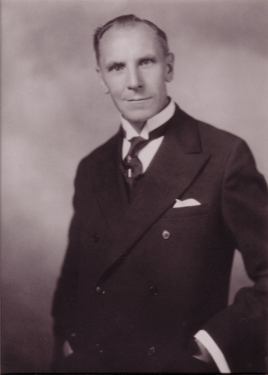
Background
Born in England in 1873, Arthur Hair emigrated to Quebec at age 13. After joining the militia at 16 and serving in the Canadian Army for a number of years, he returned to Britain. There he joined the British Army and served with the Royal Horse Artillery in India and then in the South African War before leaving the military in 1902. Hair returned to Canada and became the head orderly at the Montréal General Hospital.
An encounter that changed his life
In December 1908, an elderly man named James Daly was found in a downtown doorway and taken to the Montréal General Hospital. Suffering from exposure and malnutrition, he was clearly dying.
Arthur Hair happened to see a blue envelope sticking out of Daly’s pocket. A British Veteran himself, he recognized it as the type issued to soldiers on discharge from the British Army. He opened the envelope and saw that the man had served for 21 years, including the Crimean War.
Many British Veterans who emigrated to Canada ended up in dire economic circumstances, especially as they grew older. Their military pensions were small and often had insufficient assets to cover the cost of their own funerals.
Hair approached a local Veterans’ organization for help to get Daly a proper burial. There were few of these organizations at the time and none were able to pay for the cost of burying impoverished Veterans on a regular basis.
Instead, Hair raised money from friends and fellow hospital employees. This would lead to the establishment of the Last Post Fund.
"To honour and protect in death seems but a small return to those who have protected their country in life."
The fund’s beginnings
Hair had found a cause he believed in strongly, but solving the problem would take much work. A man of modest means, Hair knew he had to enlist the support of the city’s wealthier citizens to his cause. Through great effort, the pieces fell into place and the ‘Last Post Imperial Navy and Military Contingency Fund’ (as it first was known) was established in April 1909.
Official recognition came quickly. Governor-General Albert Grey became the honourary patron of the fund, the first of a long line of Governors-General who would fill this role. The first formal burial sponsored by the fund was later that month for A. Walter Walters, a Veteran of the South African War.
"The Last Post Fund is not a charity, it is a duty."
Impact of First World War
After the First World War began in August 1914, the fund contributed to the war effort in many ways, assisting needy families of servicemen, helping men in uniform and supporting recruitment efforts. The fund also sought to erect monuments in Canada and overseas and support convalescence homes for injured soldiers.
After the war, hundreds of thousands of Canadians returned home as Veterans. Many found themselves in poor health and psychologically scarred by what they had experienced. Those who could not work due to physical or psychological injury were often left penniless when they died. That’s when the Last Post Fund would step in.
The fund’s early work was exclusively supported by private donations. In 1921, however, the organization was federally incorporated as the Last Post Fund and began to receive regular government financial support. To receive this funding, however, the organization had to expand its operations to cover the entire country – a huge task, spearheaded by Arthur Hair.
The first Last Post Fund burial outside Quebec took place in Toronto in November 1922. In 1923, the Last Post Fund’s profile was further enhanced when Lieutenant-General Sir Arthur Currie, who had commanded the Canadian Corps during the First World War, became president of the organization.
Burials rose steadily across Canada during the 1920s, with local Last Post Fund branches arranging gravesites for the Veterans in their area. Despite the the Great Depression, the 1930s were a time of growth for the fund. The harsh economic situation meant many Veterans were very poor, even having their lives shortened as a result of poor health brought on by poverty. More Veterans were in need of assistance for funeral costs.
The most striking development of the decade, however, was the establishment of the National Field of Honour: a large cemetery in Quebec owned by the Last Post Fund.
National Field of Honour
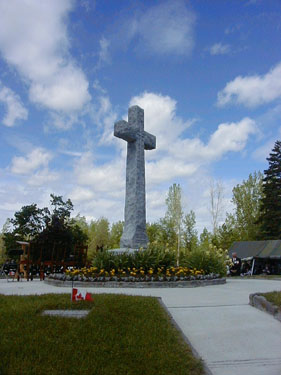
Established in 1930, the cemetery has seen many additions over the years. A large Cross of Remembrance was added in 1934 and the impressive Gate of Remembrance was unveiled in 1937.
From the beginning, those interred in the cemetery have been treated equally. Plots look alike and receive the same thoughtful care. Privates lay next to generals, war heroes lay beside those who earned no battlefield recognition, the penniless next to the wealthy – all equal in death, due to their service in the cause of peace and freedom.
Arthur Hair died in 1946, shortly after the end of the Second World War. Fittingly, he was laid to rest at the Field of Honour after a lifetime of tireless effort for his fellow Veterans.
By the 1990s, the Fund became increasingly linked with Veterans Affairs Canada. And, in 1998 the organization assumed full responsibility for delivering the Funeral and Burial Program across Canada.
Photo gallery
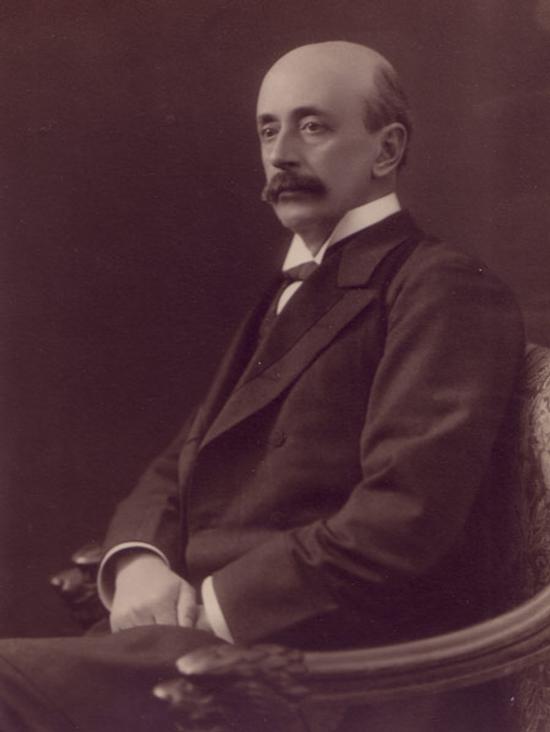
1909 – His Excellency Earl Grey, Governor General of Canada, became the first Patron of the Last Post Fund.
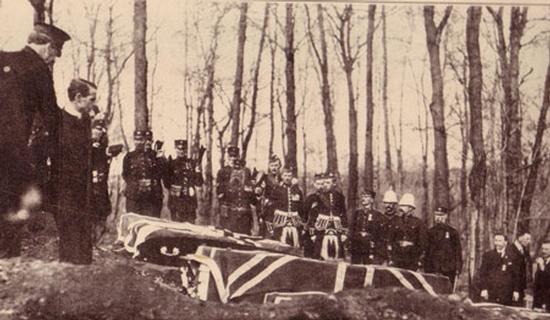
1910 – Inaugural ceremony of the Last Post Fund Plots at the Mont-Royal cemetery.
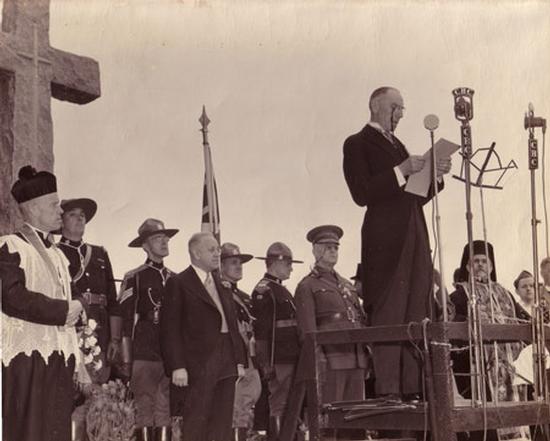
24 May 1941 – Commemoration ceremonies at the Field of Honour in Pointe-Claire, Québec. Roll Call by Arthur Hair who is reading aloud the names of those interred during the previous year.
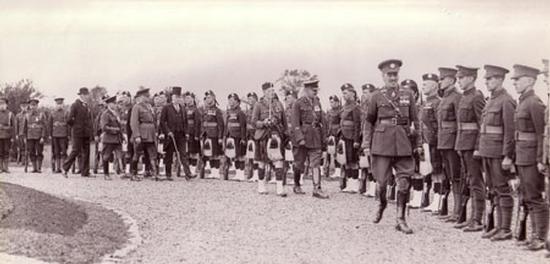
September 21, 1930 - Consecration of the National Field of Honour, Pointe-Claire, Québec. Brigadier-General W.B.M. King inspecting the Guard of Honour.
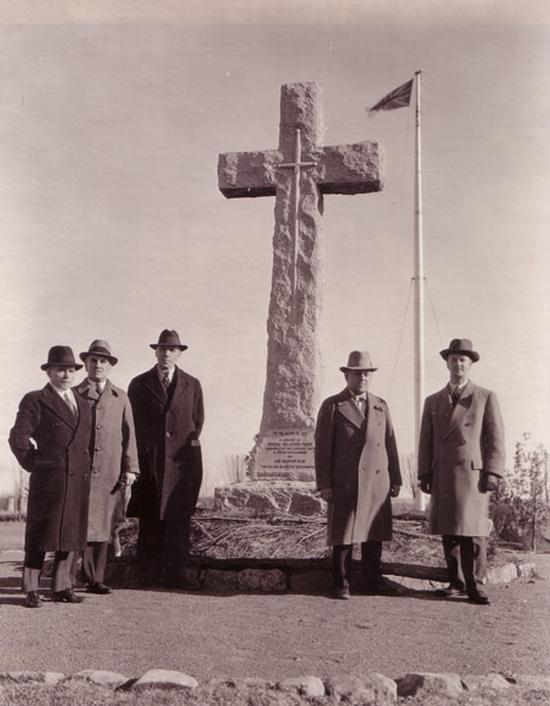
1937 – The Cross of Remembrance at the National Field of Honour. Arthur Hair is third from left.
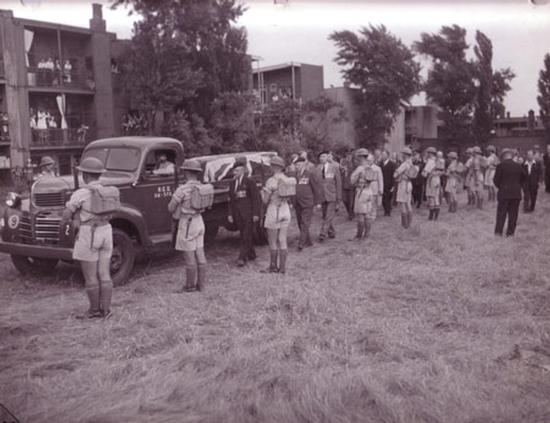
July 22, 1944 – The coffin containing the remains of Lt. Gen. Sir Benjamin d'Urban is being moved from the old Papineau military cemetery to the National Field of Honour in Pointe-Claire, Québec.
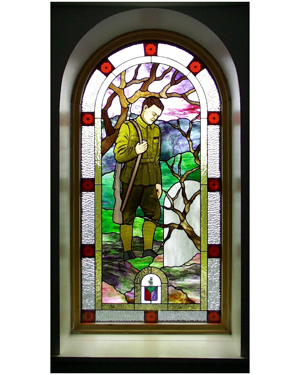
Stained glassed window in Remembrance Gate at Last Post Fund National Field of Honour.