The Canada Remembers Times newspaper is for ages 12 to 18. It focuses on educating older students about Canada's rich military history and heritage.
Page 1
Newfoundlanders at Beaumont-Hamel
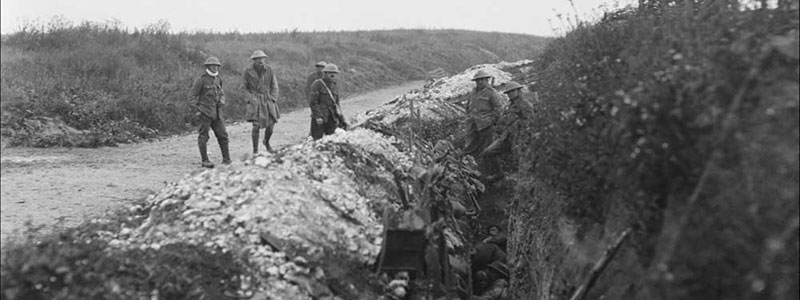
Newfoundland soldiers before their attack at Beaumont-Hamel.
Photo courtesy of the Provincial Archives of Newfoundland and Labrador (PANL NA-3105)
July 1 is Canada Day, but in Newfoundland and Labrador it is also Memorial Day.
The significance of Memorial Day in Newfoundland and Labrador dates back to the First World War. On July 1, 1916, near the French village of Beaumont‑Hamel, about 800 soldiers from the Newfoundland Regiment went into action on the opening day of the Battle of the Somme. The soldiers bravely advanced into heavy enemy fire. It is said they instinctively tucked their chins into their shoulders as if they were walking through a snowstorm.
In less than half an hour, the regiment was torn apart. Hundreds were killed, wounded or went missing. The next morning, only 68 soldiers were able to answer the roll call. The losses were felt in nearly every community in Newfoundland. The regiment would rebuild after this devastating battle. Later, it earned the title Royal Newfoundland Regiment in recognition of its members’ courage and determination.
The sacrifices made at Beaumont-Hamel were never forgotten. 110 years later, people in Newfoundland and Labrador still pause on Memorial Day to remember those who served and died.
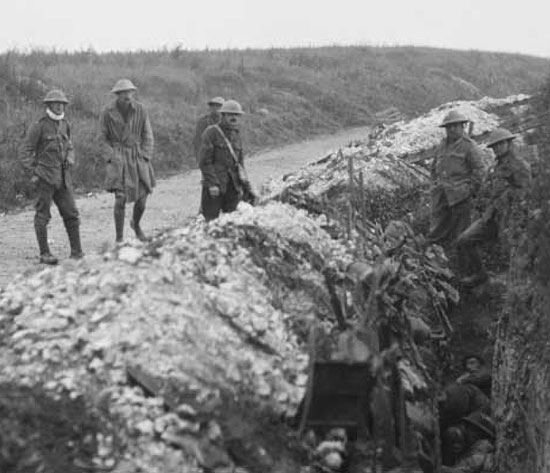
Learn more about the Battle of Beaumont-Hamel.
Rooted in sacrifice
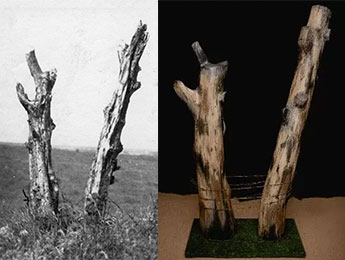
The Danger Tree – Then and now.
Photos: Memorial University of Newfoundland
Experts at Memorial University in St. John’s, Newfoundland and Labrador, are using modern technology to help tell a very old story. During the First World War, a plum tree partway across the battlefield at Beaumont-Hamel served as a key landmark for soldiers of the Newfoundland Regiment. Although it helped guide them during the attack, it was also a focus of heavy German fire and the site of many deaths. The shattered tree became known as the Danger Tree and is a powerful symbol of courage and sorrow.
Over time, the original tree deteriorated and was replaced by replicas. Engineers, historians and artists at Memorial University have created a new, durable Danger Tree made mostly of fiberglass.
It was flown to France and placed on the battlefield for ceremonies held on July 1, 2026, marking the 110th anniversary of the battle.
The Danger Tree is rooted in the past, anchored in the present and looking toward the future. It will help new generations remember those who came before them.
Fighting to serve
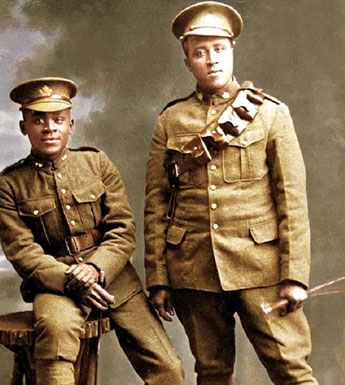
Seated, Robert Simms, No. 2 Construction Battalion, during the war.
Photo: Black Canadian Veterans Stories
No. 2 Construction Battalion was a unique Canadian military unit with an important legacy.
Black Canadians were eager to serve their country during the First World War. However, the widespread discrimination in that era often made it difficult for them to enlist in the Canadian Expeditionary Force. In response to pressure from Black communities, No. 2 Construction Battalion was formed in Pictou, Nova Scotia, on July 5, 1916. It became the largest Black unit in Canadian military history. Recruitment took place across the country, though most volunteers came from the Maritimes. By the end of the war, some 800 men had served in the unit known as the “Black Battalion.”
The unit was assigned support roles and served honourably in France while attached to the Canadian Forestry Corps. Its members provided lumber to maintain trenches on the front lines, improved roads and helped build a railway.
In 2022, the Government of Canada officially apologized for the discrimination that members of No. 2 Construction Battalion were forced to overcome. Today, their service is remembered as an important chapter in the history of Black Canadians in uniform and the evolution of attitudes within our society.
Fighting in the hills of Korea
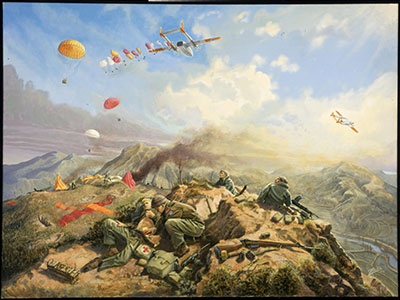
Image: Beaverbrook Collection of War Art. Canadian War Museum 19900084-001
Holding at Kapyong’ war painting by Ted Zuber.
One desperate night in the hills of Kapyong pushed the courage of Canadian soldiers to the limit.
Canadians saw heavy action during the Korean War. One of their most intense battles took place in the spring of 1951 near the Kapyong River in South Korea. There, the 2nd Battalion of the Princess Patricia’s Canadian Light Infantry joined other Commonwealth forces. Together, they fought to defend a river valley that served as a key route through the hills.
On the night of April 24-25, 1951, waves of Chinese soldiers attacked the Canadian positions under the cover of darkness. Our soldiers came under intense fire and at times our troops were completely overrun. The situation became so dangerous they even asked for Commonwealth artillery to fire on their location to drive off the attackers. As the battle dragged on, ammunition ran low and new supplies had to be dropped by aircraft.
When the fighting finally ended, 10 Canadians had been killed and 23 wounded. But against all odds the Princess Pats had held their ground. For their bravery, the Battalion received the United States Presidential Unit Citation, a rare honour for a non-American unit.
In his own words
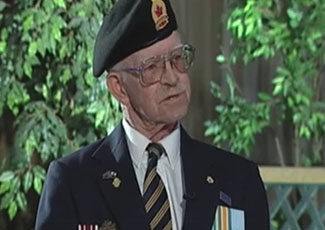
Gerald Gowing of Ontario who fought at Kapyong.
"We were surrounded… and there was a lot of fire. We were pretty well out of ammunition and out of food… that was a scary moment, let me tell you."
If a picture could talk
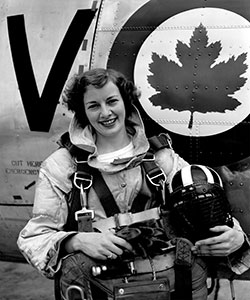
This photo shows Flying Officer Marian Neilly during a military exercise in May 1955. She was a Nursing Sister with the Royal Canadian Air Force who was a “para-belle.” These special nurses were trained to parachute out of rescue aircraft to help injured people during emergencies. Their rugged helmets and padded jumpsuits helped protect them when jumping into tough environments, like mountains and forests.
Watching the Golan Heights
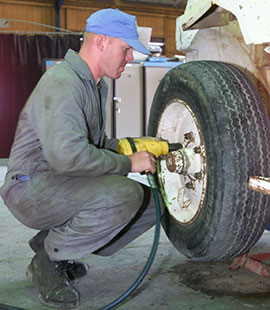
Canadian peacekeeper working on a UN vehicle in the Golan Heights in 2002.
Photo: DND
For decades, Canadian troops helped maintain a fragile peace in a tense place.
Canadian Armed Forces members first deployed to the Golan Heights in 1974. They were part of a United Nations (UN) mission created to supervise a ceasefire between Syria and Israel after the Yom Kippur War. Canada remained involved in this mission for decades, making it one of our country’s longest peacekeeping efforts.
Our peacekeepers carried out important support duties for the UN force there. They maintained vehicles, handled communications and filled other key logistical roles that helped keep the mission running day to day. More than 12,000 Canadians served in the Golan Heights before most were withdrawn in 2006. A much smaller presence remained for several years afterward.
Peace support efforts can have a high price. On August 9, 1974, nine Canadian Armed Forces members were killed when their plane was shot down in a missile attack while delivering supplies for the Golan Heights. It remains Canada’s highest single‑day loss of life during a peace mission. August 9 is now marked each year in Canada as National Peacekeepers’ Day.
Page 2
Canadian women in uniform
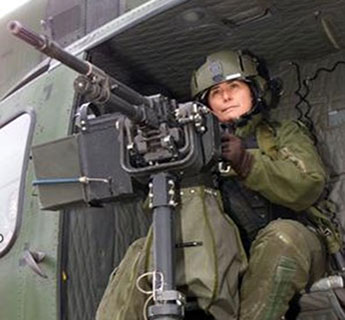
A door gunner in a Royal Canadian Air Force helicopter.
Photo: DND
Today, women in Canada’s military can fly fighter jets, command warships and lead missions across the world. But for decades, they were told: This is no place for a lady.
Women have been an important part of Canada’s military for more than 125 years. In early conflicts, opportunities to serve in uniform were limited. Women took on roles as Nursing Sisters, caring for sick and wounded soldiers during the South African War and the First World War.
During the Second World War, the scope of their contributions grew. In 1941, the Canadian Women’s Army Corps and the Royal Canadian Air Force (Women’s Division) were created. The Women’s Royal Canadian Naval Reserve followed in 1942. At first, their members filled support roles like clerical work, cooking and cleaning. Those roles expanded over time. Women became mechanics, drivers, code breakers, radar operators, parachute packers and more. Over 50,000 Canadian women had served by the time the war ended in 1945.
Progress continued in the decades that followed, though not without resistance. A major breakthrough came in 1989 when almost all Canadian Armed Forces trades were officially opened to women. The change did not erase all challenges, but it marked a turning point. Today, women can serve in all roles and make up more than 16% of Canada’s military personnel.
Watch Her story: Canadian women in uniform
From nurses in muddy field tents to leaders at the very top, Canada’s servicewomen have defied expectations. Broken barriers. Changed history. Their service is Canada’s story… and it’s yours, too.
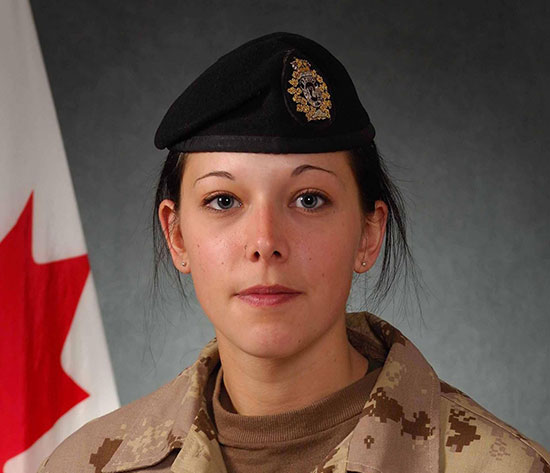
Learn more about the proud history of Canadian women in service.
Defending Hong Kong
The Defence of Hong Kong was the first time Canadian soldiers faced major combat during the Second World War.
In late October 1941, about 1,975 Canadian troops sailed from Vancouver for Hong Kong. Their mission was to help defend this British Crown Colony in East Asia from a possible Japanese invasion.
Only weeks after they arrived, enemy forces attacked on December 8. The outnumbered Allied defenders fought bravely for more than two weeks before the Japanese forced them to surrender on Christmas Day.
The cost was devastating. Some 290 Canadian soldiers were killed, almost 500 were wounded and many more were taken prisoner. Life for those in Japanese prisoner of war camps was harsh and deadly. More than 260 additional Canadians died due to malnutrition, hard labour and abuse before liberation at the end of the war in August 1945.
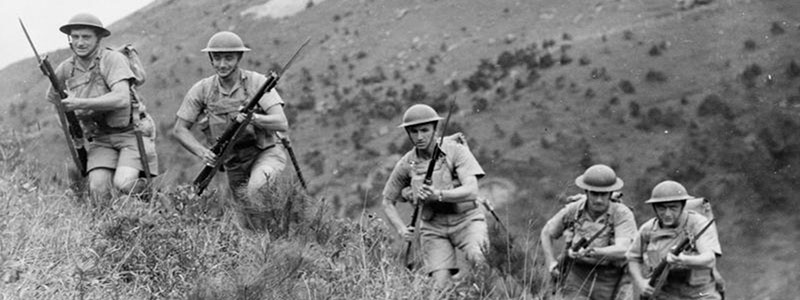
Canadian soldiers training in Hong Kong before the Japanese invasion.
Photo: IWM KF 189
In his own words
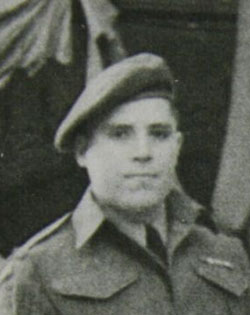
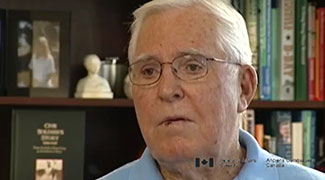
George MacDonell of Ontario was just 19 years old when he fought at Hong Kong. He later proudly remembered our soldiers’ service and sacrifice there:
“The story of Hong Kong is not how Canadians were defeated… but how they fought with courage and distinction against
Stepping up to the plate
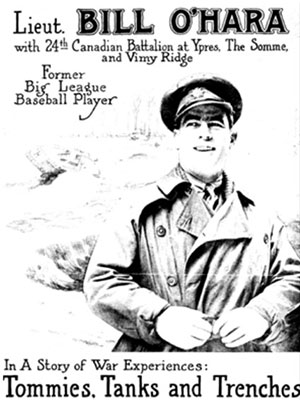
Photo : Public domain
William “Bill” O’Hara was born in Toronto in 1881. He was a talented athlete who played baseball for the Baltimore Orioles, New York Giants and St. Louis Cardinals. Known for his powerful and accurate arm, the outfielder picked off many runners who ventured too far from the bases.
When the First World War broke out, Bill decided to put on a different kind of uniform. After briefly flying planes in the air force, he transferred to the infantry and joined the 24th Battalion of the Canadian Expeditionary Force. During the Battle of the Somme in 1916, Lieutenant O’Hara made good use of his baseball skills. His great accuracy in throwing grenades during a trench raid resulted in a recommendation for a Military Cross medal. O’Hara was wounded in the Battle of Vimy Ridge and returned to Canada in 1918.
No short cuts
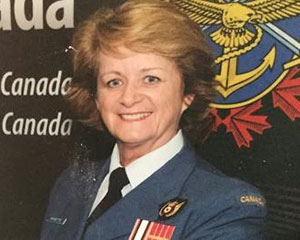
Major Doucette in uniform.
Photo: DND
Growing up in Cape Breton, Nova Scotia, Lynn Doucette dreamed of serving in the Royal Canadian Mounted Police. But nature was not on her side. Height requirements for the Mounties were strict and Lynn was one centimetre too short. One of Lynn’s brothers had recently enlisted in the military and in 1979 she decided to join him.
Lynn excelled from the start and was soon selected for officer training. In less than eight years, she rose to the rank of major in the air force. She served in Canada and beyond our borders. Shortly after the end of the Gulf War in 1991, Major Doucette was posted to an American air base in Türkiye. She became the first female Canadian Mission Crew Commander on an Airborne Warning and Control System (AWACS) aircraft. These large American warplanes had powerful radar that made them important eyes in the skies for the region.
Lynn retired from the Royal Canadian Air Force in 2014 after 35 years of service. She had flown high in the sky and reached great heights in the military… all because of a single centimeter.
What’s going on?!
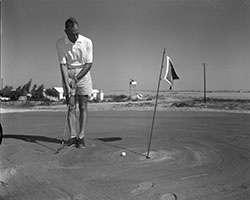
Photo: DND
Somebody playing golf is no big deal, but look closer at this picture from 1962. That’s sand, not grass! The person playing is a Canadian service member taking a break from his peacekeeping duties in Egypt.
Why do you think physical activity is important for keeping troops physically and mentally healthy?
The Royal Canadian Legion turns 100
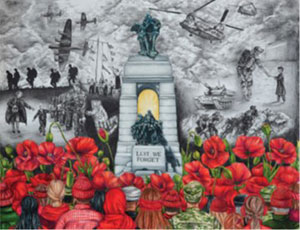
Royal Canadian Legion poster contest entry by Emma Cervinka.
Image: © The Royal Canadian Legion
The Royal Canadian Legion has been a strong presence in communities across the country over the last century. One of their best-known activities is the annual Poppy Campaign. It helps millions of Canadians wear a poppy each fall to honour those who served and died for our country.
Another key part of the Legion’s work is helping young people learn about remembrance. Each year, it holds National Youth Remembrance Contests. These contests encourage young Canadians to remember through art, writing and videos. Visual art and written reflections are powerful tools to express our thoughts and think about the meaning of remembrance.

How will you use your creativity to honour Canada’s Veterans?
For more information on The Royal Canadian Legion youth remembrance contests, visit remembrancecontests.ca.
Don’t forget to remember!
Sticky notes help us remember important thoughts. This November, they are turning the words Lest we forget into action. Write notes of thanks or the name of a Veteran you are remembering on red squares. Add a black centre to create a remembrance poppy!
Learn more about the Don’t forget to remember activity.
Remembrance online
Not all memorials are made of stone. The Canadian Virtual War Memorial honours each of the more than 120,000 Canadians and Newfoundlanders who died while serving in uniform since Confederation. Every fallen service member has their own record. Families, friends and members of the public can upload photos and information to bring their stories to life.
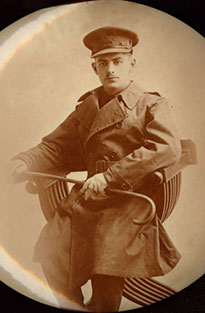
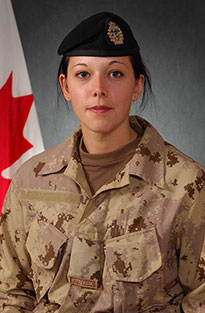
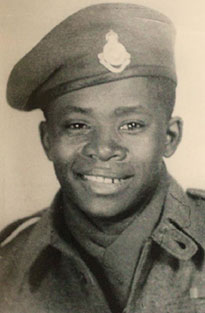
Do you have photos to share?
Researching a fallen Canadian from your family or community is a great way to honour their memory. You can share photos and information you find on the Canadian Virtual War Memorial! Be sure to also check out the daily honour roll and other collections. Learn more about Canadians who gave their lives for the freedom we enjoy today.
The Poppy Design is a trademark of The Royal Canadian Legion (Dominion Command) and is used with permission.
Page 3
Hard duty in Afghanistan
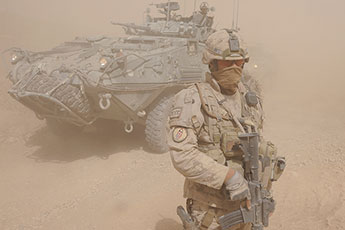
A Canadian soldier in front of a LAV III in Afghanistan.
Photo: DND
Canada’s mission in Afghanistan was our country’s largest overseas military deployment since the Second World War.
More than 40,000 Canadian Armed Forces members served in Afghanistan between 2001 and 2014. The dry, mountainous terrain of southwest Asia and evolving dangers of modern warfare made the mission especially difficult. Canada’s goals there included fighting international terrorism, improving security and helping rebuild Afghan society.
Members of our army, navy and air force all played important roles. Canadian service members patrolled the waters off southwest Asia, took part in firefights with enemy forces and supported reconstruction projects. They also helped train Afghan security forces in difficult and dangerous conditions.
For many Canadians, the Afghanistan mission is closely associated with Kandahar province. From 2005 to 2011, Canadian troops carried out combat operations in this rugged region. It was a hotbed of insurgent activity. Anytime soldiers went “outside the wire” the risk of Taliban attack was very real. Battles, improvised explosive devices (IEDs), and ambushes took a hard toll. The faces of fallen Canadians soldiers appeared in news reports all too often.
Canada’s military mission in Afghanistan ended in March 2014. In total, 158 Canadian Armed Forces members died and more than 2,000 were wounded. Although the mission is over, Veterans still feel its impacts today.
What do you see?
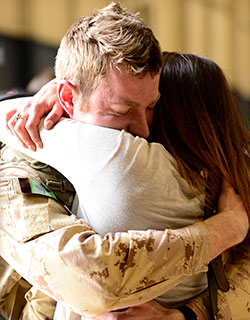
Photo: DND
What story does this photo of a soldier returning from Afghanistan tell you about the impacts of service on military members and their families?
Remembering Afghanistan
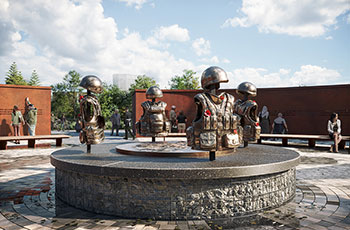
Artist’s rendition of the monument design concept.
Image © Team Stimson
An important new war memorial in our country is currently under construction. The National Monument to Canada’s Mission in Afghanistan is slated to be dedicated in 2028.
The memorial was designed by artist Adrian Stimson of the Siksika (Blackfoot) Nation. He spent time in Afghanistan in 2010 as part of the Canadian Forces Artists Program.
The monument’s circular design was inspired by the medicine wheel. This symbol of balance, healing and reflection is shared by many First Nations. The four entrances in the curved walls face north, south, east and west. Together, they help visitors think about why Canadians served, how Veterans and families were affected, and why remembering matters. Inside the circle is a peaceful space. Some of the surrounding walls show the names of the Canadian Armed Forces members and Canadian civilians who died in the mission. Four flak jackets at the centre remind us of those who served and how they protected each other and helped the people of Afghanistan.
Check out our new video on the National Monument to Canada’s Mission in Afghanistan to learn more!
Teachings of the Eagle Staff
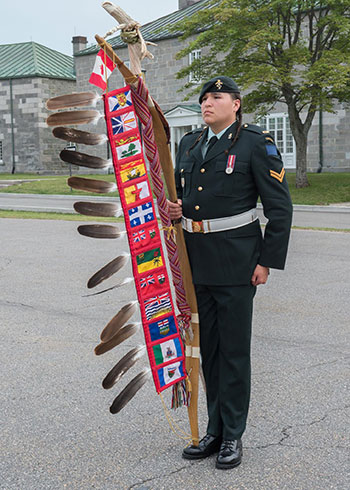
A Canadian Armed Forces Eagle Staff Bearer, 2018.
Photo: DND
A staff is a long and sturdy stick used for support when walking. In Indigenous cultures, Eagle Staffs have been part of ceremonies since time immemorial. More than just objects, they are symbols that unite generations and connect the living with their ancestors.
Indigenous people have long served in the Canadian military. However, they often felt pressured to not highlight their cultural identity and traditions. Twenty-five years ago, a small group of Indigenous Canadian Armed Forces members met to discuss issues faced by their peers in uniform. They realized the creation of a meaningful touchstone could help them feel recognized. The Canadian Armed Forces and Department of National Defence Eagle Staff was soon born. The long ash branch features a carved eagle’s head, eagle feathers, a Métis sash, a narwhal tusk and other symbolic representations of Indigenous peoples from coast to coast to coast.
The Eagle Staff
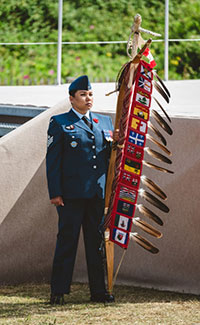
Sergeant Spence and the Eagle Staff at D-Day ceremonies in 2024.
Photo: DND
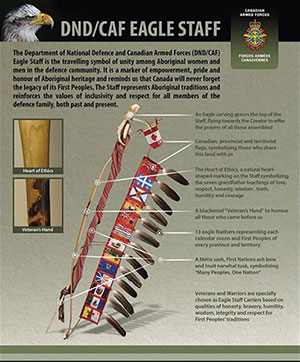
The Department of National Defence and Canadian Armed Forces Eagle Staff is a powerful symbol of the long tradition of Indigenous military service in our country. Here are some of the special meanings within its design.
Eagle carving: A powerful bird flying towards the Creator to offer prayers.
Canadian, provincial and territorial flags: Symbolizes those who share this land with Indigenous people.
Heart of ethics: Symbolizes the seven grandfather teachings: love, respect, honesty, wisdom, truth, humility and courage.
Veteran’s hand: A blackened handprint honouring those who came before us.
13 eagle feathers: Represents each calendar moon and Indigenous peoples of every province and territory.
Métis sash, First Nations ash bow, Inuit narwhal tusk: Symbolizes the different Indigenous peoples of this land.
Every memorial tells a story
We design and build memorials to honour people, remember major events and help future generations understand history. They can have local, national or international significance.
Here are some prominent Canadian military memorials here at home and overseas.
Canadian National Vimy Memorial
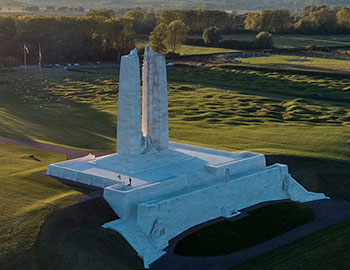
Photo: VAC
Location: Pas-de-Calais, France
Purpose: To honour all Canadians who served in the First World War, mark the site of the Battle of Vimy Ridge, and remember the names of those who died in France with no known grave.
Artist: Walter Allward of Toronto, Ontario
Year of dedication: 1936
Material: Limestone
Height: 37 meters
Highlights: Two 30 meter pylons representing Canada and France. 20 carved sculptures. 11,285 names of Canadian soldiers who died in France during the First World War and whose final resting place was unknown. Surrounded by preserved battlefield and trenches.
National Aboriginal Veterans Monument
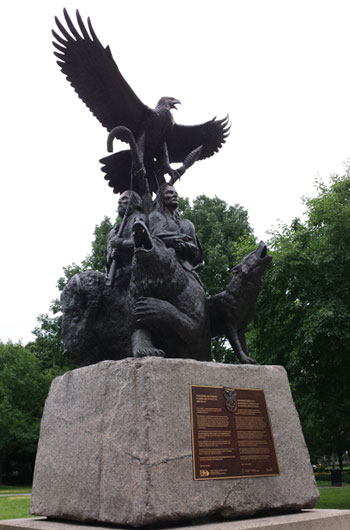
Photo: VAC
Location: Ottawa, Ontario
Purpose: To honour First Nations, Métis and Inuit people in Canada who have served in military uniform.
Artist: Lloyd Pinay of the Peepeekisis First Nation in Saskatchewan
Year of dedication: 2001
Materials: Bronze sculpture and stone base
Highlights: Depicts four members of different Indigenous groups in Canada and five animals who have special spiritual meaning in Indigenous cultures: an eagle, wolf, elk, buffalo and bear.
Thunderhead – 2SLGBTQI+ National Monument
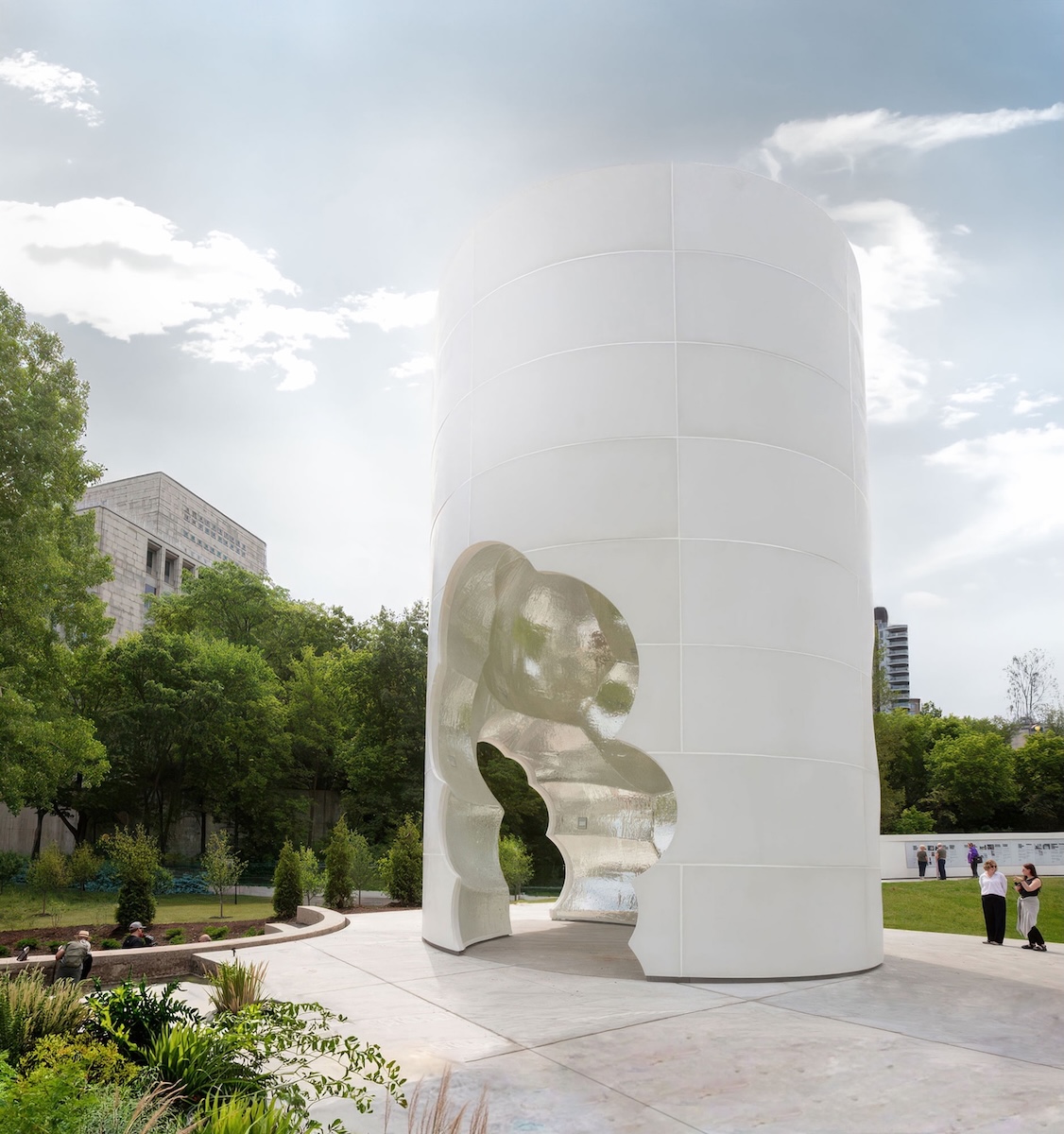
Photo: Tracey Lynne Towedo
Location: Ottawa, Ontario
Purpose: To commemorate the historic discrimination faced by 2SLGBTQI+ people in Canada, including during the LGBT Purge of the Canadian military.
Artists: Public City Architecture, with Elder Albert McLeod and artists Shawna Dempsey and Lorri Millan
Year of dedication: 2026
Materials: Sculpture, pathway and park
Height: 10 meters
Highlights: Thunderhead cloud design embodies the strength, activism and hope of 2SLGBTQI+ communities. The mirror ball interior represents breaking of barriers. The landscaping includes a healing circle ringed by stones.
Page 4
A groundbreaking idea
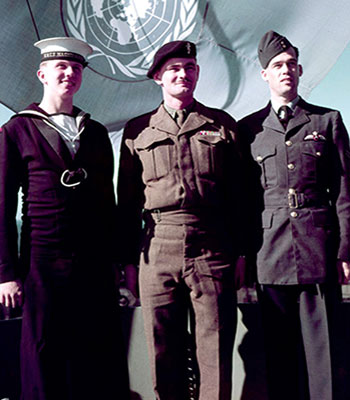
Canadian service members in 1957 during the UN peacekeeping mission in Egypt.
Photo: LAC
The Suez Crisis in 1956 was a defining moment in Canada’s military history and helped introduce the concept of international peacekeeping.
Tens of thousands of Canadian Armed Forces members have served in the Middle East. Their involvement dates back to the First World War and has included peacekeeping missions, the Gulf War and more recent efforts. Over the years, Canadians have carried out combat operations, enforced trade embargoes, delivered humanitarian aid and worked alongside allies to promote stability in the region.
One of Canada’s most important contributions in the region began 70 years ago during the Suez Crisis of 1956. This armed standoff took place in Egypt’s Sinai Peninsula. Egyptian forces faced troops from Israel, Britain and France. The situation was extremely tense and threatened to draw the world into war.
The United Nations (UN) moved quickly to find a peaceful solution, and Canada played a leading role. Lester B. Pearson, Canada’s Minister of External Affairs and a future prime minister, proposed a new kind of international mission: creating a multinational UN force. Soldiers from several countries, including Canada, would be sent to the region. They would help enforce a ceasefire and oversee the withdrawal of foreign troops.
This idea worked and became a model for future peacekeeping missions around the world. It also helped define Canada’s international role and identity in the following decades. In recognition of his leadership, Lester B. Pearson was awarded the Nobel Peace Prize in 1957.
History through graffiti
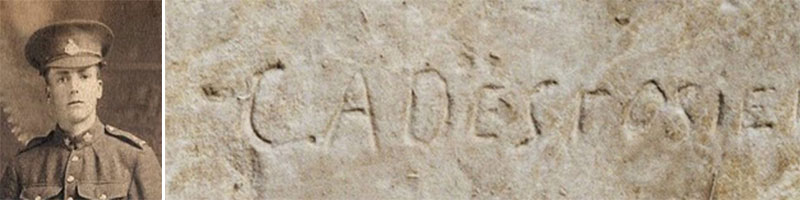
Private Charles Auguste Desrosiers of Quebec carved his name in a tunnel near Vimy Ridge. Source: Les Tranchées de Mémoire
People have left their mark on walls throughout history. Whether using spray paint today or carving words and images into stone centuries ago, humans have always looked for ways to tell the world: I was here. Soldiers were no different.
Millions of soldiers fought in northern France during the First World War. Discoveries of their graffiti continue more than a century later. Some soldiers created complex carvings inside underground tunnels. Others scratched their names and service numbers on walls of buildings.
Patrice Machin, a history buff from France, is working to preserve this fragile evidence of the past. He photographs war graffiti, then uses modern databases to research the names and service numbers he finds. Machin created the website Les Tranchées de Mémoire to share his discoveries. So far, he has identified more than 250 Canadian service members. Through his work, simple markings left long ago help tell the stories of those who served.
Think like a historian
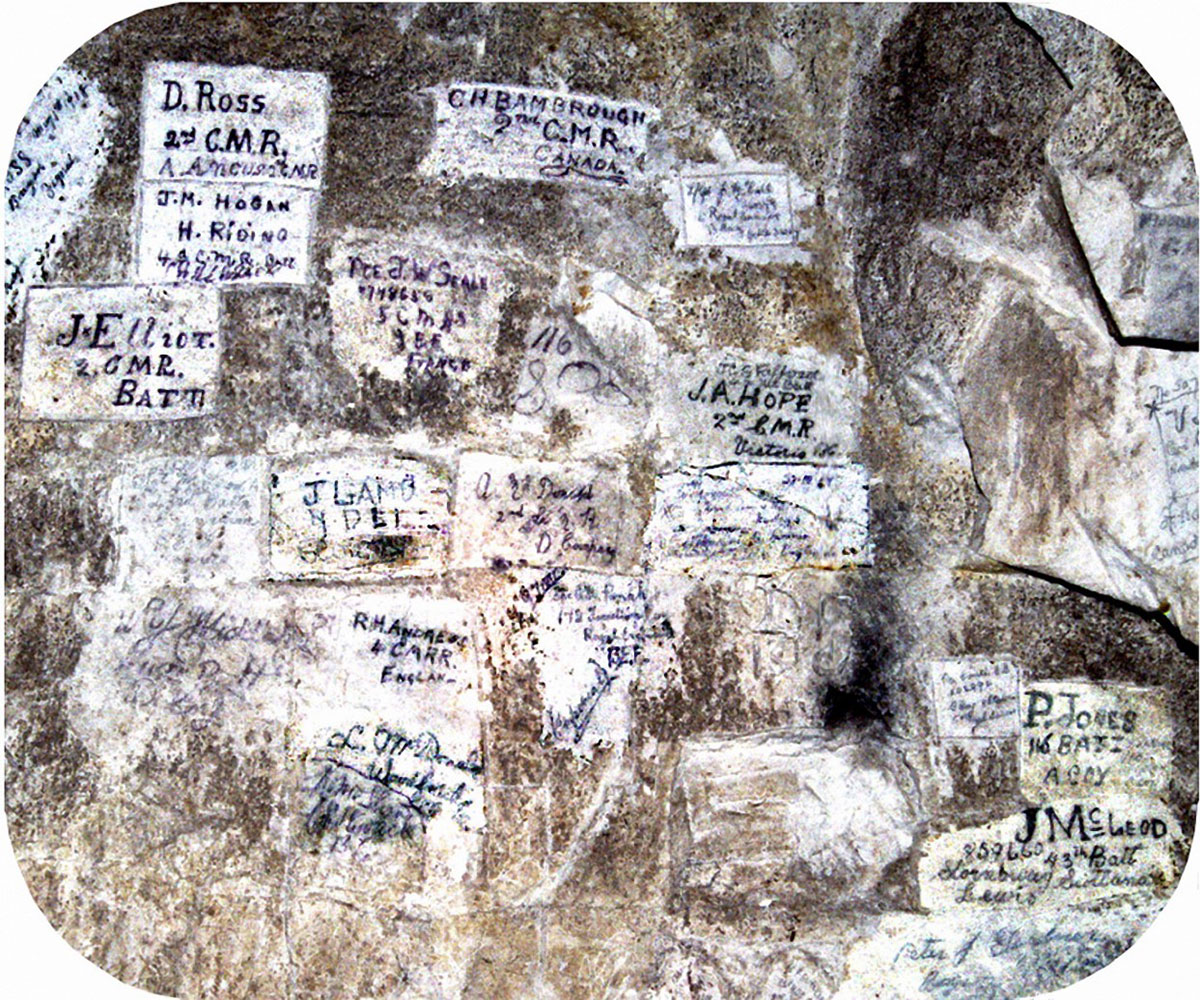
Photo: Durand Group
Click to enlarge
This is graffiti left in the Goodman Subway, a tunnel used by soldiers before the Battle of Vimy Ridge in 1917.
What names do you see? Pick one and try to research the soldier!
The traveling 100-year memorial
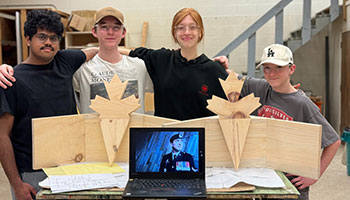
Sir Wilfrid Laurier School Board students building the memorial in 2023.
Photo: D. Johnson, SWLSB
François “Franck” Dupéré was born in Sept-Îles, Quebec, in 1980. He joined the Royal 22e Régiment while still a teenager. During his Canadian Armed Forces career, he served overseas in Bosnia and Afghanistan.
In April 2011, during his second tour in Afghanistan, Corporal Dupéré was badly wounded in an explosion. He lost an eye and a lung, and suffered other serious wounds. He spent three months in hospital but recovered enough to continue serving until his release from the military in 2015.
Dupéré lived life with energy and purpose. He climbed Mount Kilimanjaro and trekked in the Himalayas with fellow Veterans. He took part in the Nijmegen March in the Netherlands and worked with the Dallaire Institute in Africa to help prevent the use of child soldiers. He also visited schools in Montreal to share his story and inspire young people with his resilience and optimism.
Franck died in an accident in 2021. To honour his life, students from the Sir Wilfrid Laurier School Board launched a 100-year memorial project. The Corporal François (Franck) Dupéré Legacy Memorial is a wooden remembrance display that travels across Canada. Each year, its host school adds the engraved name of a local Veteran who has been an example of courage and service. In 2026, it is with James M. Hill Memorial High School in Miramichi, New Brunswick.
Who from your community would you honour with this unique military memorial?
Design choices
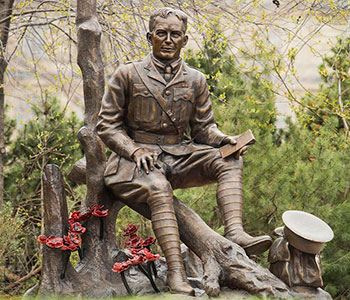
Remember Flanders monument in Ottawa.
Photo: VAC
Click to enlarge
Memorials can highlight many people or focus on just one. The Remember Flanders memorial honours John McCrae, a Canadian poet and army doctor during the First World War. He is the author of the famous poem In Flanders Fields.
Memorial designers carefully choose each element in their creations. What symbols do you see in this photo?
One poem, many voices
John McCrae’s poem is still read at Remembrance Day services around the world. Visit our website to watch, read and hear In Flanders Fields in more than 25 Indigenous and international languages spoken in Canada today!
Read between the lines
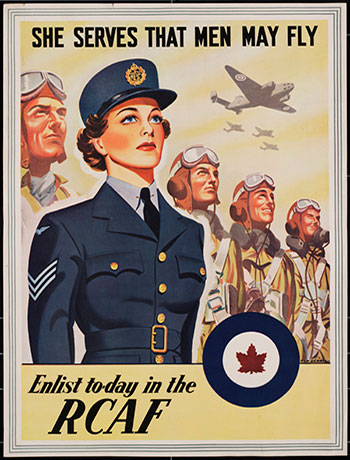
Image: LAC
Click to enlarge
Take a look at this Canadian Second World War poster, created by artist Ted Harris.
- Who is the main person in the poster?
- Is she a civilian or in the military?
- How can you tell?
- Who is in the background?
- What do you think the poster’s main message is?
- Who do you think the target audience is?
- What does “RCAF” stand for?
- The tag line says “She serves that men may fly.” Research and make a list of the types of tasks “she” was allowed and not allowed to do during the Second World War.
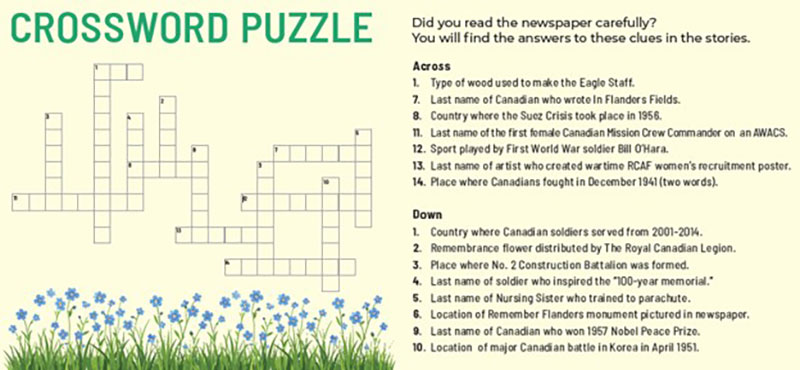
Crossword puzzle