

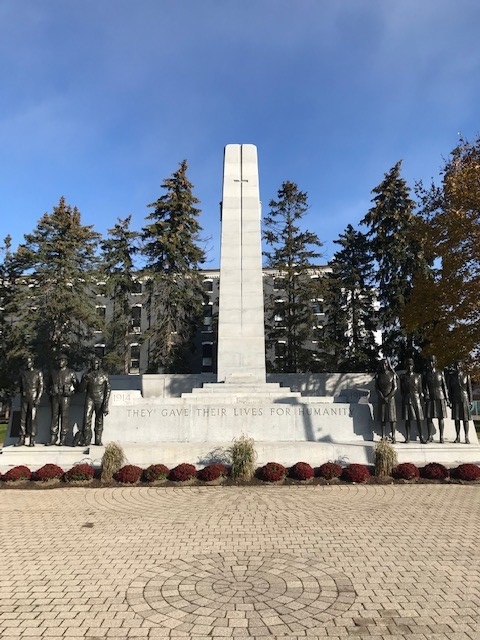
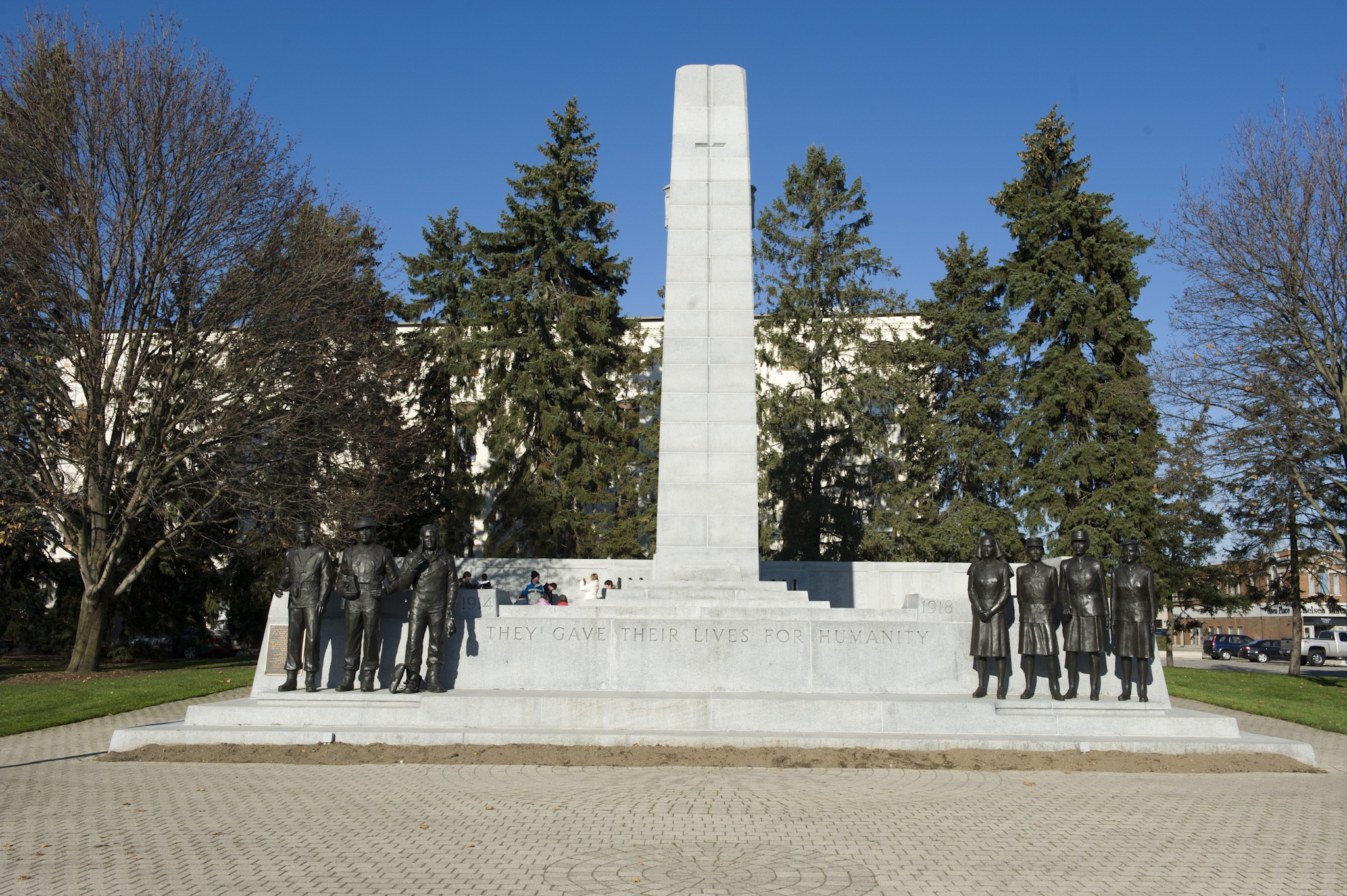
The Brant War Memorial was designed by Walter S. Allward and erected in 1933 in memory of the local war dead of the First World War. The pylons dominate, their great mass gives dignity, solemnity and a sense of guardianship over the stone of remembrance. The stone is a raised slab, ornamented with poppies. Above the remembrance stone is a cross, deeply cut in the main pylon. The park land on which the memorial sits was formerly used as a parade ground for those who left Brantford during the First World War.
Brant County, which included the City of Brantford and the Town of Paris had 5,571 enlist in the First World War. 701 died and 58 were reported missing or taken prisoner.
The memorial was later modified to incorporate the commemoration of the local war dead of the Second World War and the Korean War. In 1952, a Memorial Gallery was added and serves as a backdrop to the Brant War Memorial. On July 2, 1954, the memorial was rededicated.
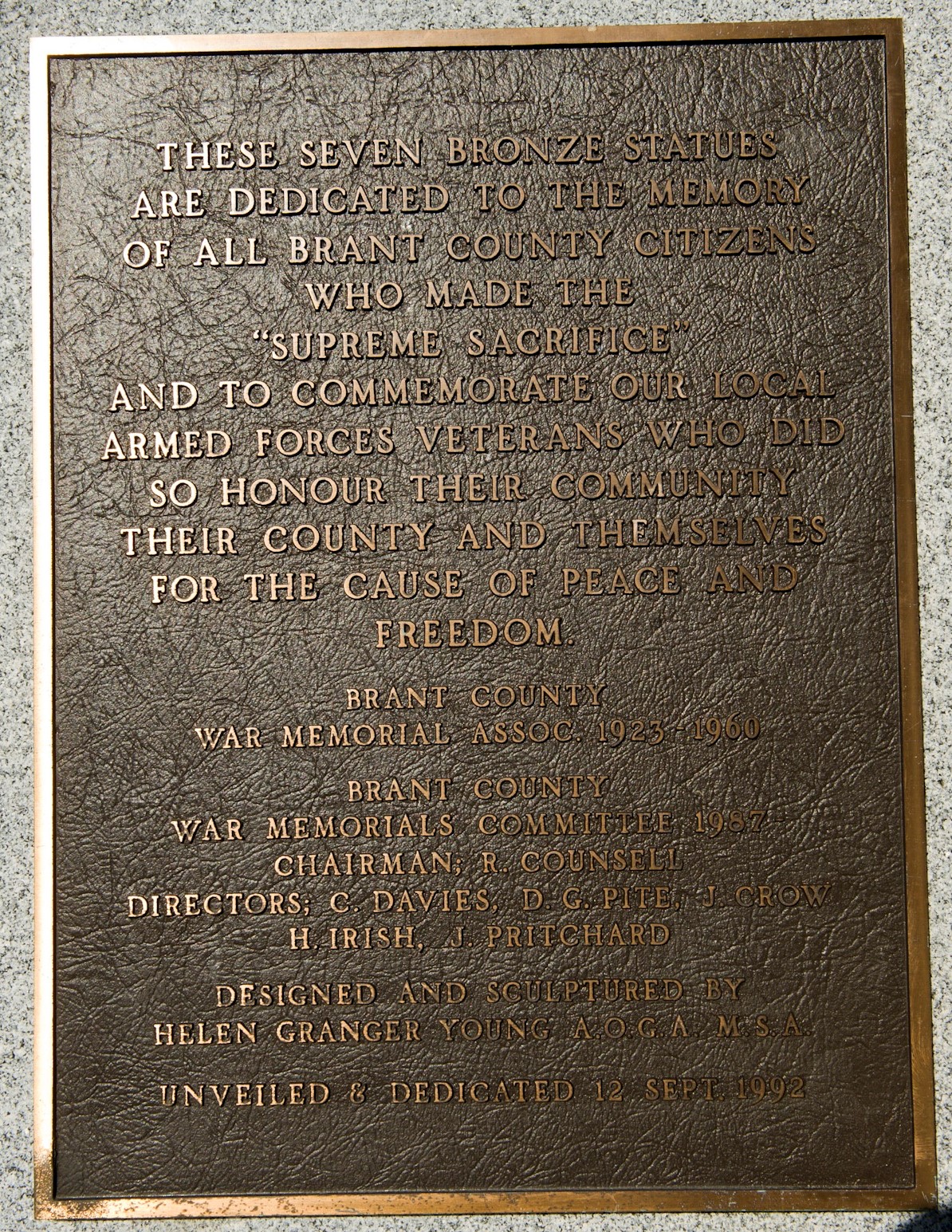
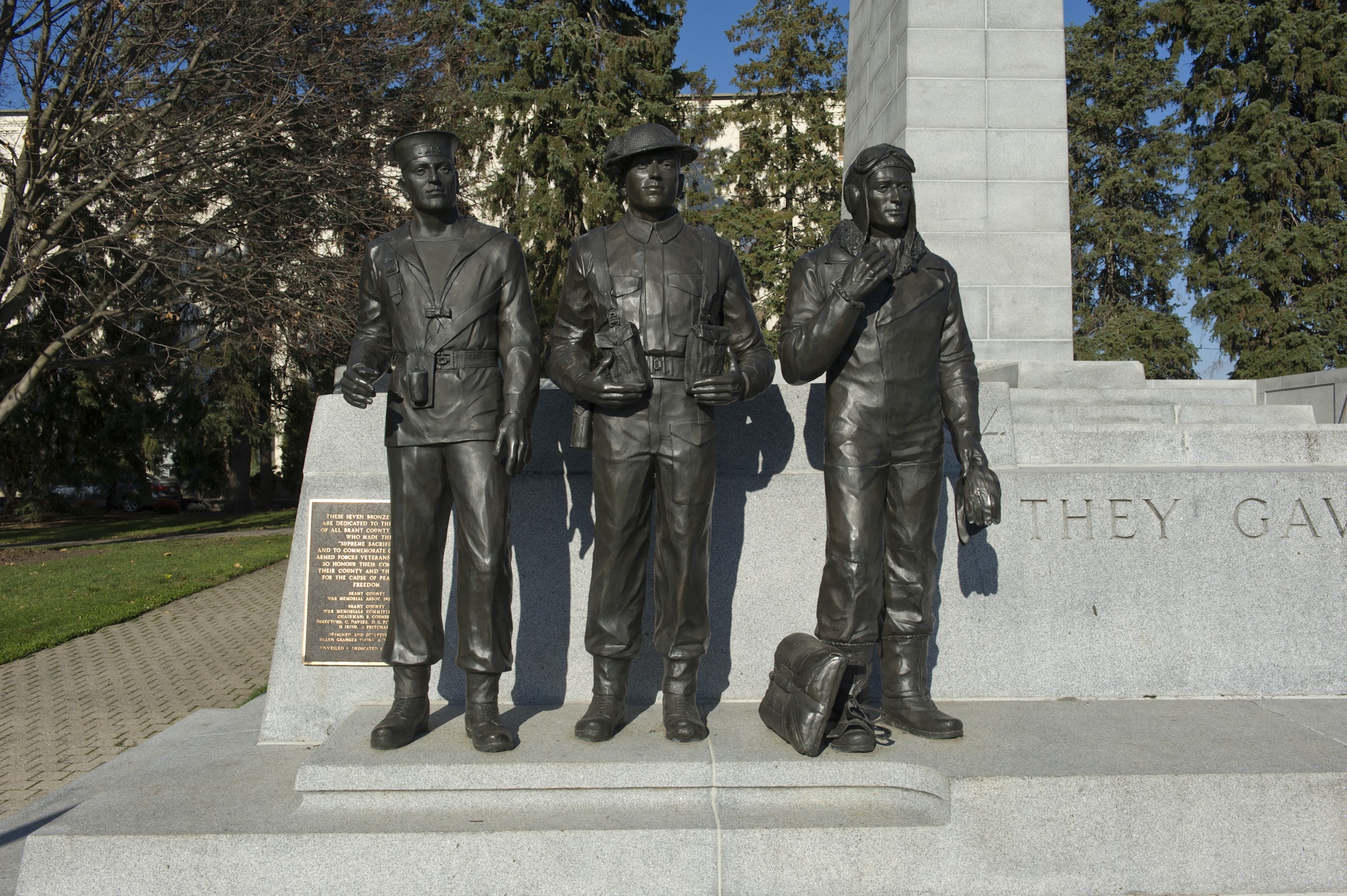
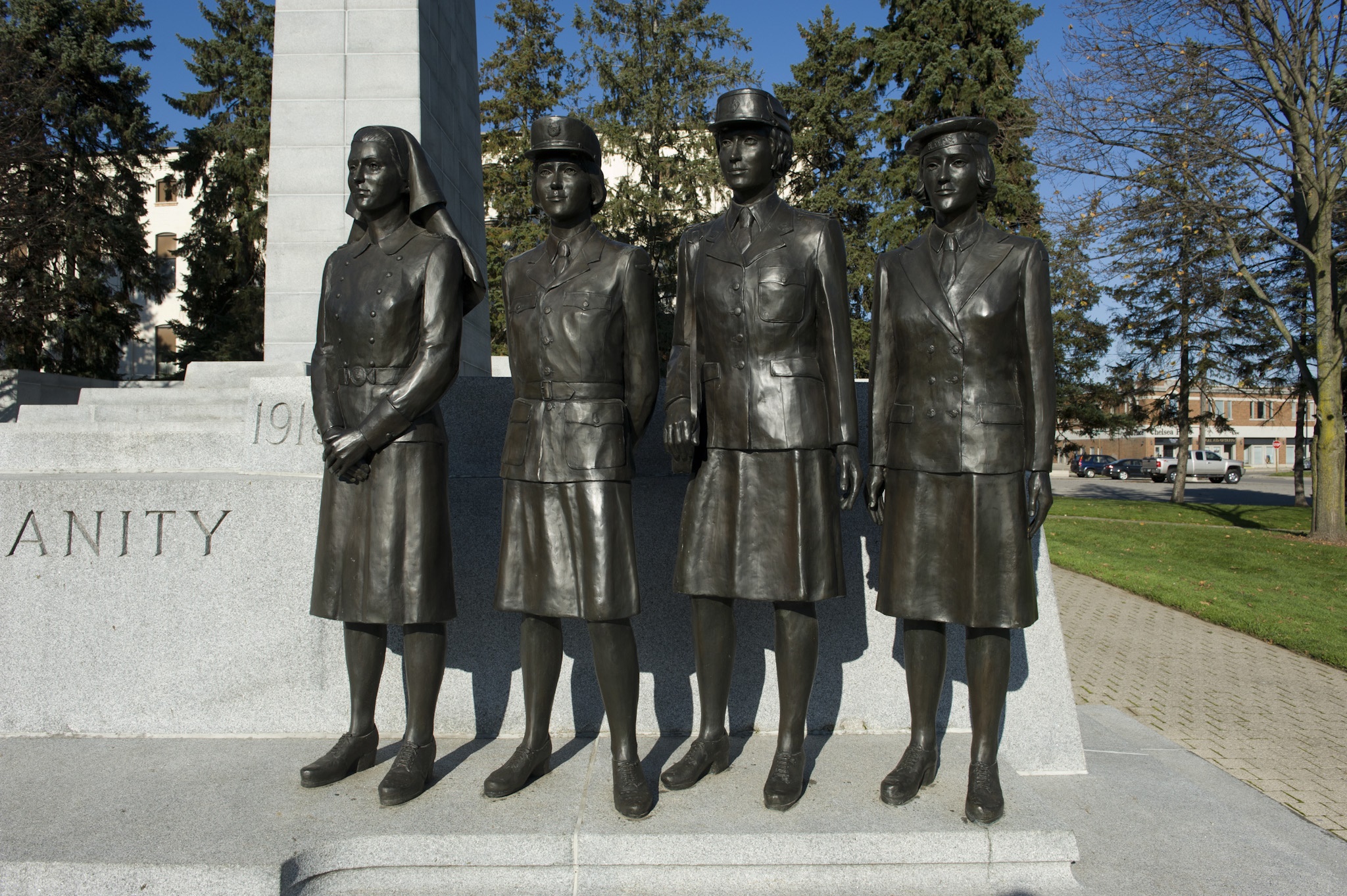
The original design by Allward included a group of bronze sculptures to represent "Humanity", consisting of a wounded youth, a resolute mother and a figure praying. Financial obstacles prevented the completion of the monument according to the original design. The Brant County War Memorial Committee initiated the completion of seven bronze statutes which were designed and sculpted by Helen Granger Young. The figures represent men and women who made the supreme sacrifice and commemorate local Veterans and are depicted in the uniforms of a nursing sister, Navy, Army, Airforce, Women's Royal Canadian Naval Service, Canadian Women's Army Corps, and Royal Canadian Air Force Women's Division. The statutes were unveiled and dedicated on September 12, 1992.
Sculptor Walter S. Allward left school at fourteen and learned about sculpture through books and magazines at the local library and by studying replicas at a nearby museum. By twenty, he had won his first commission. One of Allward’s first projects was through Sir Edmund Walker, President of the Bank of Commerce. In 1918, Walker asked Allward for memorial ideas honouring bank employees who had served and Allward submitted two wax models sculptures. The first, The Service of Our Women—Healing the Scars of War, depicts a woman sowing seeds on rocky incline strewn with war debris, including a broken canon. The second, The Service of Our Men–Crushing the Power of the Sword, portrays a man standing over a recumbent figure with his sword cast aside, symbolizing the brute beast of willful war waged by a misguided nation. The sculptures were never used, but his proposals explored ideas that would be expressed in his future war memorials: Stratford, 1919–22; Peterborough, 1921–29; and Brantford, 1921–33.