
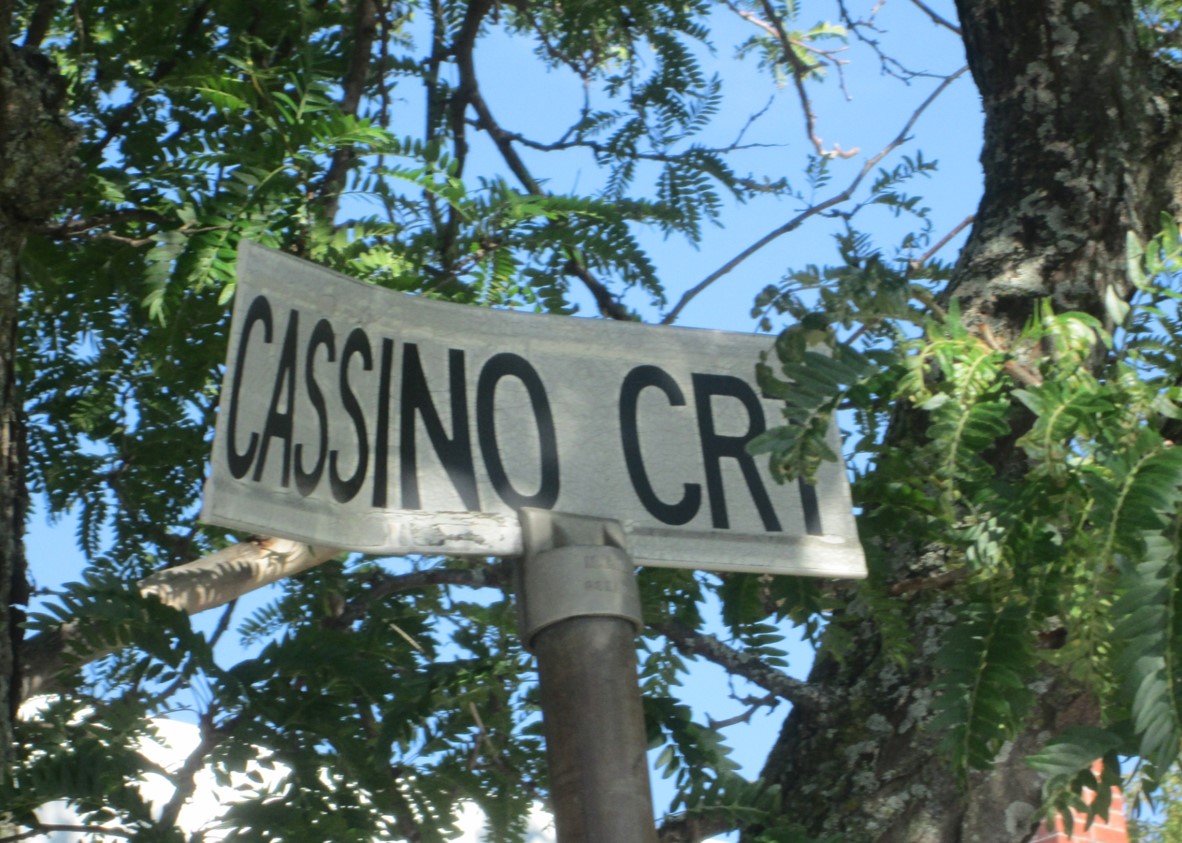
Cassino Court is dedicated to the Canadian participation in the Battle of Monte Cassino.
Built in 1940 as one of many training establishments for the British Commonwealth Air Training Plan (BCATP), Camp Picton’s 700 acres became home for numerous young Commonwealth airmen undergoing bombing and gunnery training. After the Second World War, the site was used as a storage and equipment maintenance centre for the Royal Canadian Air Force before being taken over by the Royal Canadian Artillery School (anti-aircraft). With the addition of a Permanent Married Quarters (PMQ) area in the 1950’s, the base was expanded and in the early 60’s became the Home Station for the Canadian Guards regiment. The Base was closed in 1969 and the airfield was eventually transformed into an industrial site. The PMQ area was sold to individual homeowners with many of the roads retaining their original military name.
The Battle of Monte Cassino was a costly series of four assaults by the Allies against the Winter Line in Italy held by Axis forces during the Italian Campaign of the Second World War. The intention was a breakthrough to Rome. At the beginning of 1944, the western half of the Winter Line was being anchored by Germans holding the Rapido, Liri, and Garigliano valleys and some of the surrounding peaks and ridges. Together, these features formed the Gustav Line. Monte Cassino and its abbey, dominated the nearby town of Cassino and the entrances to the Liri and Rapido valleys, but had been left unoccupied by the German defenders. The Germans had, however, manned some positions set into the steep slopes.
Fearing that the abbey did form part of the Germans’ defensive line, the Allies sanctioned its bombing on February 15. The destruction and rubble left by the bombing raid now provided better protection from aerial and artillery attacks, so, two days later, German paratroopers took up positions in the abbey’s ruins. Between January 17 and May 18, Monte Cassino and the Gustav defences were assaulted four times by Allied troops. The final battle, involving 1 Canadian Corps and 1st Canadian Armoured Brigade, began on May 11, 1944, and by May 13, the German right wing began to give way. Vicious fighting continued for another five days and on May 18, a patrol of Polish cavalry finally made it to the heights. The German defenders had been driven from their positions, but at a high cost.