
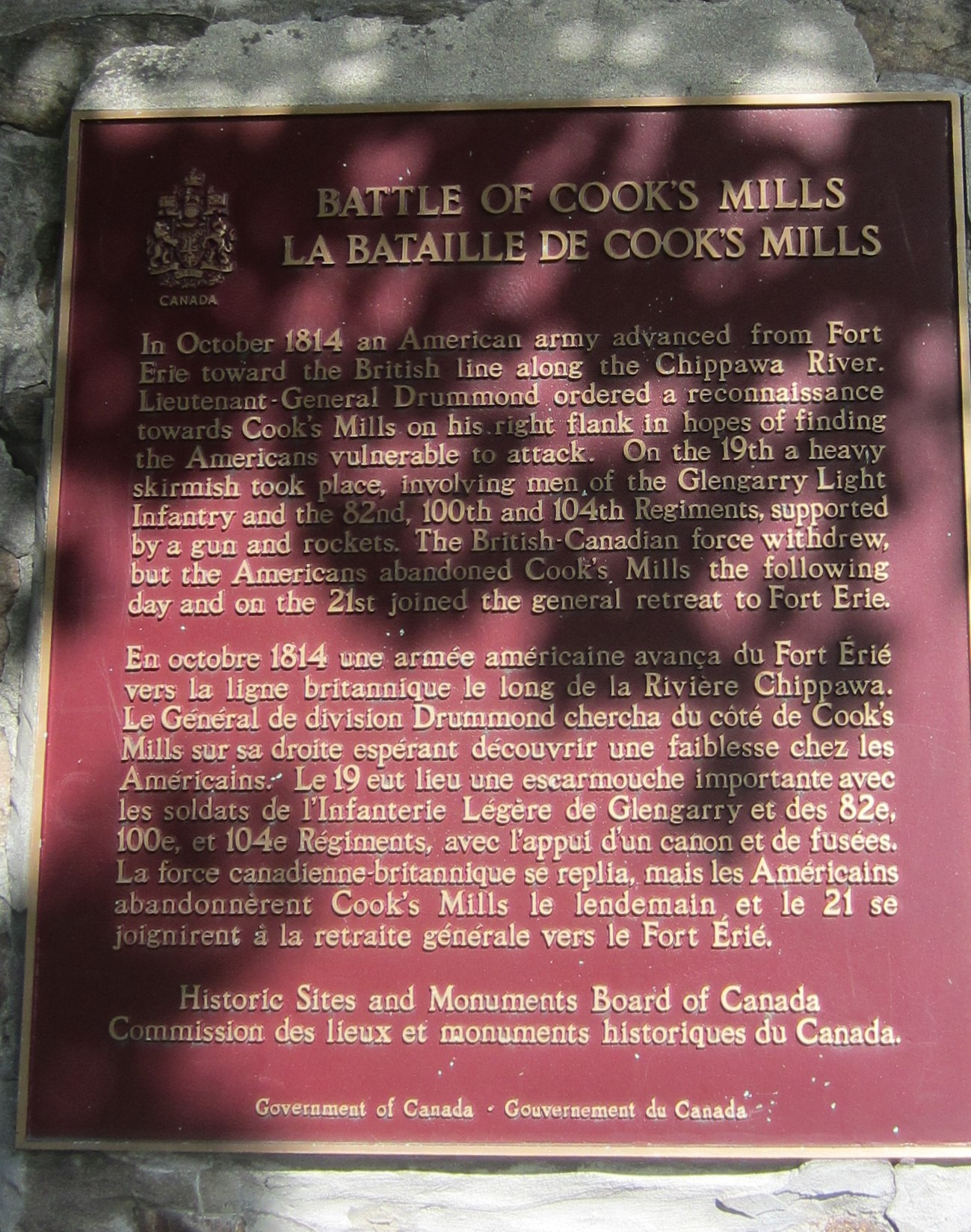

After his unsuccessful siege of Fort Erie, British Lieutenant-General Gordon Drummond withdrew north and concentrated his army along the Chippawa River. In October 1814, American forces under Major-General George Izard advanced northwards. On 18 October, Izard ordered Brigadier General Bissell with a force of about 900 men to march to Cook's Mills, a British outpost, to seize provisions in the form of wheat intended for British troops. On October 19, at Cook's Mills, a heavy skirmish took place, involving men of the Glengarry Light Infantry and the 82nd, 100th and 104th Regiments.
Led by Lieutenant-Colonel Christopher Myers the British and Canadian troops succeeded in their objective of assessing the American forces so that Drummond could take appropriate action. Having accomplished their reconnaissance in force they withdrew in good order. Bissel also accomplished his mission of destroying the wheat stored at the mills after which he and his men withdrew to join the main American force. Shortly afterwards the Americans destroyed Fort Erie and re-crossed the Niagara River to go into winter quarters. The British suffered one man killed and 35 wounded while American casualties included 12 killed and 55 wounded, primarily by rocket and cannon fire.
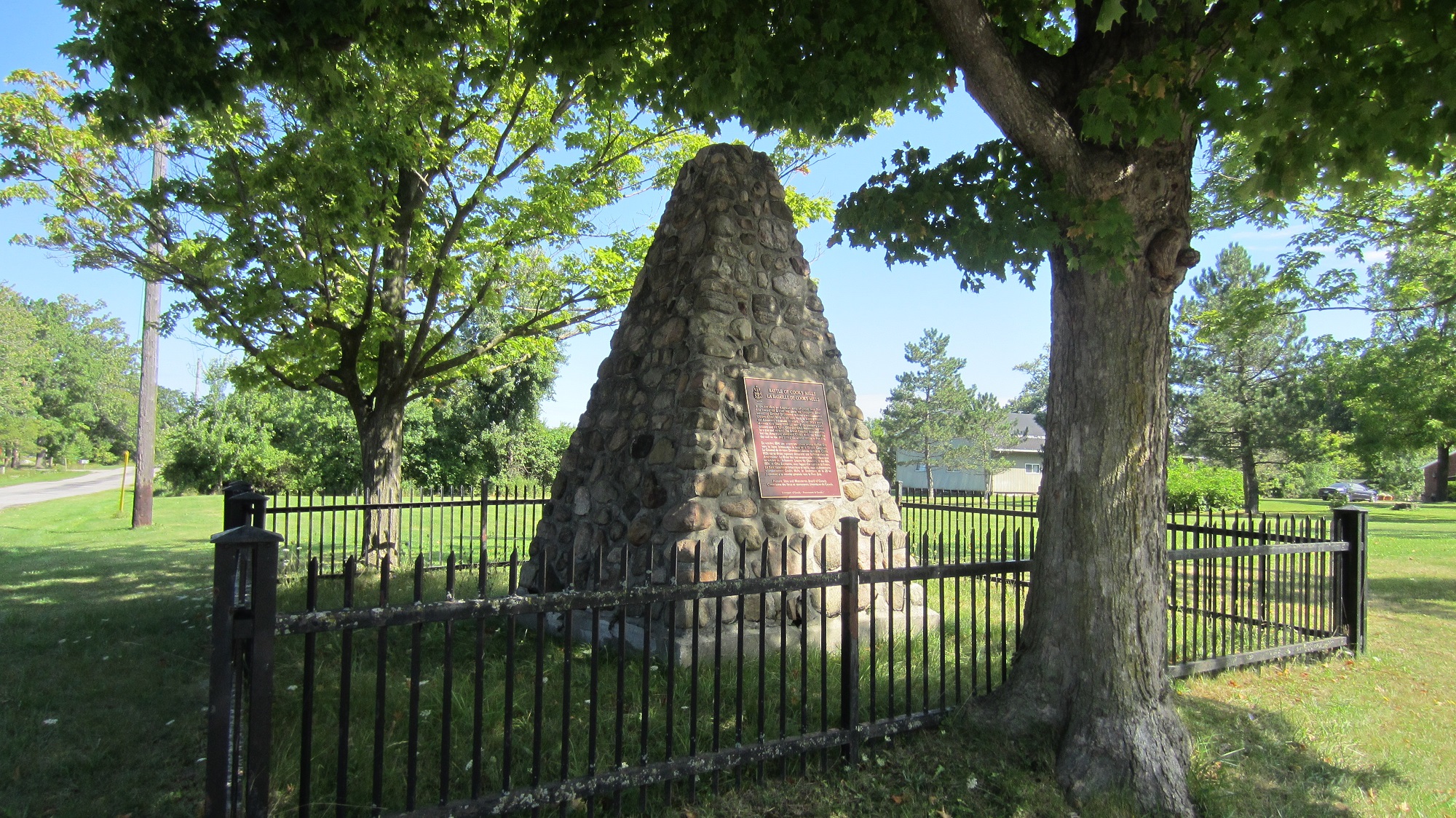
The cairn and plaque, erected in 1923, marks the south-west corner of the battle site. A replacement plaque was installed around 1977.