
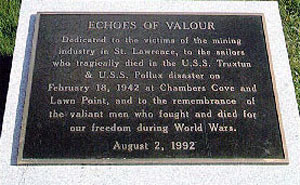
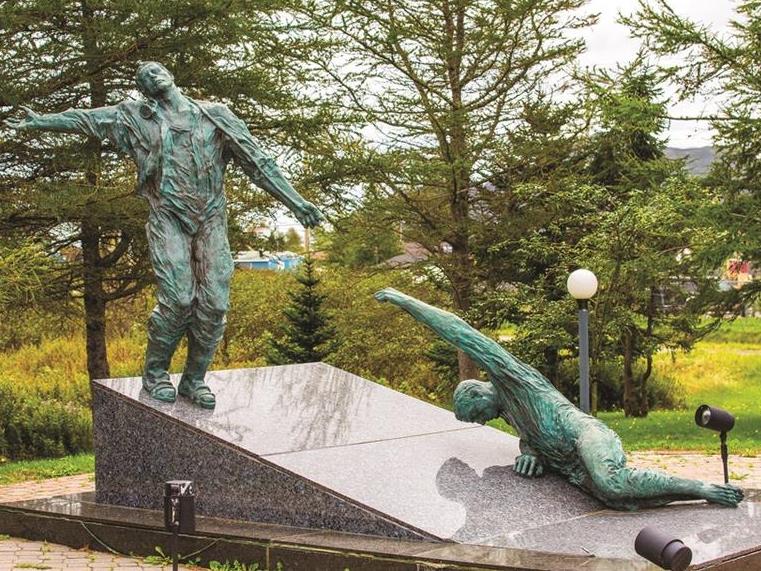
The Echoes of Valour memorial, erected in 1992 by world renowned sculptor Luben Boykov, stands as a tribute to the victims of the devastating mining disease, the sailors who tragically died in the USS Truxtun and USS Pollux disaster on February 18, 1942, at Chamber Cove and Lawn Point, and a memorial of remembrance to the valiant men who fought and died for our freedom during the World Wars. A War and Workers Cenotaph approved by the Government of Newfoundland & Labrador as a Workers Monument.
On February 18, 1942, two United States Navy ships, the USS Truxtun and the USS Pollux, heading to the United States Naval Base in Argentia, Newfoundland, were caught in a violent Atlantic storm and shipwrecked off the coastline of southern Newfoundland at Chambers Cove and Lawn Point. Prospects were dim for the sailors until one sailor from the USS Truxtun managed to reach Iron Spring Mine, St. Lawrence. The miners rushed to the scene risking their lives on ice-covered cliffs and in the raging sea, and managed to save 186 of the sailors. Despite the courageous and heroic acts displayed by these men, 203 American sailors lost their lives.
Fluorspar was first discovered on the west side of St. Lawrence Harbour in 1843. Commercial mining began in 1928, with the first ore being extracted in 1933. The shafts at Iron Springs Mine eventually reached 970 feet. It was down in the shafts that radiation first began to take its toll on the miners. The miners were also subjected to constant dust which filled their lungs and, along with the lack of oxygen in the shafts, caused them great difficulty in breathing. Many of the miners got sick with tuberculosis and more with lung cancer. By the 1950s, when the issue was brought to the attention of the Department of Health, it was too late for the hundreds of miners who had been exposed for so long to the deadly radon gas.