
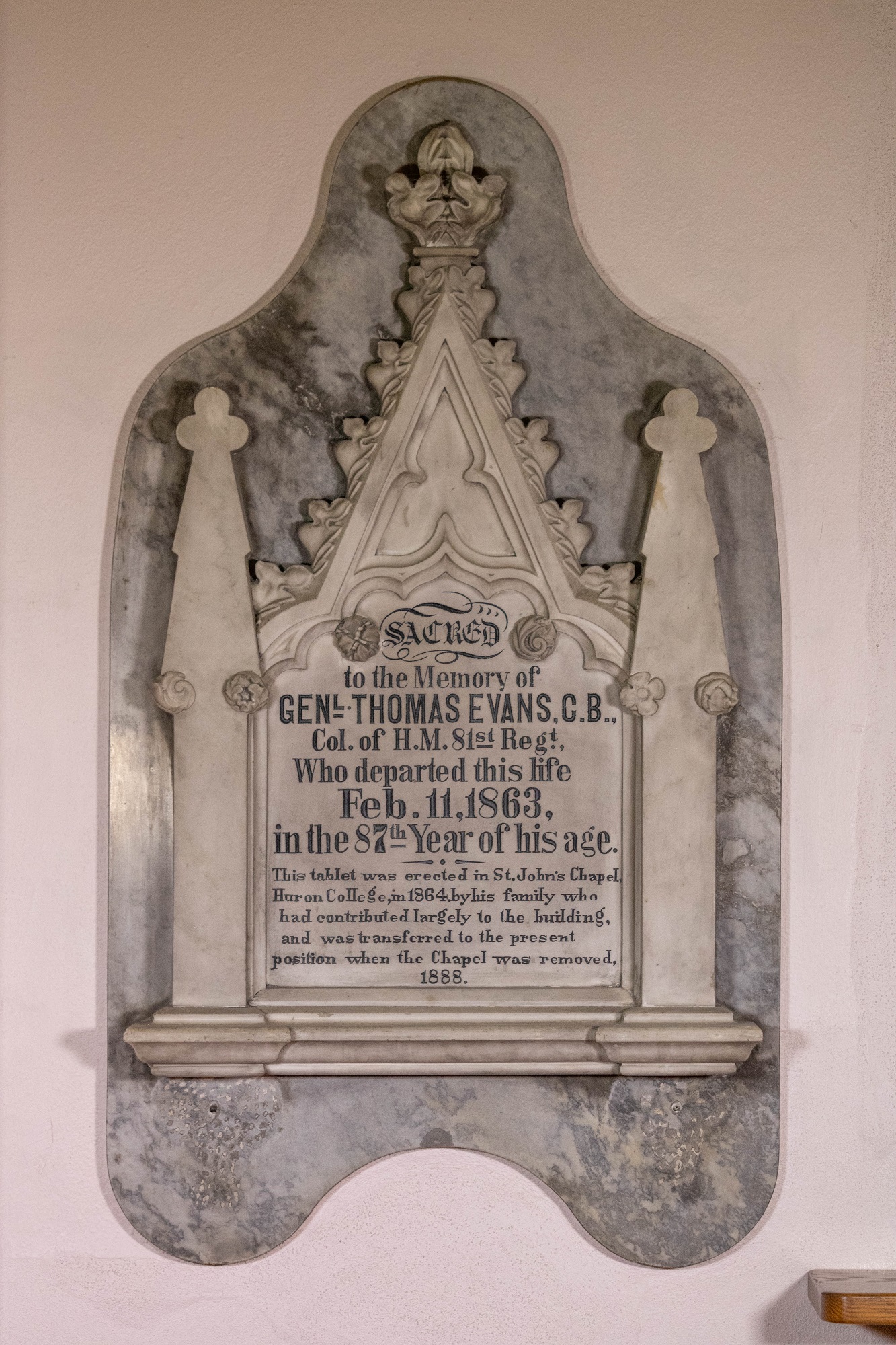
The General Thomas Evans Memorial was erected in 1888. Evans was born on 9 March 1777, near Wolverhampton, Staffordshire, England. He volunteered for the British army in 1793 and became a lieutenant in the King’s Regiment, on 11 October 1796. He served in the West Indies, Egyptian campaign and Gibraltar. By August 1808 he was in Quebec, second in command in British North America.
In the summer of 1811, Captain Evans was posted to Upper Canada as brigade-major to Major-General Isaac Brock. On the outbreak of war with the United States in June, he was primarily responsible for preparing the expedition which compelled the surrender of General William Hull’s army at Detroit on 16 August. His brilliant handling of reinforcements at Queenston on 13 October, following the death of Brock, proved a vital contribution to victory.
He was honoured with a Lieutenant-Colonel’s brevet retroactive to 13 October 1812. He commanded five companies of his regiment in the operation against the American base at Sackets Harbor, suffering three wounds. He had important roles in the expulsion of the Americans from Forty Mile Creek on the Niagara peninsula in June and in the remaining actions of the campaign of 1813.
In the winter of 1813–14, Evans commanded six service companies of the 2nd battalion of the 8th, as well as 230 seamen posted to the fleet at Kingston, on a forced snowshoe march through the wilderness from New Brunswick to Quebec. In March, he proceeded to Upper Canada and the command of the 8th’s 1st battalion, winning commendation for effective leadership at the battle of Chippawa on 5 July, and at Lundy’s Lane on the 25. He was wounded for the fourth time in the assault on Fort Erie on 15 August, but continued on active service until the end of the war, by which time he had won ten honourable mentions in dispatches and general orders.
Evans commanded the 2nd battalion of the 8th in Montreal in February 1815 and returned to the United Kingdom with the battalion in August. He returned to Canada in 1816, joined the 70th in Kingston in July where he served the next 11 years, frequently as its commanding officer.