
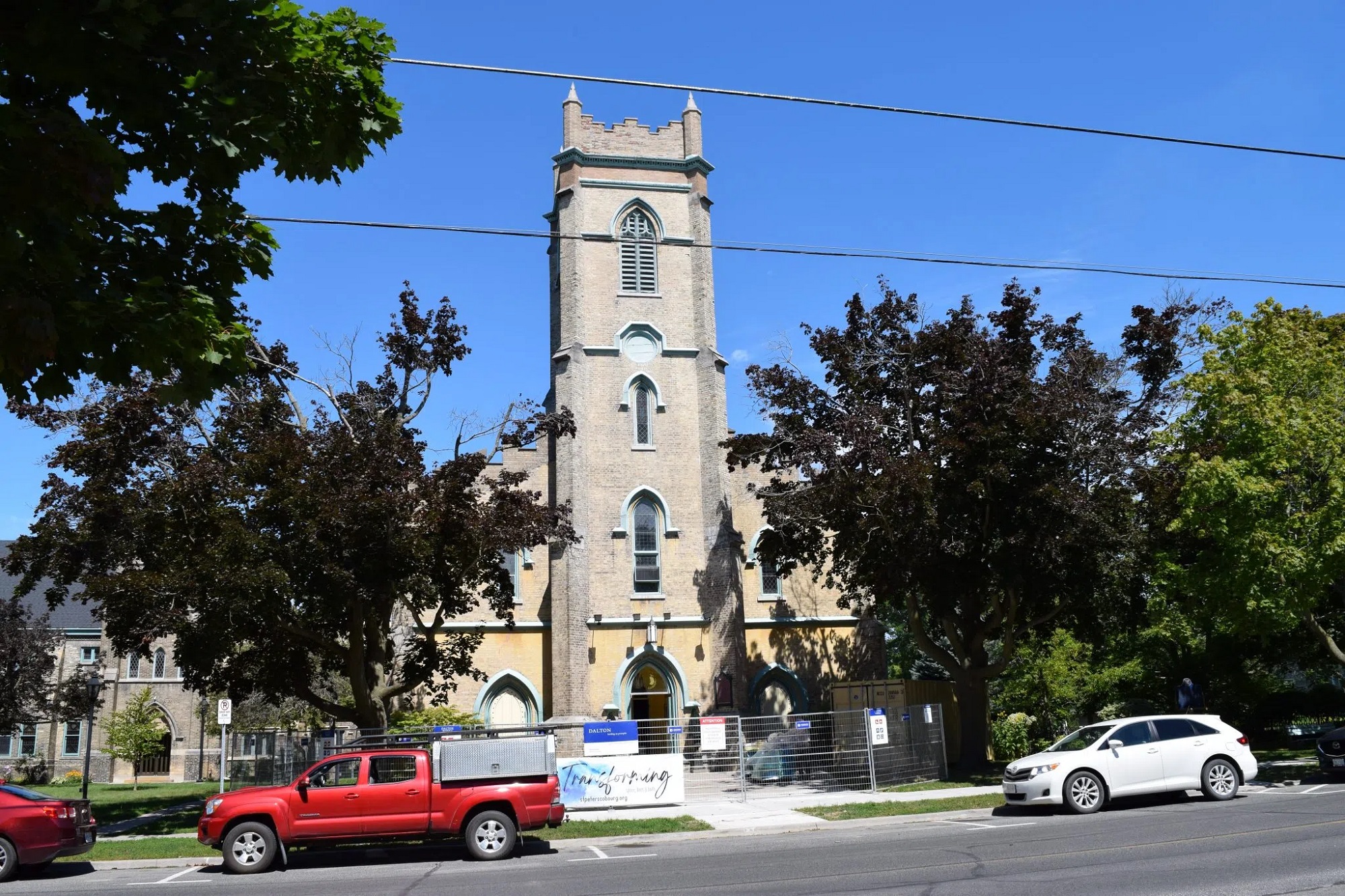
In the 1920s, the tower at St. Peter's was dedicated to the men of the parish who served in the First World War. St. Peter’s was the regimental church for the 40th Northumberland Regiment and the Canadian Garrison Artillery and the Colours for both are framed inside the sanctuary.
The First World War had a profound effect on the life of St. Peter’s. In August 1914, just three weeks from the outbreak of war, St. Peter’s hosted a special service for the 40th Northumberland Regiment who were about to go overseas. In March 1915, the 139th Battalion, Canadian Expeditionary Force Colours were deposited in St. Peter’s. By 1917, the church’s Honour Roll contained 111 names, of which eight had paid the supreme sacrifice. The final count was 14 men of the parish that died and their names are commemorated on a memorial tablet on the back wall of the church. The Lieutenant Douglas Denton Window is also located in the church.
On November 7, 1976, a service was held in this church for Victoria Cross and George Cross recipients in Canada - the highest awards for gallantry in the Commonwealth. A Belgium glass chalice was gifted to St. Peter's by the Victoria Cross and George Cross Association to commemorate the service. One of the two First World War Veterans attending was Victoria Cross recipient Charles Rutherford who lived in Cobourg at that time. As a 26-year-old Lieutenant in 1918, Rutherford persuaded 50 German soldiers to surrender while armed with only a revolver.
The outbreak of the Second World War created a number of challenges for St. Peter's. In June of 1940, Rector Canon Phillip Dykes was appointed Chaplain of the 14th Artillery Battery in Petawawa. This led to a succession of priests coming in to take services at the church. In September 1941, Reverend Robert Seaborn was inducted as rector, but in July of the following year was appointed Chaplain of The Queen’s Own Rifles of Canada. Seaborn had a distinguished career as chaplain and received the Croix de Guerre by the French government in recognition of his heroic service on D-Day. Upon his return to the parish in November 1945, he was given a hero’s welcome. The Cobourg Second World War Honour Roll is located in the nave of the church.