
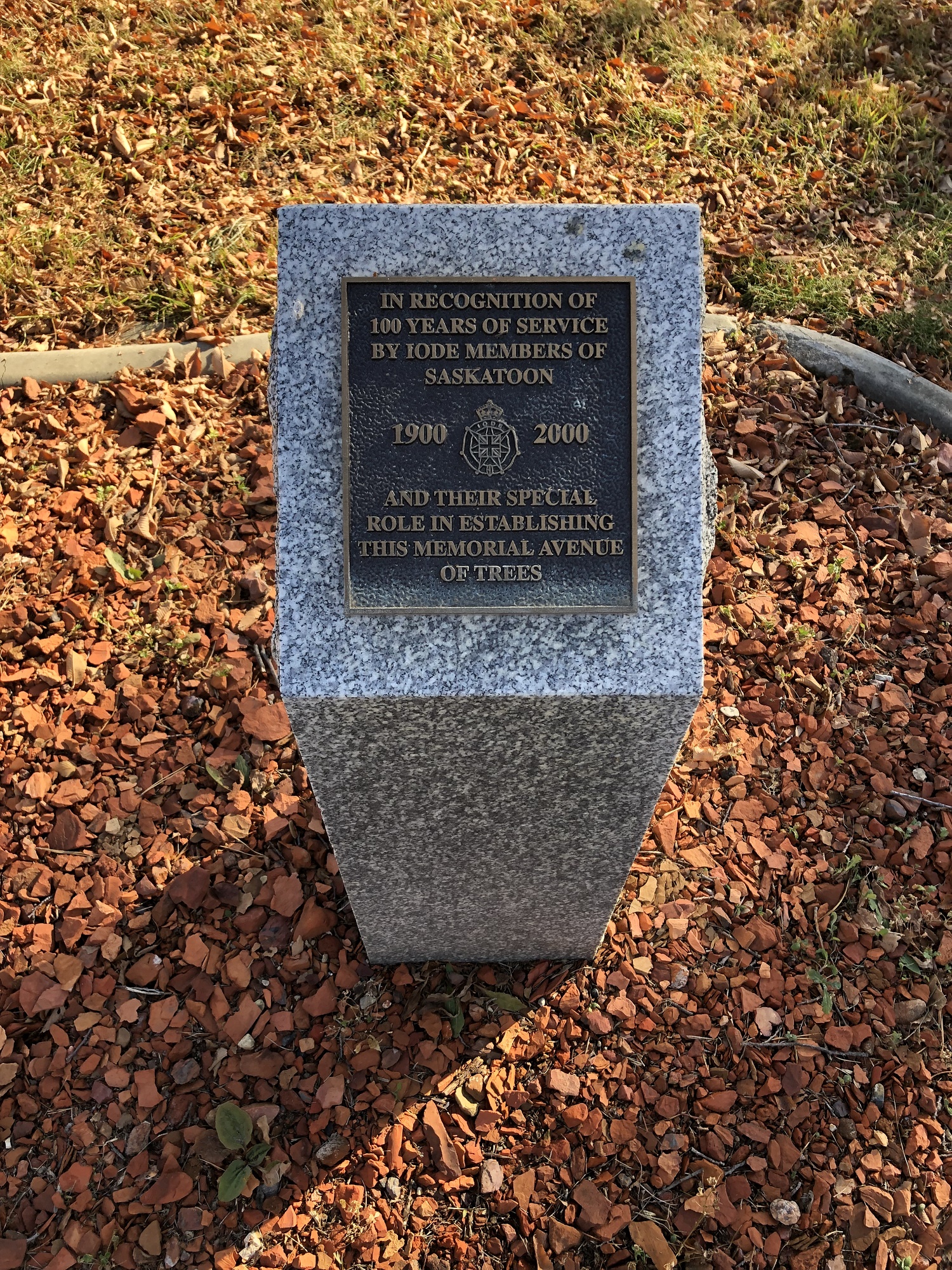
The idea for a memorial avenue originated with the Education Committee of the local Military Chapter of the Imperial Order of the daughters of the Empire. Mrs. Jean Jarvis and Mrs. A. H. Hanson, key members of the committee, presented the concept to the City of Saskatoon in May 1922. The following month, the council endorsed a committee consisting of Parks Board staff and Imperial Order of the daughters of the Empire members.
From the Saskatoon Imperial Order Daughters of the Empire branch: "A tree is a living memorial often more enduring than marble or bronze; a tree is a thing of beauty and of inspiration — a living token of the wonder and glory of nature — a symbol of service — for the life of a tree is a life of service, even the end of life is not the end of a tree's service; to the contrary, the end of a life opens new fields of service which add immeasurably to our civilization, our culture, and our happiness; therefore, is not a tree a fitting symbol for those valiant men who gave their lives for the service of their country and who died that humanity might continue to live in civilization, in culture, and in happiness?"
On June 17, 1923 the first trees were dedicated at a formal ceremony with Brigadier-General Alexander Ross, military units and representatives of every organization in Saskatoon in attendance. A crowd of 8,000 attended the event as 265 trees and plaques were dedicated. Each tree was purchased by the next-of-kin of a deceased soldier and dedicated to that specific individual with a brass plaque. For twenty years, Albert Meek skillfully engraved the plaques.
The 1923 ceremony was the first annual memorial service. Originally a private drive, Next-of-Kin Memorial Avenue was officially dedicated as a street on February 15, 1937. The yearly event and scope of the avenue has been expanded to memorialize those who died in both World Wars, the Korean War and all subsequent military engagements. Since that first dedication of 265 trees in 1923, more than 1,200 trees have been planted on various “branches” or avenues stemming from Next-of-Kin Memorial Avenue and running throughout the cemetery. The branches of the Avenue are names after distinguished soldiers, major battles, or ships.
The City of Saskatoon website maintains a listing of each memorial tree including the individual’s name, rank during service, place of death, age and the sponsor. The Imperial Order of the daughters of the Empire was responsible for the management of this program until February 10, 1986 when the City of Saskatoon assumed the administration of the program.
Two sets of gates are located within the initial Next-of-Kin Memorial Avenue. The first is the original entrance to Woodlawn Cemetery located on the north end of the Avenue. The original entrance is marked by two stone pillars and predates Next-of-Kin Memorial Avenue. The second gate is currently used as the entrance near 33rd Street. Two pillars of stone and brick were erected in the early 1950s. The Imperial Order of the daughters of the Empire contributed financially to the construction. A plaque is affixed to each pillar.
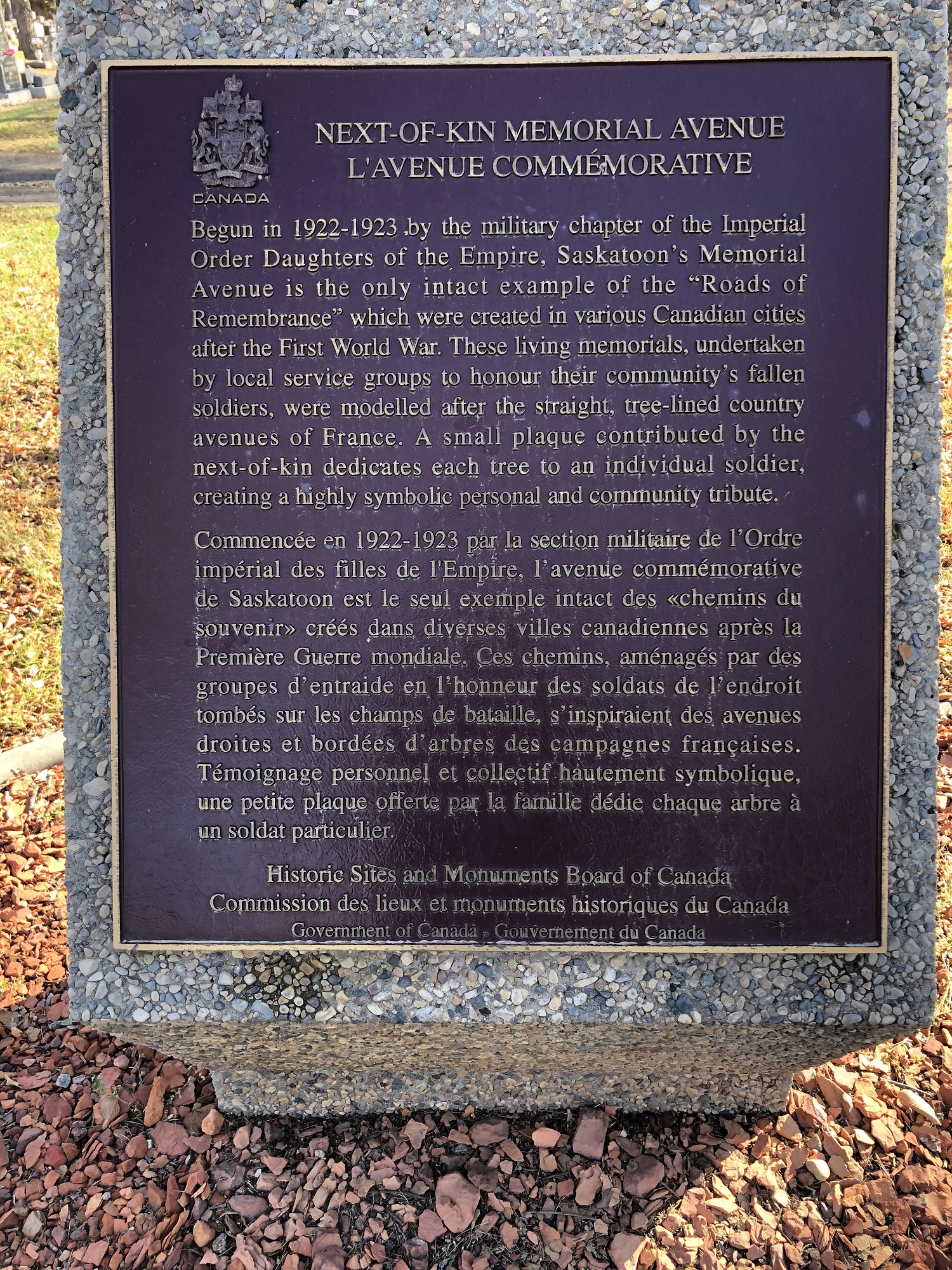
In 1991 Jim Hall, an Executive Committee member of the Royal Canadian Legion, contacted the Historic Sites and Monuments Board of Canada with the proposal that Memorial Avenue be declared a National Historic Site. Gordon Fulton, along with Fern Graham, both of the Parks Service Architectural History Branch, had researched "Roads of Remembrance" in Canada and prepared a report.
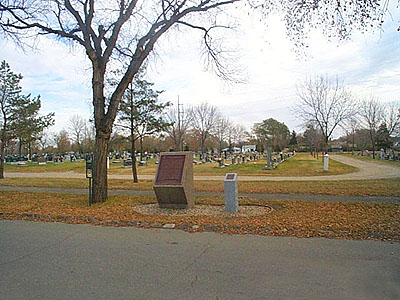
In 1992, the Next-of-Kin Memorial Avenue was designated a national historic site of Canada because: it is an excellent example of the “Roads of Remembrance” and it is the only such boulevard in Canada to have retained its integrity. Official recognition refers to the roadway known as Memorial Avenue, beginning at the north edge of Warman Road and ending at the stone cairn located between cemetery lots J and K and includes the road, the stone cairn and a measured boundary extending 14.2 meters from the center-point of Memorial Avenue. On August 28, 1994, a plaque was unveiled during the annual Decoration Day Memorial Service at the Soldiers' Cairn in Woodlawn Cemetery.
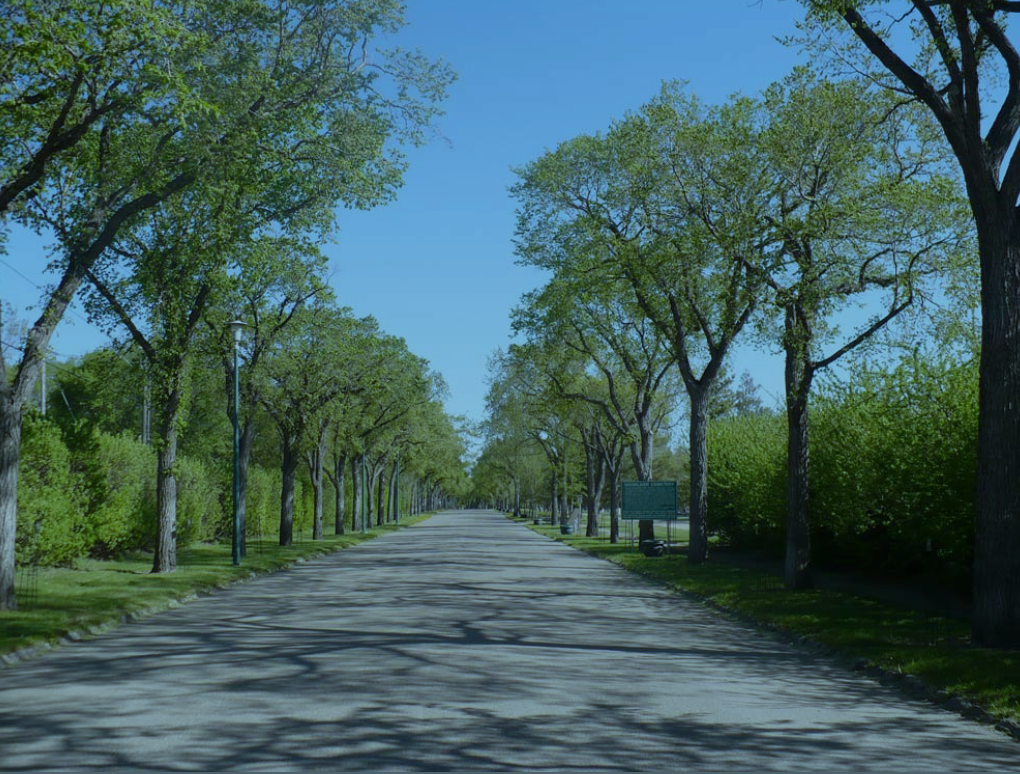
The Next-of-Kin Memorial Avenue National Historic Site of Canada is a picturesque 0.7 kilometer-long Road of Remembrance. The avenue begins at a pair of stone pedestals, flanked by a wrought-iron fence and runs northwards following the western boundary of the cemetery. It ends in a paved circle surrounding a stone memorial cairn. The asphalt-paved roadway is flanked on either side by a single row of 112 stately, mature elm trees, accompanied by bronze plaques on wrought-iron stands that dedicate each tree to a deceased soldier.
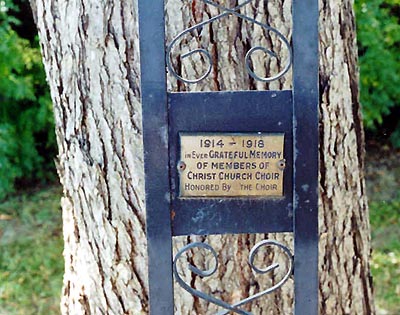
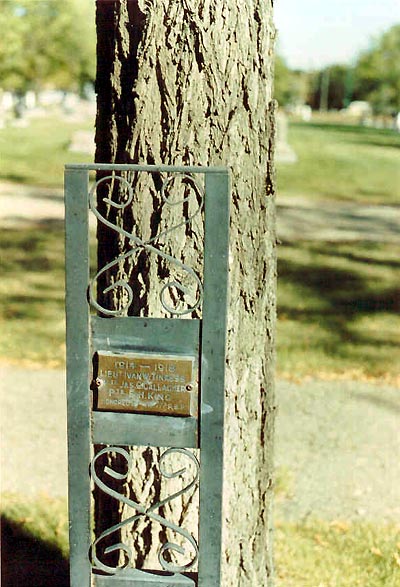
Each tree has a plaque and plaque stand associated with it. Each plaque, or brass plate, contains the individual’s name, rank and date of service. Initially serving as protection for the tree, the guards are now used solely as stands for the plaque. Some of the original guards have grown into some trees. In the past, plaques and stands have been replaced as required (due to damage). Three different styles of plaque stands have been used over the years and can be found on the avenue. The original style was replaced with a two-spiked plaque stand (date uncertain). In 1984, the Director of Woodlawn Cemetery chose a one-rod stand instead of two to facilitate lawn maintenance. Since 2002, replacement stands are replicas of the original style and are constructed of black wrought iron. They are distinguishable from the originals because they are slightly taller. Of the 1,360 memorial tree plaques, 99% are in honor of a Veteran.
In November 1918, Canadians turned to the duty of commemorating the dead. Some promoted practical memorials like Roads of Remembrance. These linear tree-lined avenues had trees that were typically a single species, regularly spaced along each side of the avenue that would grow tall and stately. American elms were chosen for many of these avenues. A small plaque was used to assign a particular tree to a specific fallen soldier. In some cases, the next-of-kin was involved in purchasing the tree and/or plaque for the deceased soldier.
Roads of Remembrance were based on two symbol-laden images. The first was France’s tree-lined country avenues: “long straight roads, with large elms on either side, beautiful and useful, and loved by the Canadians overseas.” The second symbol was a living memorial: trees represented the victory of life over death. Memorial trees became living symbols of the sacrifices made in France and Belgium.