
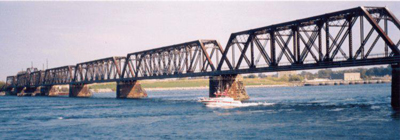
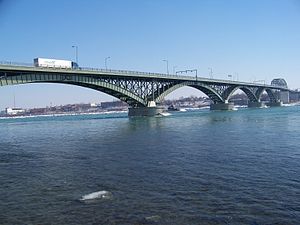
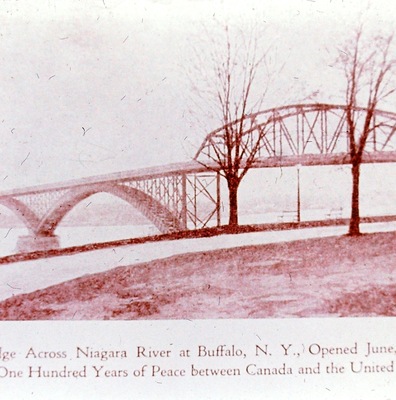
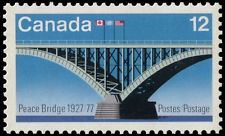
The Peace Bridge was constructed in 1927 to recognize over 100 years of peace and prosperity between the U.S. and Canada. The Peace Bridge is an international bridge between Canada and the United States at the east end of Lake Erie at the source of the Niagara River, about 20 kilometres upriver of Niagara Falls. The Peace Bridge was dedicated on August 7, 1927. The bridge is a 2580 foot long steel structure with three lanes. The Peace Bridge is the second busiest border crossing between the US and Canada.
The Peace Bridge is located near the center of downtown Buffalo, New York, and Fort Erie, Ontario, where it crosses the Niagara River. The main approaches to the Peace Bridge on the United States side are the New York State Thruway (I-190) and Porter Avenue, a four-lane arterial. On the Canadian side, the principal approach highways are the Queen Elizabeth Way ("QEW"), a four-lane controlled-access highway, Highway 3, a regional four-lane highway and the Niagara Parkway. The Peace Bridge addresses are 100 Queen Street Fort Erie, ON L2A 3S6 Canada and 1 Peace Bridge, Buffalo, NY 14213, United States.
The building of the Peace Bridge was approved by the International Joint Commission on August 6, 1925. A major obstacle to building the bridge was the swift river current, which averages 7.5 to 12 miles per hour (12.1 to 19.3 km/h). Construction began in 1925 and was completed in the spring of 1927. On March 13, 1927, Edward Lupfer who served as chief engineer, drove the first car across the bridge. On June 1, 1927, the bridge was opened to the public.
The Peace Bridge measures 3,580 feet in length from abutment to abutment. The roadway is 36 feet wide from curb to curb with two six-foot pedestrian sidewalks on either side of the bridge. The superstructure of the Peace Bridge consists of riveted steel with reinforced concrete deck slabs and a latex modified concrete wearing surface. Today, the Peace Bridge has been modified to a three-lane bridge with twelve-foot wide lanes, able to accommodate heavy-duty commercial loads. The center lane of this three-lane bridge is reversible, allowing for two-lane operation in one direction during peak hours.