
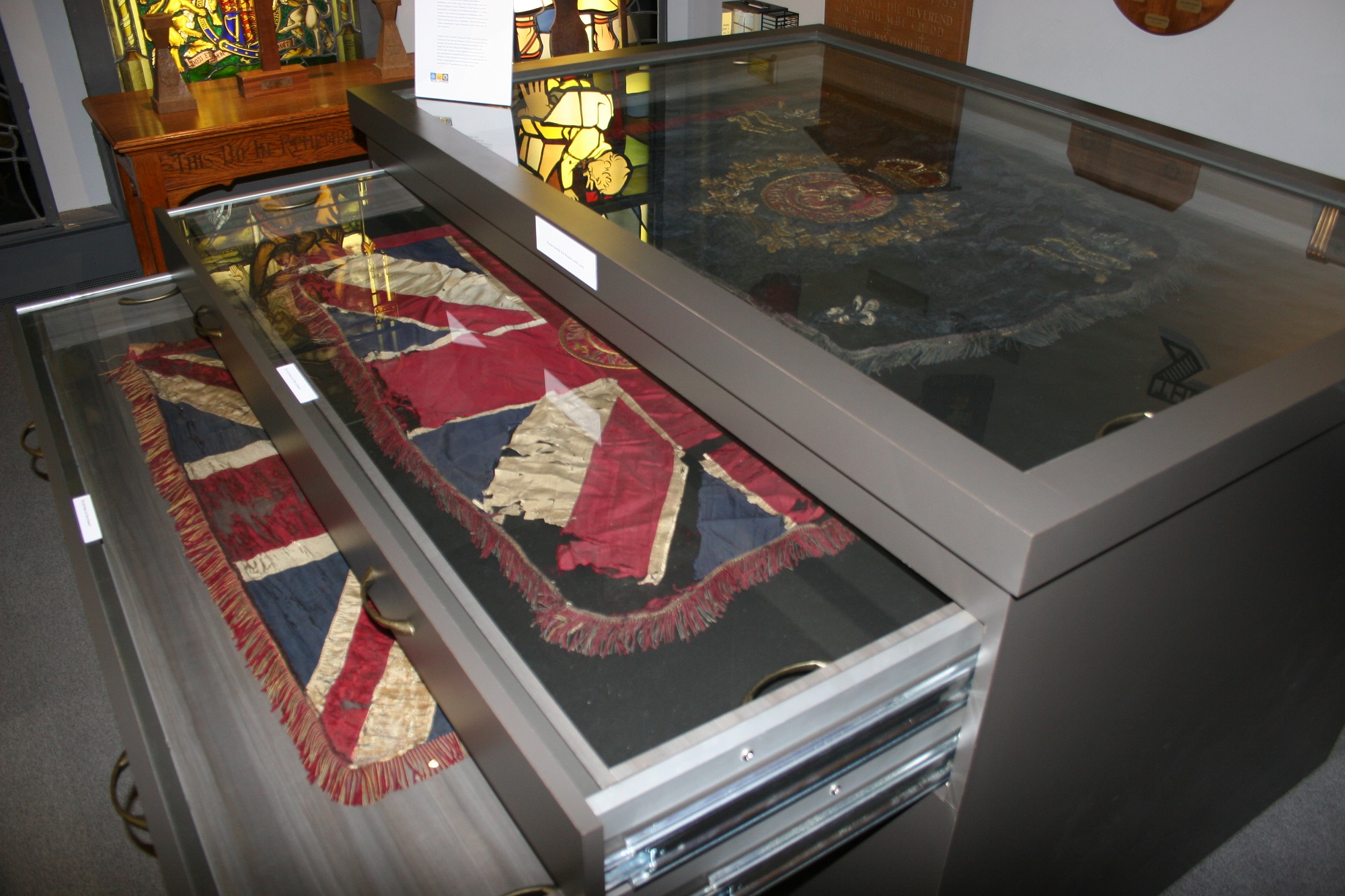
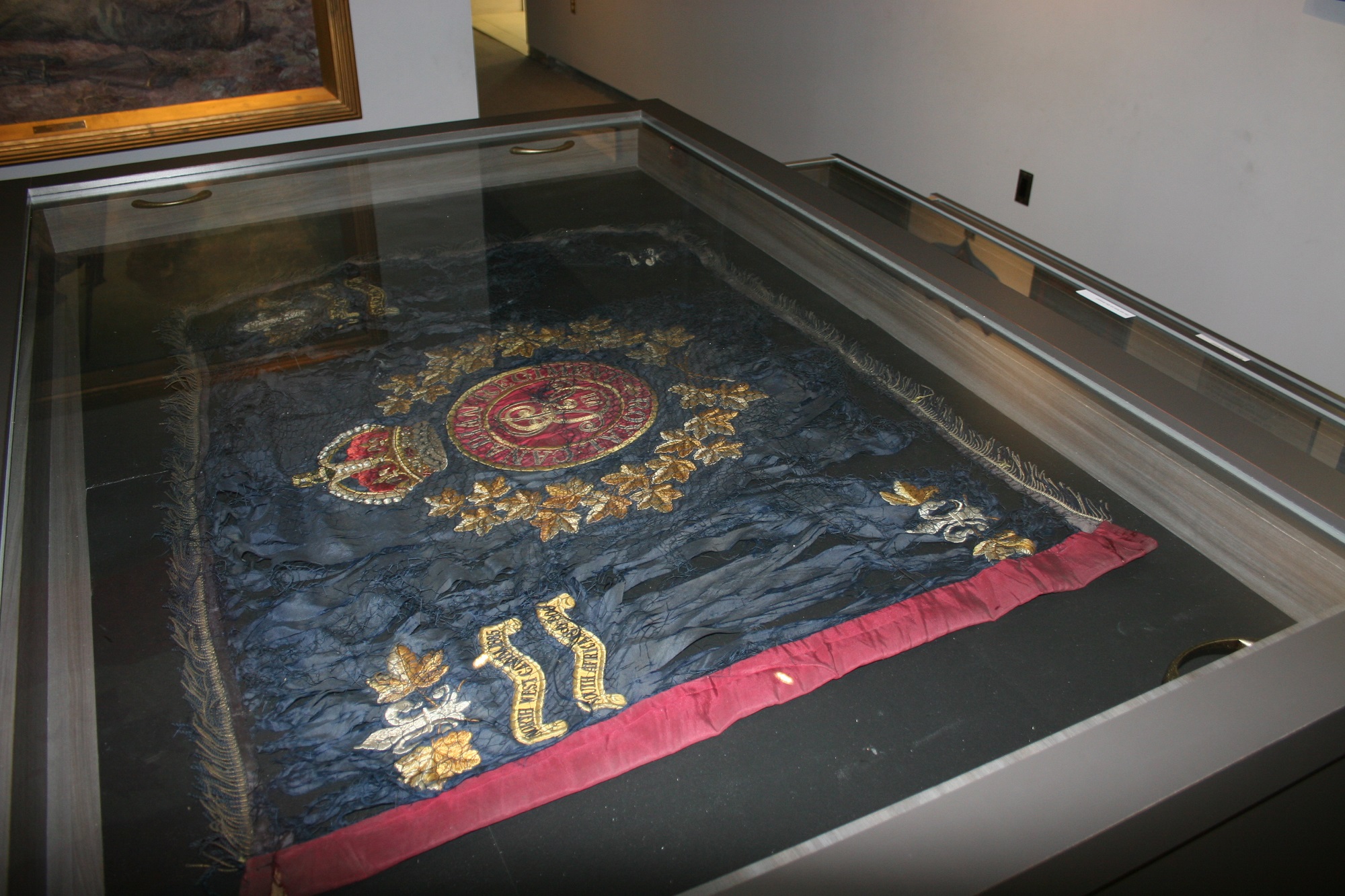
For many years Cronyn Memorial Church was the Garrison Church of The Royal Canadian Regiment and of the Permanent Force Detachments stationed in London following the First World War. The church was originally called The Memorial Church and officially opened on December 14, 1873.
Prior to the Second World War, it was the custom of The Royal Canadian Regiment to parade to Cronyn Memorial Church on the 3rd Sunday of every month. Their old Colours hung in the chancel of the church. The 1st Battalion of The Royal Canadian Regiment laid up its old Colours at Cronyn Memorial Church on May 26, 1932. In earlier times, Colours played a prominent part in many battles. They served to identify units in battle, often marking the focal point of a struggle. Captured Colours were a prized trophy and attracted enemy attention and inspired much gallantry. By the late 19th and 20th Century, however, they were no longer carried in battle, but their status as the heart and soul of a Regiment continued, and the laying up of Colours signifies and helps keep holy the memories of the men who sacrificed their lives. The affiliation between the church and The Regiment was deep and long lasting.
In 2016, when Bishop Cronyn Church was re-designated, The Royal Canadian Regiment Museum retrieved The Royal Canadian Regiment Colours that were laid there in 1932 and 1991, along with the 1st Battalion, The RCR Queen’s Colour presented in 1959.
Regimental Colour and King’s Colour were presented to The Regiment for the first time in Toronto on 11 October 1901 by the Duke of York, future King George V. It took five years to emblazon the Battle Honours Northwest Canada and South African War on the newly presented Colours. A Union Jack banner, known as the ‘South African banner’, was presented on behalf of King Edward VII in 1904, in Ottawa, by the Governor General of Canada, the Earl of Minto. Trooping the South African banner was customary on Paardeberg Day and other regimental parades until the late 1920s.