
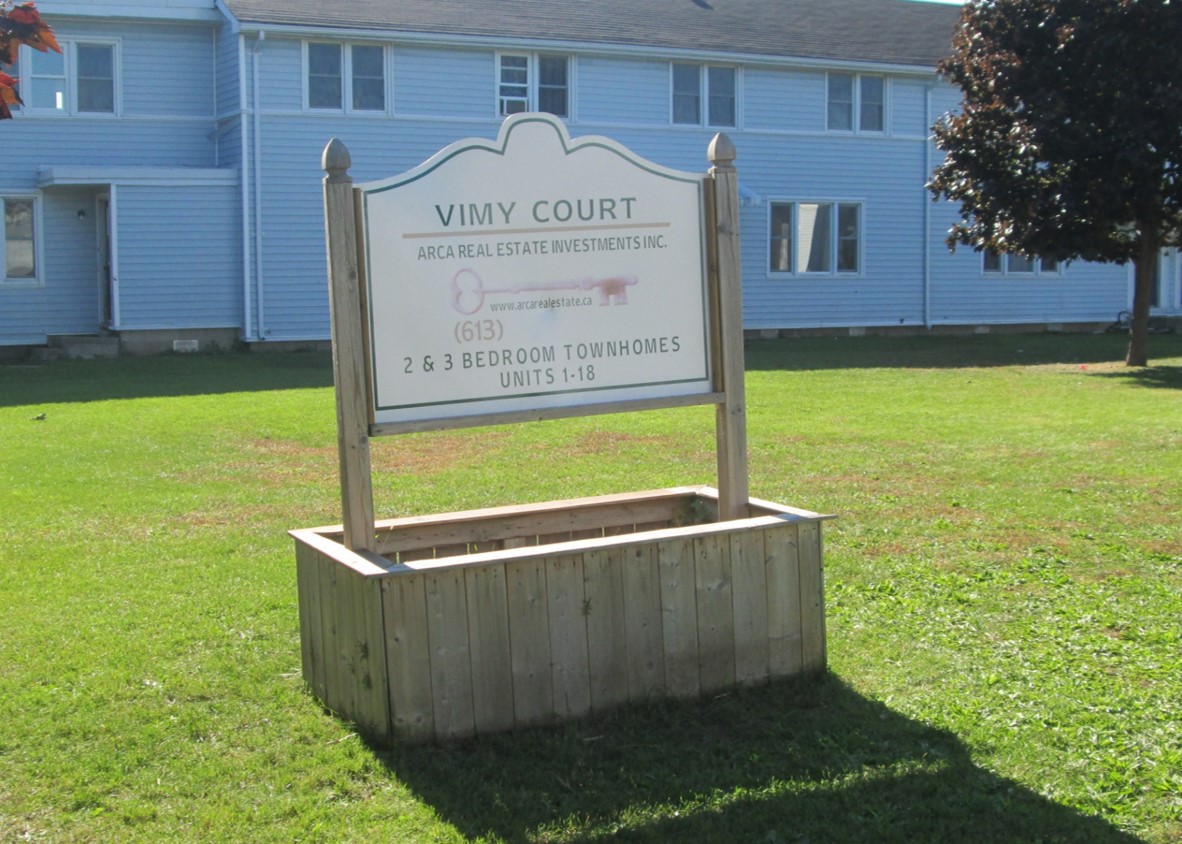
Vimy Court is dedicated to the Canadian Corps' victory at the Battle of Vimy Ridge.
Built in 1940 as one of many training establishments for the British Commonwealth Air Training Plan (BCATP), Camp Picton’s 700 acres became home for numerous young Commonwealth airmen undergoing bombing and gunnery training. After WWII, the site was used as a storage and equipment maintenance centre for the RCAF before being taken over by the Royal Canadian Artillery School (anti-aircraft). With the addition of a Permanent Married Quarters (PMQ) area in the 1950’s, the base was expanded and in the early 60’s became the Home Station for the Canadian Guards regiment. The Base was closed in 1969 and the airfield was eventually transformed into an industrial site. The PMQ area was sold to individual homeowners with many of the roads retaining their original military name.
The Battle of Vimy Ridge took place from April 9 to 12 in 1917 with the combatants being the Canadian Corps, of four divisions, against three division of the German Sixth Army.
The objective of the Canadian Corps was to take control of the German-held high ground along an escarpment at the northernmost end of the Arras Offensive. This would ensure that the southern flank could advance without suffering German enfilade fire. Supported by a creeping barrage, the Canadian Corps captured most of the ridge once the Canadian Corps overcame a salient of considerable German resistance. The final objective, a fortified knoll located outside the town of Givenchy-en-Gohelle, fell to the Canadian Corps on April 12. The German forces then retreated to the Oppy-Méricourt line.
Historians attribute the success of the Canadian Corps in capturing the ridge to a combination of technical and tactical innovation, meticulous planning, powerful artillery support and extensive training. The battle was the first occasion when all four division of the Canadian Expeditionary Force participated in a battle together and thus became a Canadian nationalistic symbol of achievement and sacrifice. A 100 ha (250 acres) portion of the former battleground serves as a preserved memorial park and site of the Canadian National Vimy Memorial.