
War of 1812 Interpretive Panel

Mississauga, Ontario
Type
Other

In September 2021, Trinity Church Streetsville Cemetery was officially designated an historic cemetery. A plaque was placed and soldiers in traditional garb marched and fired muskets as they recognized three militia men who served in the War of 1812 and rest in the cemetery:

Private John Barnhart (1790-1863), with the Embodied Militia of the 1st Regiment of Lennox Militia;

Sergeant William Birdsall (1791-1877), participated in the Battle of Queenston Heights;

Private James Davidson (1787-1864), was at St. David’s and the Battle of Lundy’s Lane in 1814. His rare gravestone depicts a soldier in uniform standing in front of a cannon.

Inscription

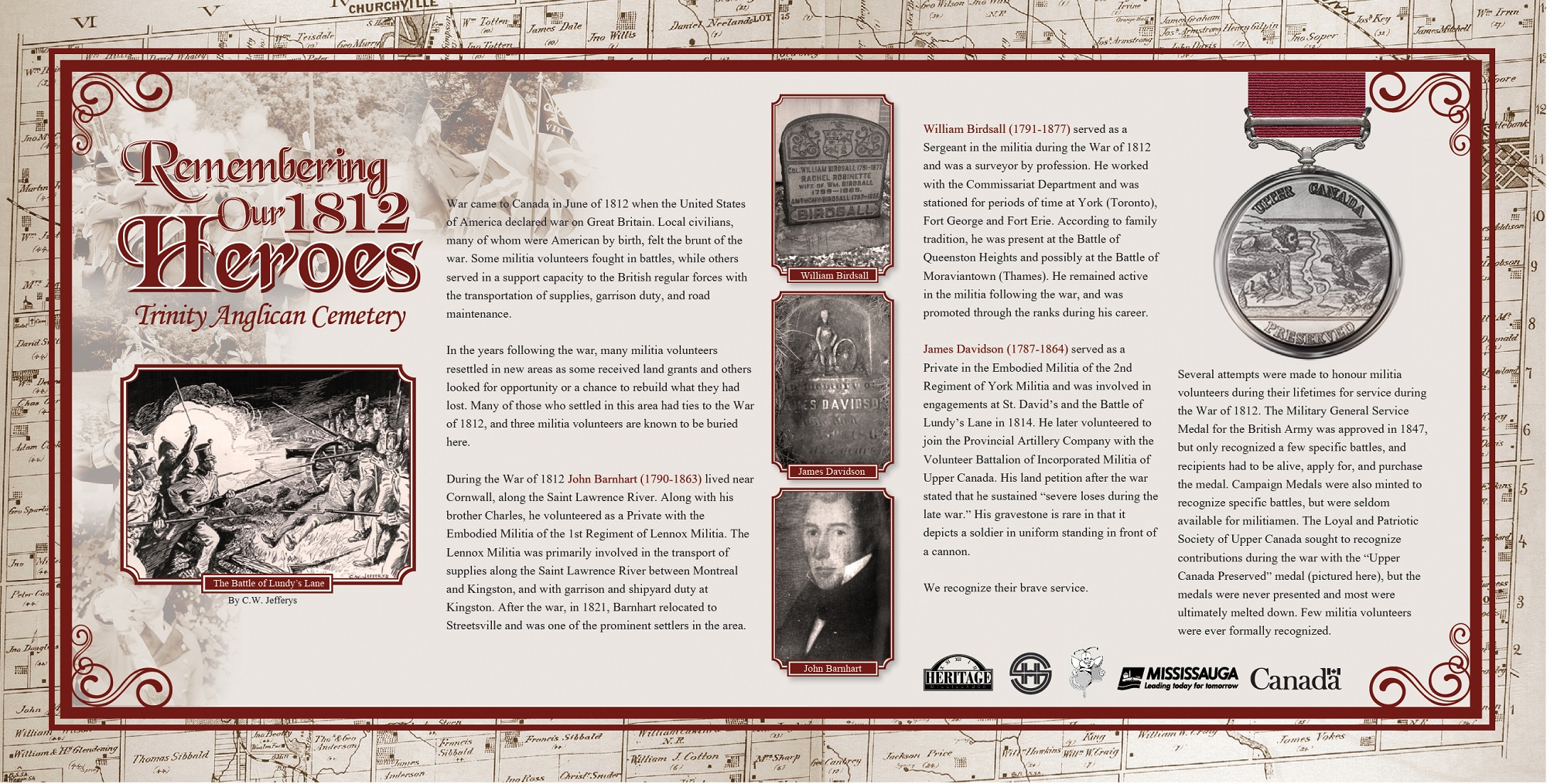
Remembering Our 1812 Heroes
Trinity Anglican Cemetery

War came to Canada in June of 1812 when the United States of America declared war on Great Britain. Civilians in what is now Canada felt the brunt of the war; some volunteered with the militia, while others were caught up in the conflict. Some militia volunteers fought in battles, while others served in a support capacity to the British regular forces with the transportation of supplies, garrison duty, and road maintenance.

In the years following the war, many militia volunteers resettled in new areas as some received land grants and others looked for opportunity or a chance to rebuild what they had lost. Many of those who settled in this area had ties to War of 1812, and three militia volunteers are known to be buried here.

During the War of 1812 John Barnhart (1790-1863) lived near Cornwall, along the Saint Lawrence River. Along with his brother Charles, he volunteered as a Private with the Embodied Militia of the 1st Regiment of Lennox Militia. The Lennox Militia was primarily involved in the transport of supplies along the Saint Lawrence River between Montreal and Kingston, and with garrison and shipyard duty at Kingston. After the war, in 1821, Barnhart relocated to Streetsville and was one of the prominent settlers in the area.

William Birdsall (1791-1877) served as a Sergeant in the militia during the War of 1812 and was a surveyor by profession. He worked with the Commissariat Department and was stationed for periods of time at York (Toronto), Fort George and Fort Erie. According to family tradition, he was present at the Battle of Queenston Heights and possibly at the Battle of Moraviantown (Thames). He remained active in the militia following the war, and was promoted through the ranks during his career.

James Davidson (1787-1864) served as a Private in the Embodied Militia of the 2nd Regiment of York Militia and was involved in engagements at St. David’s and the Battle of Lundy’s Lane in 1814. He later volunteered to join the Provincial Artillery Company with the Volunteer Battalion of Incorporated Militia of Upper Canada. His land petition after the war stated that he sustained “severe loses during the late war.” His gravestone is rare in that it depicts a soldier in uniform standing in front of a cannon.

We recognize their brave service.

Several attempts were made to honour militia volunteers during their lifetimes for service during the War of 1812. The Military General Service Medal for the British Army was approved in 1847, but only recognized a few specific battles in the War of 1812. Campaign Medals were also minted to recognize specific battles, but were seldom available for militiamen. The Loyal and Patriotic Society of Upper Canada sought to recognize contributions of the militia during the war with the “Upper Canada Preserved” medal (pictured here), but the medals were never presented and most were ultimately melted down. Few militia volunteers were ever formally recognized.

Location
War of 1812 Interpretive Panel

69 Queen Street S
Mississauga
Ontario
GPS Coordinates
Lat. 43.5853055
Long. -79.7174953

War of 1812 Interpretive Panel

Table of contents