
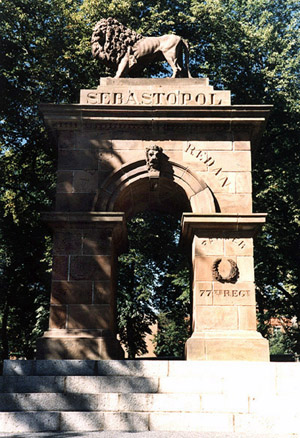
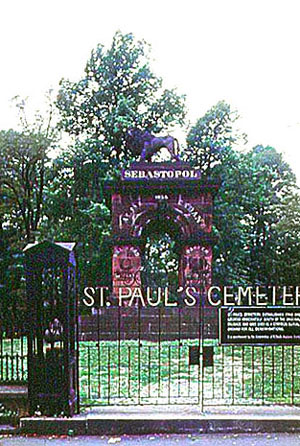
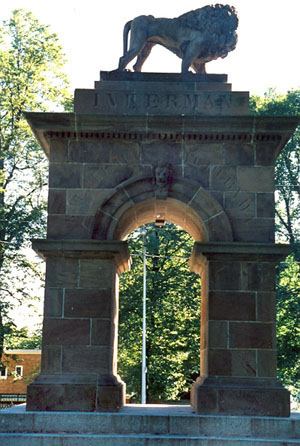
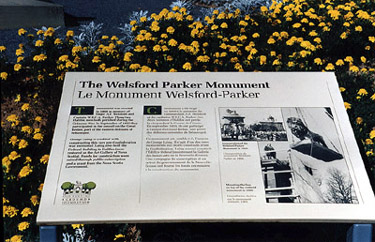
The Wellsford Parker Monument : This Monument was erected in 1860 in memory of Major A.F. Wellsford and Captain W.B.C.A. Parker. These two Halifax men both perished during the Crimean War. In September of 1855, they participated in the assault on the Great Redon, part of the Eastern defences of Sebastopol. George Laing is credited with constructing this rare pre-confederation war memorial. Laing also built the Federation Building in Halifax (now restored as the Art Gallery of Nova Scotia) Funds for construction were raised through public subscription and a grant from the Nova Scotia Government. Dates of major Crimean War Battles Alma — 8 September 1854 (OS), 20 September 1854 (NS) Balaklava — 13 October 1854 (OS), 25 October 1854 (NS) Inker man — 24 October 1854 (OS), 5 November 1854 (NS) Thorny — 13 August 1855 (OS), 25 August 1855 (NS) First attack on the Great Redon – 18 June 1855 (NS) Second attack on the Great Redon – 8 September 1855 (NS) OS means Old Style (Russian calendar) NS means New Style (British calendar) In the 1850s these two calendars were twelve days apart. Siege of Sevastopol (Sebastopol) October 1854 to September 1855.
The first burial at the Old Burying Ground came a day after the arrival of Edward Cornwallis, who established a settlement in 1749. The earliest gravestone dates from 1752. The entrance is dominated by the lion-topped Welsford-Parker Monument, the only such memorial to the Crimean War in North America. The site has been restored, and visitors are encouraged to ramble through Halifax’s past. Interpretation plaques on site help you delve into history. Open dawn to dusk from May to October, the Old Burying Ground is located on Barrington Street, at Spring Garden Road.