
Military service
Burial/memorial information
On 22 January 1942, in heavy weather and with the ship rolling violently, at around 5:20 pm, the ship suffered a violent jolt followed by a huge explosion on the port side, as she was hit by a torpedo. The torpedo was fired by the German submarine U-135, commanded by the. The Gandia immediately began to list and sink by the stern 420 miles (675 km) east of Cape Race, Newfoundland, position 45°00'N/41°00'W. Captain Potie gave the order to abandon ship and the crew began lowering the lifeboats. Bad weather considerably hampered this action and the lifeboats were violently knocked against the ship's sides. Lifeboats number 1 and 3, located on the side of the ship exposed to the weather, broke up and threw their occupants and provisions into the sea. The portable radio in lifeboat 1 was also lost. This, together with the fact that the main mast fell onto the radio room as the vessel sank, meant that no distress call could be sent. The Gandia sank within ten minutes, going down vertically by the stern. After 14 days at sea, seven survivors of the 18 sailors on board lifeboat 2 were rescued on 5 February by the American destroyer USS Bernadou (DD-153) and landed in Reykjavik, Iceland. After 26 days of despair, 28 sailors from lifeboat 4 were rescued by the Portuguese trawler Joao Corte Real, position 46°30'N/46°56'W, and brought to Oporto, Portugal on 26 February, the others having died. The attack killed 42 crew members and 23 others perished at sea while awaiting rescue. The date of Davis' death is therefore approximate.
In the Books of Remembrance
Commemorated on:
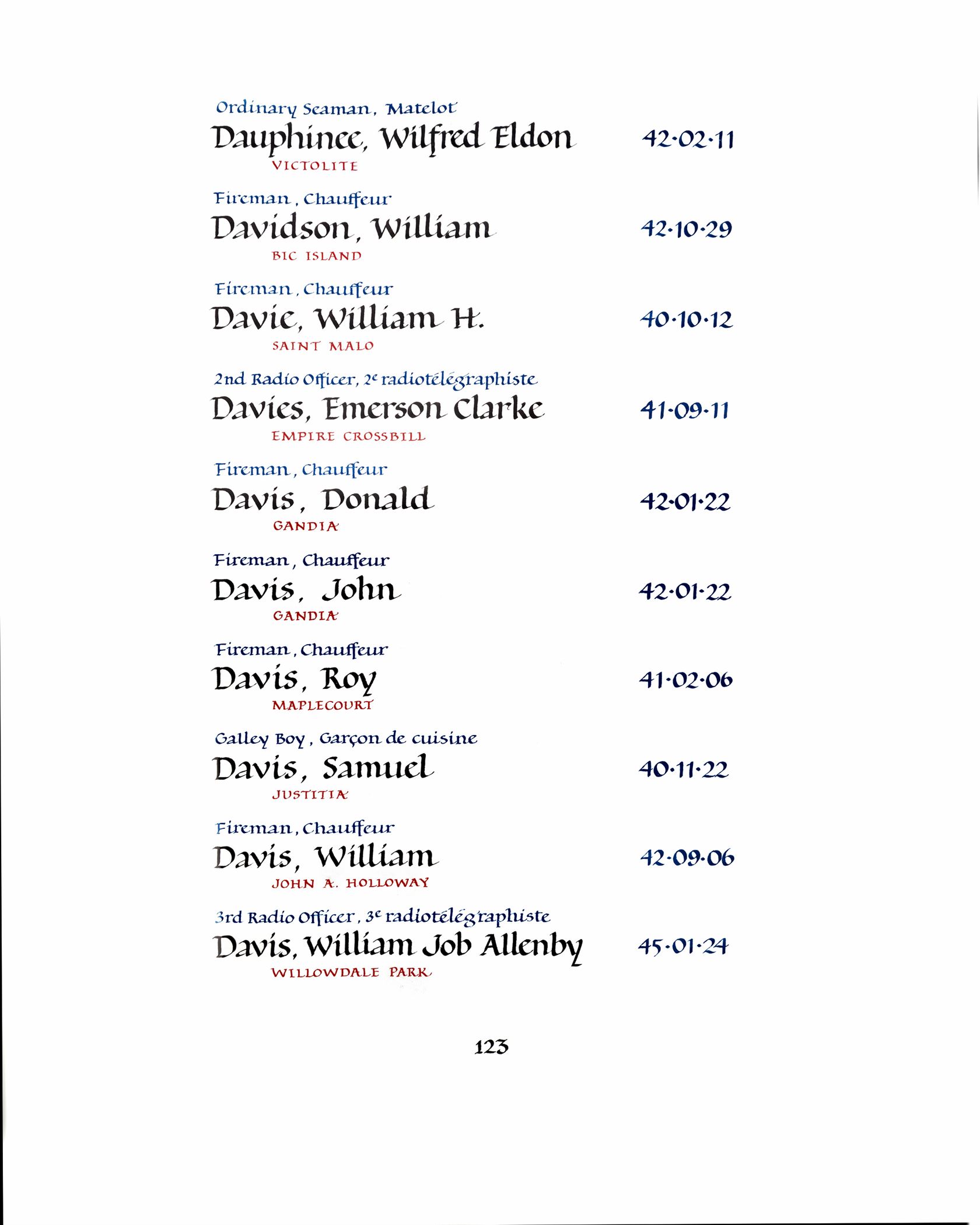
Page 123 of the Merchant Navy Book of Remembrance.
Request this page
Download this page
The Poppy Design is a trademark of The Royal Canadian Legion (Dominion Command) and is used with permission. Click here to learn more about the poppy.
Did we miss something?
Contribute information to this commemorative page
Do you have photographs, information or a correction relating to this individual’s virtual memorial? Learn more about the CVWM and the information we collect.