
About the memorial
This memorial is one of the eight battle sites for commemoration awarded to Canada by the governments of Belgium and France as a sign of gratitude for our sacrifice and support in liberating their countries.
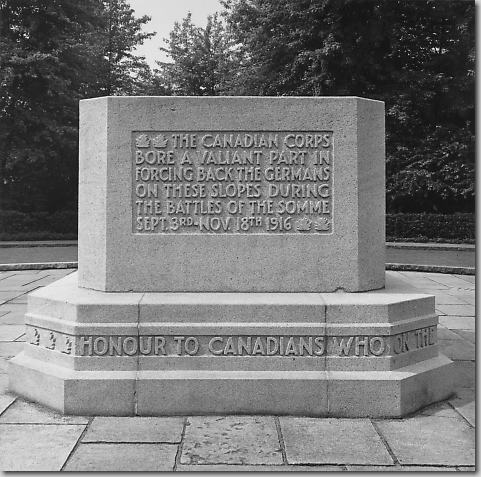
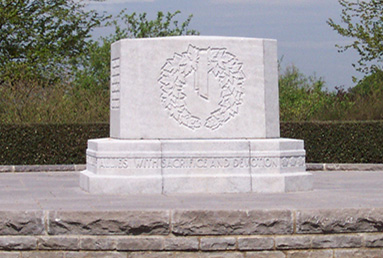
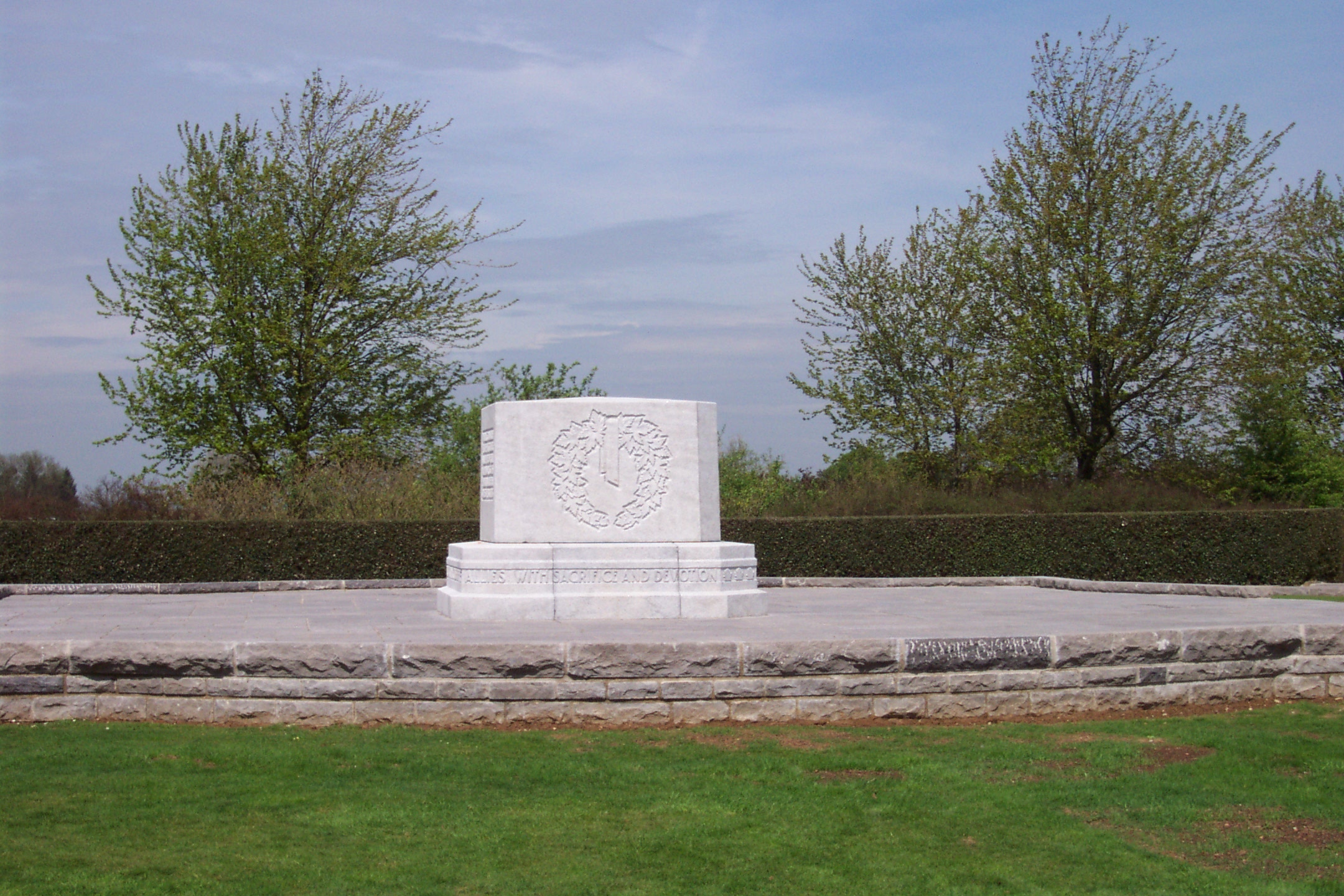
On the granite block of the Courcelette Canadian Memorial is this simple inscription:
THE CANADIAN CORPS BORE A VALIANT PART IN FORCING BACK THE GERMANS ON THESE SLOPES DURING THE BATTLES OF THE SOMME SEPT. 3RD - NOV. 18TH 1916
A circular park surrounds the memorial, screened from the road by tall trees. More than ten varieties of maples have been planted beside wide paths of well-tended turf. There are few bright colours to distract the eye from the pleasing shades of green, making the memorial park at Courcelette a place for meditation.
The Somme
When the Canadian Corps moved from the Ypres Salient to the Somme River region at the beginning of September 1916, its first major action was the Battle of Flers-Courcelette—a two-army assault launched by Sir Douglas Haig on September 15.
In the offensive that began at dawn, the Canadian Corps assaulted on a two-kilometre front near the village of Courcelette. Advancing behind a creeping barrage (a tactic only recently adopted by the artillery), the infantry was aided by the "new engine of war", the armoured tank, which frequently threw the enemy into complete confusion. The attack went well. By 8:00 a.m. the main objective, a defence bastion known as the Sugar Factory, was taken, and the Canadians pushed ahead to Courcelette. Numerous German counterattacks were successfully repulsed and by the next day the position was consolidated. It is fitting, therefore, that the memorial to mark the 11 weeks of bloody fighting by Canadians on the battlefields of the Somme should be sited at the scene of their initial victory in that long and costly struggle.
In the weeks that followed, the three Canadian divisions again and again attacked a series of German entrenchments. The final Canadian objective was that "ditch of evil memory," Regina Trench. It repeatedly defied capture, and when the first three divisions were relieved in the middle of October, Regina Trench was closer, but still not taken.
When the newly arrived 4th Division took its place in the line, it faced an unbelievable ordeal of knee-deep mud and violent, murderous, enemy resistance. However, despite the almost impenetrable curtain of fire, on November 11, the Division captured Regina Trench only to find it reduced to a mere depression in the chalk.
A week later, in the final attack at the Somme, the Canadians advanced to Desire Trench - a remarkable feat of courage and endurance. The 4th Division then rejoined the Corps opposite Vimy Ridge.
There were no further advances that year. The autumn rains turned the battlefield into a bog and the offensive staggered to a halt. The line had been moved forward only ten kilometres; the Allies had suffered 600,000 casualties and 236,000 Germans were killed. The Germans refer to the Battle of the Somme as das Blutbad - the blood bath.
The Somme had cost Canada 24,029 casualties, but it was here that the Canadians confirmed their reputation as hard-hitting shock troops. "The Canadians," wrote Lloyd George, "played a part of such distinction that thenceforward they were marked out as storm troops. For the remainder of the war, they were brought along to head the assault in one great battle after another. Whenever the Germans found the Canadian Corps coming into the line they prepared for the worst."
Visit Canadian memorials in Europe
A profound experience awaits those who visit the monuments and cemeteries in Europe that honour Canada's contributions to defending peace and freedom.
Directions
The Courcelette Canadian Memorial is about 30 kms northeast of Amiens, 35 kms south of Arras and 145 kms north of Paris. You can reach Amiens by train or by bus and from there take a taxi to the Memorial.